


Taiwan would take action to back Australians at a time when they are “under tremendous pressure,” President Tsai Ing-wen (蔡英文) said yesterday, as tensions between Australia and China heated up.
Taipei and Canberra have been mutually supportive in fighting the COVID-19 pandemic, especially in exchanging critical medical materials in the early stages, Tsai said, before chairing the Democratic Progressive Party (DPP) Central Standing Committee meeting in Taipei.
Taiwan and Australia are like-minded nations, sharing the common values of democracy, freedom and human rights, while their economic and trade relations have also become close, she said.
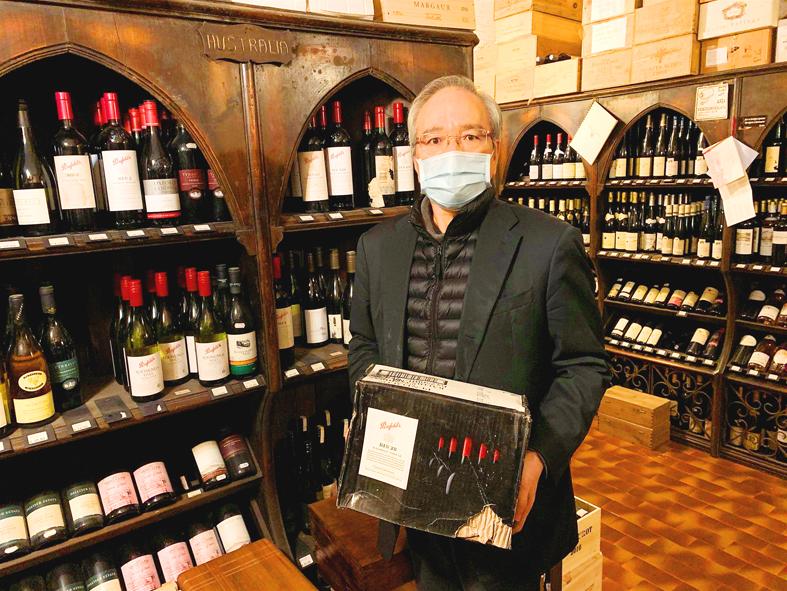
Photo: screen grab from Facebook
Canberra has been voicing support for Taiwan’s international participation, and Taiwanese are empathetic and supportive of Australians at a time when they are under tremendous pressure, Tsai said.
The government would deliberate the best means to let Australians feel the friendship of Taiwanese, she said.
Canberra-Beijing ties have soured after a series of trade and diplomatic disputes.

Photo: screen grab from Facebook
Beijing on Saturday last week started imposing import tariffs of up to 212 percent on Australian wine, accusing Australia of dumping its wine on the Chinese market.
Canberra said that it was “extremely disappointed” by the decision.
Chinese Ministry of Foreign Affairs spokesman Zhao Lijian (趙立堅) on Monday posted on Twitter a doctored photograph showing a grinning Australian soldier holding a bloody knife to the throat of an Afghan child holding a lamb. The caption read: “Shocked by murder of Afghan civilians & prisoners by Australian soldiers.”
Australian Prime Minister Scott Morrison demanded that China remove the photograph and apologize for the “repugnant post,” but was rejected by Beijing.
Over the past few days, many government agencies and Internet users have shown their support for Australia by sharing photographs of Australian wine on social media.
“Australian wine will be featured at a White House holiday reception this week. Pity vino lovers in China who, due to Beijing’s coercive tariffs on Aussie vintners, will miss out. #AussieAussieAussieOiOiOi!” the US National Security Council wrote on Twitter on Tuesday.
The Ministry of Foreign Affairs yesterday posted on Twitter a photograph of two bottles of wine, with a caption that read: “We stand in solidarity with #Australia by serving #FreedomWine at @MOFA_Taiwan.”
The Australian Office in Taipei is to mark its 40th anniversary next year, showing that the bilateral friendship is steadfast and enduring, ministry spokeswoman Joanne Ou (歐江安) said in a statement.
Taiwan and Australia stand stronger together, and would continue to deepen their partnership to defend their shared values and maintain regional stability, she said.
Meanwhile, lawmakers joined their counterparts from around the world in calling on their constituents to drink Australian wine this month as part of a campaign to rebuff China’s tariffs.
The Inter-Parliamentary Alliance on China, a group of more than 200 lawmakers from 19 nations, on Tuesday released a video urging people to “join us in standing against [Chinese President] Xi Jinping’s (習近平) authoritarian bullying” by buying Australian wine.
Democratic Progressive Party (DPP) Legislator Chiu Yi-ying (邱議瑩), chairwoman of the Taiwan-Australia Inter-Parliamentary Amity Association, yesterday posted a video on Facebook featuring a number of lawmakers extolling their support for Australian “freedom wine.”
DPP Legislator Lo Chih-cheng (羅致政) said that Australia is experiencing the worst of China’s bullying, similar to Taiwan.
As to whether any Taiwanese lawmakers would join the alliance, Lo said that some have applied, but their applications are under review.
Independent Legislator Freddy Lim (林昶佐) said that he believes some would join when the time is right.
Ambassador to the Holy See Matthew Lee (李世明) also joined in the campaign on Tuesday by buying a box of Australian wine.
Lee on the embassy’s Facebook page posted a photograph of himself holding the box of wine, along with the message: “Fraternity is not a trend or a fashion ... but the result of concrete acts,” echoing Cardinal Pietro Parolin’s presentation of Pope Francis’ October encyclical Fratelli Tutti.

A signaling system malfunction disrupted high-speed rail (HSR) services beginning at 8am today, with trains temporarily reduced to three northbound and three southbound trains per hour as authorities conduct inspections. The malfunction occurred on a section of track in Miaoli County during pre-operation checks early this morning, forcing northbound and southbound trains to use a single track, the HSR operator said. The regular schedule has been replaced with three hourly trains offering only nonreserved seating in each direction, stopping at every station, it said, adding that business class cars would still have reserved seating. Departures from terminal stations are scheduled at the top

DRONE CENTRAL: Taiwan aims to become Asia’s democratic hub for drones, with most exports focused on high-quality military-grade models, an official said Taiwan’s drone industry is expected to expand significantly by 2030, producing 100,000 units per month and exporting half of them, the Ministry of Economic Affairs said yesterday. Current drone production capacity is about 15,000 units per month, but the industry can quickly scale up as demand increases, Industrial Development Administration Director-General Chiou Chyou-huey (邱求慧) told a news conference in Taipei. Taiwan’s drone output grew 2.5-fold last year to NT$12.9 billion (US$408.3 million) under a government program to develop the uncrewed vehicle sector, he said. The Executive Yuan in October last year approved plans to invest NT$44.2 billion into domestic production of uncrewed aerial

VERBOSE VESSELS: A CGA cutter and a China Coast Guard exchanged verbal barbs for more than a day in Taiwanese-controlled waters before the Chinese vessel left The Taiwanese and Chinese coast guards had a standoff near the strategically located Pratas Islands (Dongsha Islands, 東沙群島) in the north of the South China Sea, the Coast Guard Administration (CGA) said yesterday. The two sides engaged in intense radio exchanges over sovereignty claims during the 33-hour standoff. China Coast Guard vessel 3501 eventually left the restricted waters, 26.6 nautical miles (49.2km) west of the Pratas Islands, at 5pm yesterday, the CGA said. Lying approximately between southern Taiwan and Hong Kong, the Taiwan-controlled Pratas are seen by some security experts as vulnerable to Chinese attack due to their distance — more than
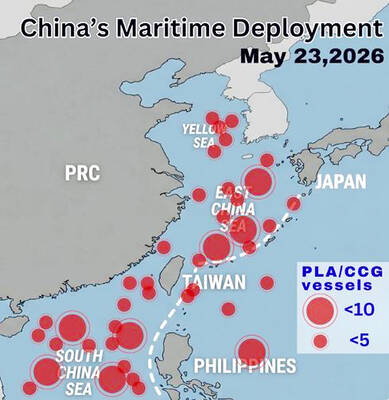
WARNING: China should stop engaging in actions that undermine regional peace and stability, as it would only build resentment among people across the Strait, the CGA said China has deployed more than 100 navy, coast guard and other vessels in waters from the Yellow Sea to the South China Sea and the western Pacific since US President Donald Trump and Chinese President Xi Jinping (習近平) met in Beijing, National Security Council Secretary-General Joseph Wu (吳釗燮) said yesterday. “In this part of the world, #China is the one & only PROBLEM wrecking the #StatusQuo & threatening regional peace & stability,” Wu wrote on X. In a separate post, he said Beijing was coercing Taiwan’s maritime domain, calling it illegal and provocative, after the Coast Guard Administration (CGA) expelled a


 RSS
RSS