


Taiwan’s life insurance companies might be allowed to sell more policies denominated in foreign currencies, in a bid to help the central bank curb the New Taiwan dollar’s appreciation against the US dollar, the Financial Supervisory Commission (FSC) said yesterday.
The commission currently limits premiums generated from a life insurer’s products denominated in foreign currencies: The cap is 35 percent of the insurer’s liability reserve multiplied by another percentage that equals one minus the firm’s approved ratio of overseas investment, the Insurance Bureau said.
The central bank advised the bureau to raise the limit to 45 percent, so insurers could sell more US dollar-denominated policies, which would increase demand for the US dollar and slow the strong NT dollar, bureau Director-General Shih Chiung-hwa (施瓊華) told reporters by telephone yesterday.
Photo: Wu Chi-lun, Taipei Times
The bureau has been given similar advice by some foreign trade groups, but as easing the limit would be a big change, it has asked the Life Insurance Association to evaluate what the effect would be on the market, Shih said, adding that a final decision has not yet been made.
If the commission decides to raise the ceiling, it would ask life insurers to inform policyholders of the foreign-exchange risks, she added.
Most consumers buy US dollar-denominated policies for better returns, but they should be fully aware that as the policyholder, they bear the foreign-exchange risks, a bureau official said by telephone.
For example, it is economical for people to exchange local currency into the greenback to pay their US-denominated premiums, as the NT dollar has remained strong, but if the NT dollar weakens, the foreign-exchange rate would no longer favor policyholders, the official said.
A preliminary assessment showed that if the limit were raised by 10 percentage points, life insurers could sell at least an additional NT$1 trillion (US$34.7 billion) in policies denominated in foreign currencies.
Shih’s comment came after the Chinese-language Apple Daily reported yesterday that central bank Governor Yang Chin-long (楊金龍) had contacted FSC Chairman Thomas Huang (黃天牧) to discuss the possibility of deregulating life insurers’ overseas investments to boost demand for the US dollar.
The reason behind the request is that the central bank has been working to manage the fast appreciation of the NT dollar, which so far this year has strengthened more than 4 percent against the greenback, the Apple Daily reported.
The NT dollar yesterday closed lower at NT$28.82, approaching the central bank’s reported defense threshold of NT$28.50. The possibility of the bank’s intervention caused a retreat from a jump of NT$0.298 in noon trading.
Not disclosing details of the agencies’ discussion, Shih only said that the commission is cautious about the bank’s recommendation of relaxing the 45 percent limit on total overseas investments that life insurance companies must currently follow.
“That would be too big of a change, as life insurance companies invest tens of trillions of NT dollars overseas,” Shih said. “We worry about their risk exposure, so we tend to be a bit reserved about that suggestion.”
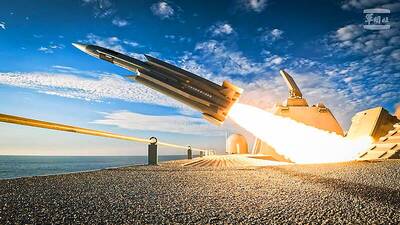
DETERRENCE: With 1,000 indigenous Hsiung Feng II and III missiles and 400 Harpoon missiles, the nation would boast the highest anti-ship missile density in the world With Taiwan wrapping up mass production of Hsiung Feng II and III missiles by December and an influx of Harpoon missiles from the US, Taiwan would have the highest density of anti-ship missiles in the world, a source said yesterday. Taiwan is to wrap up mass production of the indigenous anti-ship missiles by the end of year, as the Chungshan Institute of Science and Technology has been meeting production targets ahead of schedule, a defense official with knowledge of the matter said. Combined with the 400 Harpoon anti-ship missiles Taiwan expects to receive from the US by 2028, the nation would have

POSSIBILITIES EMERGE: With Taiwan’s victory and Japan’s narrow win over Australia, Taiwan now have a chance to advance if South Korea also beat the Aussies Taiwan has high hopes that the national baseball team would advance to the World Baseball Classic (WBC) quarter-finals after clinching a crucial 5-4 victory over South Korea in a nail-biting extra-inning game at the Tokyo Dome yesterday. Boosted by three home runs — two solo shots by Yu Chang (張育成) and Cheng Tsung-che (鄭宗哲) and a two-run homer by Stuart Fairchild — the triumph gave Taiwan a much-needed second victory in the five-team Pool C, where only the top two finishers would advance to the knockout stage in Miami, Florida. Entering extra innings with the game tied at four apiece, Taiwan scored
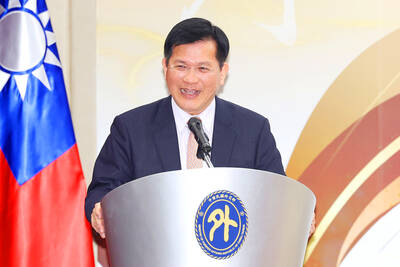
MISSION OF PEACE: The foreign minister urged Beijing to respect Taiwan’s existence as an independent nation, and work together to ensure peace and stability in the region Minister of Foreign Affairs Lin Chia-lung (林佳龍) yesterday rejected Chinese Minister of Foreign Affairs Wang Yi’s (王毅) comments about Taiwan, criticizing China as a “troublemaker” in the international community and a disruptor of cross-strait peace. Speaking at a news conference on the sidelines of the Chinese National People’s Congress, Wang said that Taiwan has always been a territory of China and that it would be impossible for it to become its own country. The “return” of Taiwan to China was the natural outcome of the Chinese people’s resistance against Japan in World War II, and that any pursuit of independence was “doomed

‘UNWAVERING FRIENDSHIP’: A representative of a Japanese group that co-organized a memorial, said he hopes Japanese never forget Taiwan’s kindness President William Lai (賴清德) yesterday marked the 15th anniversary of the Tohoku earthquake and tsunami, urging continued cooperation between Taiwan and Japan on disaster prevention and humanitarian assistance. Lai wrote on social media that Taiwan and Japan have always helped each other in the aftermath of major disasters. The magnitude 9 earthquake struck northeastern Japan on March 11, 2011, triggering a massive tsunami that claimed more than 19,000 lives, according to data from Japanese authorities. Following the disaster, Taiwan donated more than US$240 million in aid, making it one of the largest contributors of financial assistance to Japan. In addition to cash donations and


 RSS
RSS