


At least seven people were killed yesterday as Typhoon Goni pounded the Philippines, ripping off roofs, toppling power lines and causing flooding in the hardest-hit areas where hundreds of thousands have fled their homes.
The strongest typhoon of the year also triggered deadly landslides that buried a number of houses in the southern part of the most populous island of Luzon, officials said.
Goni was a classified a “super typhoon” when it made landfall on Catanduanes Island before dawn, packing maximum sustained wind speeds of 225kph.
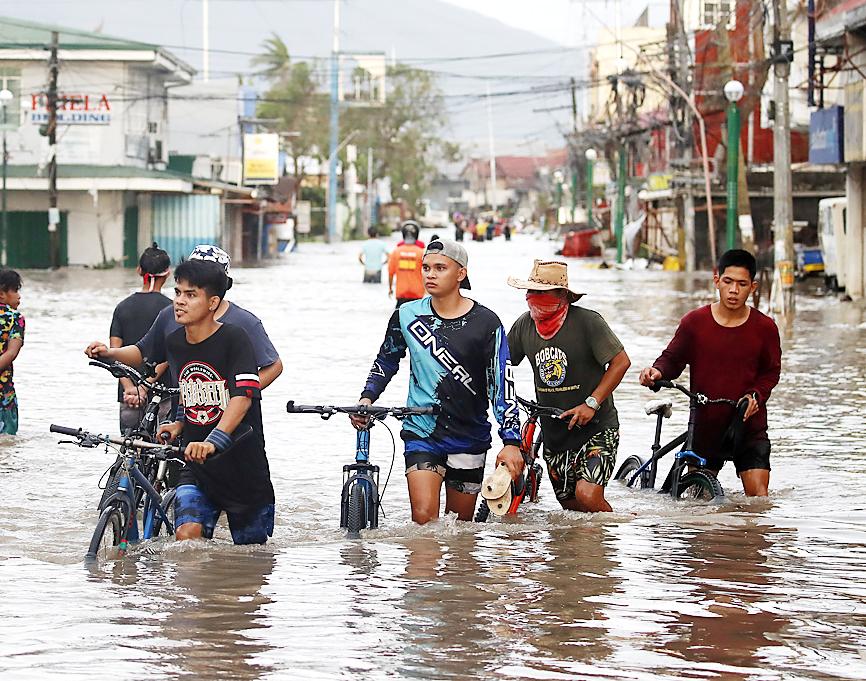
Photo: EPA-EFE
It was downgraded a few hours later as it swept across Luzon and reduced intensity as it headed toward the capital, Manila, where the sprawling city of 12 million was bracing for strong winds in the evening.
“Destructive winds and intense rainfall” were affecting areas in the typhoon’s path, including provinces near the capital, the state weather forecaster said.
At least seven people were killed in Albay province, the Philippine Office of Civil Defense said in a statement.
Several of the victims died in rain-induced landslides of volcanic ash that police said engulfed numerous houses in two adjacent villages near the active Mayon volcano.
“We have recovered three bodies and are looking for three more,” said Major Domingo Tapel, chief of police in the town of Guinobatan.
The roofs of at least two evacuation centers were torn off by the force of the wind, while floods inundated some villages.
“The winds are fierce. We can hear the trees being pummeled. It’s very strong,” Francia Mae Borras, 21, said from her home in the nearby coastal city of Legazpi.
Nearly 400,000 people have fled their homes, most of them to evacuation centers, the Office of Civil Defense said.
Officials in affected areas have reported power cuts, which are disrupting telecommunication services and hampering efforts to assess the extent of the damage.
“Our roads have a lot of debris from the mountains such as branches and sand, some which came from Mayon. Some roads are unpassable,” said Camalig Mayor Carlos Irwin Baldo of his town near Legazpi.
In Manila, the airport was closed and residents were evacuated from low-lying slum areas at risk of being inundated by storm surges.
Thousands of soldiers and police were on standby to help with evacuations and rescue efforts.

South Korea has adjusted its electronic arrival card system to no longer list Taiwan as a part of China, a move that the Ministry of Foreign Affairs said would help facilitate exchanges between the two sides. South Korea previously listed “Taiwan” as “Taiwan (China)” in the drop-down menus of its online arrival card system, where people had to fill out where they came from and their next destination. The ministry had requested South Korea make a revision and said it would change South Korea’s name on Taiwan’s online immigration system from “Republic of Korea” to “Korea (South),” should the issue not be

Tainan, Taipei and New Taipei City recorded the highest fines nationwide for illegal accommodations in the first quarter of this year, with fines issued in the three cities each exceeding NT$7 million (US$220,639), Tourism Administration data showed. Among them, Taipei had the highest number of illegal short-term rental units, with 410. There were 3,280 legally registered hotels nationwide in the first quarter, down by 14 properties, or 0.43 percent, from a year earlier, likely indicating operators exiting the market, the agency said. However, the number of unregistered properties rose to 1,174, including 314 illegal hotels and 860 illegal short-term rental

Both sides of the Taiwan Strait share a political foundation based on the “1992 consensus” and opposition to Taiwanese independence, Chinese Nationalist Party (KMT) Chairwoman Cheng Li-wun (鄭麗文) today said during her meeting with Chinese President Xi Jinping (習近平). Both sides of the Strait should plan and build institutionalized and sustainable mechanisms for dialogue and cooperation based on that foundation to make peaceful development across the Strait irreversible, she said. Peace is a shared moral value across the Strait, and both sides should move beyond political confrontation to seek institutionalized solutions to prevent war, she said. Mutually beneficial cross-strait relations are what the

ECONOMIC COERCION: Such actions are often inconsistently applied, sometimes resumed, and sometimes just halted, the Presidential Office spokeswoman said The government backs healthy and orderly cross-strait exchanges, but such arrangements should not be made with political conditions attached and never be used as leverage for political maneuvering or partisan agendas, Presidential Office spokeswoman Karen Kuo (郭雅慧) said yesterday. Kuo made the remarks after China earlier in the day announced 10 new “incentive measures” for Taiwan, following a landmark meeting between Chinese President Xi Jinping (習近平) and Chinese Nationalist Party (KMT) Chairwoman Cheng Li-wun (鄭麗文) in Beijing on Friday. The measures, unveiled by China’s Xinhua news agency, include plans to resume individual travel by residents of Shanghai and China’s Fujian


 RSS
RSS