


Samsung Electronics Co chairman Lee Kun-hee, who transformed the South Korean firm into a global tech titan, died at the age of 78 yesterday, the company said.
Under Lee’s leadership, Samsung rose to become the world’s largest producer of smartphones and memory chips, and the firm’s overall turnover today is equivalent to one-fifth of South Korea’s GDP.
Samsung’s meteoric rise helped make Lee South Korea’s richest and most powerful industrialist.
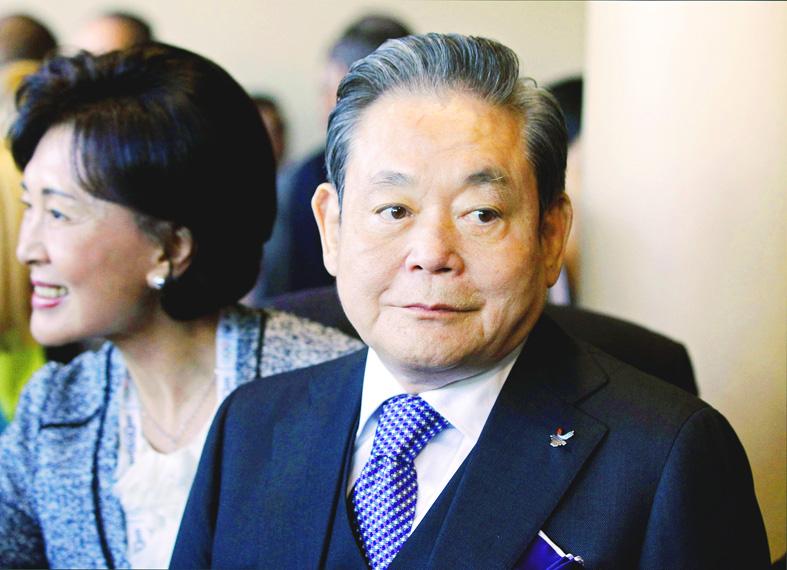
Photo: AP
“It is with great sadness that we announce the passing of Kun-hee Lee, Chairman of Samsung Electronics,” the company said in a statement.
“Chairman Lee was a true visionary who transformed Samsung into the world-leading innovator and industrial powerhouse from a local business,” the firm said. “His legacy will be everlasting.”
Samsung is by far the biggest of the chaebols that dominate business in South Korea.
They drove the nation’s transformation from a war-ravaged ruin to the world’s 12th-largest economy, but nowadays are accused of murky political ties and stifling competition — with Lee himself twice convicted of criminal offenses, in one case bribing a president.
When Lee inherited the chairmanship of the Samsung group in 1987 — founded by his father as a fish and fruit exporter — it was already the country’s largest conglomerate, with operations ranging from consumer electronics to construction.
However, it was seen as a shoddy producer of cheap, low-quality products.
“Let’s change everything except our wives and kids,” Lee said in 1993.
The company gathered up and burnt all 150,000 mobile phones it had in stock, paving the way for the rebirth of the highly successful “Anycall” handset.
With Lee at the helm, Samsung became a global behemoth: By the time he suffered a heart attack in 2014, it was the world’s biggest maker of smartphones and memory chips, and a major player in semiconductors and LCDs.
Lee rarely spoke to the media, but was closely watched whenever he broke his long silences, often with doom-laden New Year corporate addresses.
Despite his immense wealth and power, Lee seldom ventured out from the high walls of his private compound in central Seoul to visit the company headquarters, earning him the nickname “hermit king.”
Lee, the third son of Samsung group founder Lee Byung-chull, had a soft spot for dogs — developed as a child in Japan where he went to school from age 11. He was also known for his love of movies, horseriding and exotic supercars.
He studied at Japan’s prestigious Waseda University and earned an MBA at George Washington University in the US.
He became vice chairman of the group’s construction and trading arm at the age of 36, and became group chairman nine years later, shortly after his father’s death.
Lee Kun-hee married Hong Ra-hee — whose father was a justice minister — with whom he had a son and three daughters.
In 1996, he was convicted of bribing former South Korean president Roh Tae-woo to get favors for Samsung in business policy decisions.
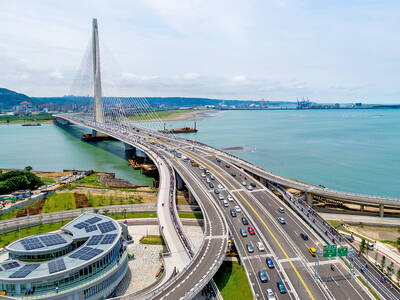
The Ministry of Transportation and Communications yesterday inaugurated the Danjiang Bridge across the Tamsui River in New Taipei City, saying that the structure would be an architectural icon and traffic artery for Taiwan. Feted as a major engineering achievement, the Danjiang Bridge is 920m long, 211m tall at the top of its pylon, and is the longest single-pylon asymmetric cable-stayed bridge in the world, the government’s Web site for the structure said. It was designed by late Iraqi-British architect Zaha Hadid. The structure, with a maximum deck of 70m, accommodates road and light rail traffic, and affords a 200m navigation channel for boats,
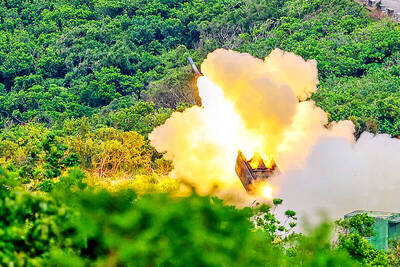
PRECISION STRIKES: The most significant reason to deploy HIMARS to outlying islands is to establish a ‘dead zone’ that the PLA would not dare enter, a source said A High Mobility Artillery Rocket System (HIMARS) would be deployed to Penghu County and Dongyin Island (東引) in Lienchiang County (Matsu) to force the Chinese military to retreat at least 100km from the coastline, a military source said yesterday. Taiwan has been procuring HIMARS and Army Tactical Missile Systems (ATACMS) from the US in batches. Once all batches have been delivered, Taiwan would possess 111 HIMARS units and 504 ATACMS, which have a range of 300km. Considering that “offense is the best defense,” the military plans to forward-deploy the systems to outlying islands such as Penghu and Dongyin so that
Taiwan Semiconductor Manufacturing Co (TSMC, 台積電), the world’s largest foundry service provider, yesterday said that global semiconductor revenue is projected to hit US$1.5 trillion in 2030, after the figure exceeds US$1 trillion this year, as artificial intelligence (AI) demand boosts consumption of token and compute power. “We are still at the beginning of the AI revolution, but we already see a significant impact across the whole semiconductor ecosystem,” TSMC deputy cochief operating officer Kevin Zhang (張曉強) said at the company’s annual technology symposium in Hsinchu City. “It is fair to say that in the past decade, smartphones and other mobile devices were
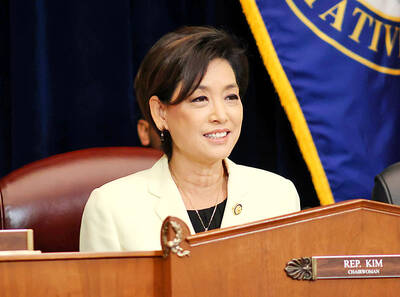
‘CLEAR MESSAGE’: The bill would set up an interagency ‘tiger team’ to review sanctions tools and other economic options to help deter any Chinese aggression toward Taiwan US Representative Young Kim has introduced a bill to deter Chinese aggression against Taiwan, calling for an interagency “tiger team” to preplan coordinated sanctions and economic measures in response to possible Chinese military or political action against Taiwan. “[Chinese President] Xi Jinping [習近平] has directed the People’s Liberation Army to be ready to invade Taiwan by 2027. China has a plan. America should have one too,” Kim said in a news release on Thursday last week. She introduced the “Deter PRC [People’s Republic of China] aggression against Taiwan act” to “ensure the US has a coordinated sanctions strategy ready should


 RSS
RSS