


The nation could deploy 450,000 soldiers — including roughly 260,000 reservists and 185,000 standing forces — as a first-response force in the event of a military invasion, Minister of National Defense (MND) Yen De-fa (嚴德發) told a meeting of the Legislative Yuan’s Foreign Affairs and National Defense Committee yesterday.
Chinese Nationalist Party (KMT) Chairman Johnny Chiang (江啟臣) asked whether the ministry had an estimate of how long it would take to recall reservists if a war broke out, adding that, if not, the ministry should definitely conduct simulation exercises.
The ministry has plans to conduct such simulations in 2022, Yen said, adding that recall and training programs would be staggered for the least disruption to social order.
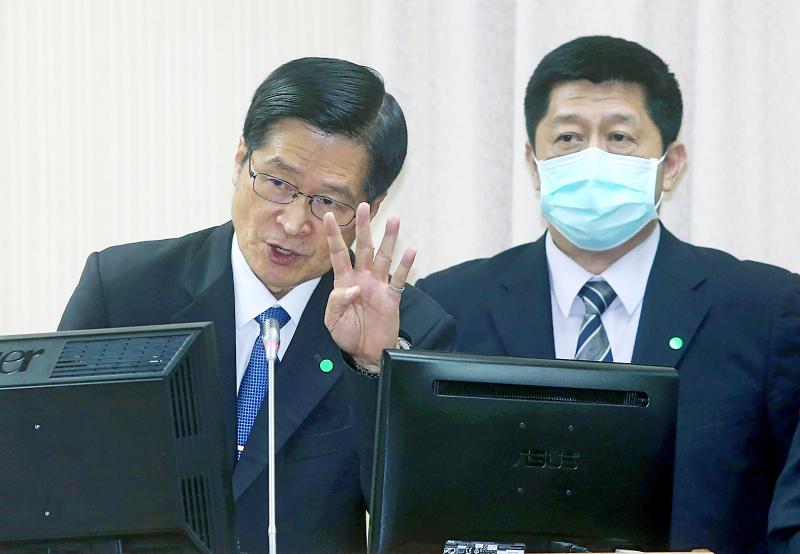
Photo: CNA
Chiang said that the ministry must have the information, even at the cost of disrupting society.
The ministry has considered extending recall and training programs to two weeks to address such concerns, Yen added.
Democratic Progressive Party (DPP) Legislator Tsai Shih-ying (蔡適應) asked about leave for reservists, their discipline and whether active-duty female soldiers should serve as reservists.
The Regulations on Leave Days for the Reservist Recall and Training Program (國軍後備軍人教育召集訓練期間休(請)假實施規定) state that reservists are not allowed to take leave during a recall, although an emergency might qualify them for at most two days’ leave, General Mobilization Office Director Han Kang-ming (韓岡明) said.
Recalled reservists receive the same punishment as active-duty soldiers for any breach of the code of conduct for military personnel, such as drinking alcohol before returning to base or not returning to base, Han added.
Tsai cited Internet users’ posts that active-duty female soldiers should serve as reservists and asked for Yen’s “professional opinion.”
Existing laws do not require active-duty female soldiers to serve as reservists, but the increasing number of women in the military has prompted calls for them to be eligible for recalls.
In 2018, the ministry said that it might begin listing active-duty female soldiers as reservists, but so far no measure has been announced.
Asked whether the ministry should reveal the number of available soldiers, Association of Strategic Foresight research fellow Chieh Chung (揭仲) said that the figure is not sensitive information, as it could be deduced from public documents.
The key is whether reserve forces can be rapidly deployed when a crisis hits, especially when shorter reaction times are crucial as the Chinese People’s Liberation Army continues to improve its capabilities, he said.
The ministry’s response time is also dependent on whether the government declares a wartime emergency, which would have considerable social costs and affect diplomatic negotiations, Chieh said.
Many reservists lack proper combat training, National Taiwan University political science associate professor Chen Shih-min (陳世民) said, urging the government to extend military service from four months to six months, or longer.
Lawmakers of all parties should consider if military conscription should be reinstated, he said, adding that the system is unwelcome by many, but might prove essential.
Given that, President Tsai Ing-wen (蔡英文) should speed up military reforms while her support base is strong and she is not under pressure to be re-elected, he said.
Improving the nation’s reserve forces is not just the ministry’s job, said Su Tzu-yun (蘇紫雲), director of the Institute for National Defense and Security Research’s Division of National Defense Resources and Industries.
The Executive Yuan should coordinate with other agencies — including the Ministry of Education and the Ministry of Finance — and modify regulations so that schools and workplaces are more willing to release people for defense training, Su said, adding that tax exemptions, salary subsidies and bidding incentives are all feasible.
Additional reporting by Lin Chia-nan
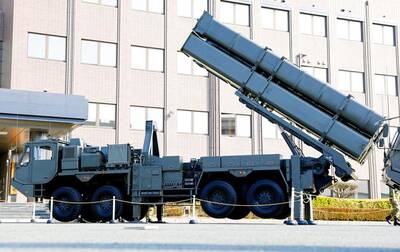
Japan has deployed long-range missiles in a southwestern region near China, the Japanese defense minister said yesterday, at a time when ties with Beijing are at their lowest in recent years. The missiles were installed in Kumamoto in the southern region of Kyushu, as Japan is attempting to shore up its military capacity as China steps up naval activity in the East China Sea. “Standoff defense capabilities enable us to counter the threat of enemy forces attempting to invade our country ... while ensuring the safety of our personnel,” Japanese Minister of Defense Shinjiro Koizumi said. “This is an extremely important initiative for

MORE POPULAR: Taiwan Pass sales increased by 59 percent during the first quarter compared with the same period last year, the Tourism Administration said The Tourism Administration yesterday said that it has streamlined the Taiwan Pass, with two versions available for purchase beginning today. The tourism agency has made the pass available to international tourists since 2024, allowing them to access the high-speed rail, Taiwan Railway Corp services, four MRT systems and four Taiwan Tourist Shuttles. Previously, five types of Taiwan Pass were available, but some tourists have said that the offerings were too complicated. The agency said only two types of Taiwan Pass would be available, starting from a three-day pass with the high-speed rail and a three-day pass with Taiwan Railway Corp. The former costs NT$2,800

POLLS CONCERNS: There are concerns within the KMT that a Cheng Li-wun-Xi Jinping meeting could trigger a voter backlash in elections in November Chinese Nationalist Party (KMT) Chairwoman Cheng Li-wun (鄭麗文) accepted an invitation from Chinese President Xi Jinping (習近平) to visit next month, her party and Chinese state media reported yesterday. Cheng, who took up her role in November last year, “gladly accepted” the invitation to lead a delegation to China, the KMT said in a statement, confirming a Xinhua news agency report. Cheng “looks forward to joint efforts by both parties to advance the peaceful development of cross-strait relations, promote cross-strait exchanges and cooperation, and work for peace in the Taiwan Strait and greater well-being for people on both sides,” the statement said. Chinese
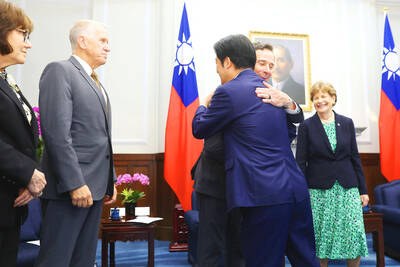
SIGNIFICANT TO THE WORLD: The delegation’s visit aims to send a clear message that bipartisan support for Taiwan is consistent, US Senator Jeanne Shaheen said The US Senate’s bipartisan support for Taiwan remains strong and Taiwan-US ties would continue for decades to come, a US Senate delegation said in Taipei yesterday, while calling on the legislature to swiftly pass a special defense budget bill. A US delegation led by Democratic US Senator Jeanne Shaheen and Republican US Senator John Curtis — both members of the US Senate Committee on Foreign Relations — arrived in Taiwan yesterday for a two-day visit. The other senators of the delegation included Senate Taiwan Caucus cochair Thom Tillis and Senate Committee on Armed Services senior member Jacky Rosen. Shaheen told a news


 RSS
RSS