


Minister of Transportation and Communications Lin Chia-lung (林佳龍) yesterday backed the Tourism Bureau’s decision to withdraw from last month’s Pacific Asia Travel Association’s (PATA) Travel Mart after the organizer insisted on changing the bureau’s name to “Taiwan Strait Tourist Association.”
The annual trade show, which had been scheduled to run in conjunction with the Sichuan International Travel Expo in Sichuan, China, was held virtually due to the COVID-19 pandemic.
“We must defend our national sovereignty and dignity. Taiwan is Taiwan, and China cannot obliterate Taiwan’s existence by simply changing the bureau’s name,” Lin said.
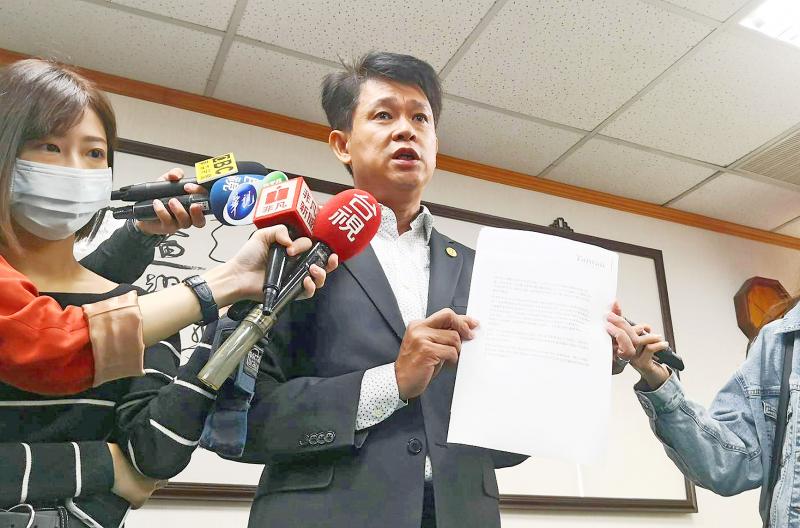
Photo courtesy of the Tourism Bureau via CNA
“China’s oppression of Taiwan would harm itself and others. The nation can share with the world how it has effectively contained the COVID-19 outbreak, which is key in developing the tourism industry,” he said. “Despite the withdrawal, we will continue sharing our disease-prevention experiences with the international community through other channels.”
Lin also wrote on Facebook that China had “used its political influence to interfere in the affairs of PATA, a non-governmental organization.”
“It has been proven that China will not win itself any real respect from the international community with its diplomatic threats and economic incentives. Leaders from the US, France and the Philippines have all criticized and challenged China in their addresses at the UN General Assembly this year,” Lin said.
The Bangkok-based association was established in 1951. Taiwan, a founding member, joined under the title, “PATA Chinese Taipei Chapter.”
This year’s PATA Travel Mart was sponsored by the Culture, Radio, Television and Tourism Bureau of Lehsan, a city in Sichuan.
The Tourism Bureau used the name “Taiwan Tourism Bureau” to register for the event, which opened on Sept. 23.
However, on Sept. 9, the bureau discovered that its title had been changed to Taiwan Strait Tourist Association. It lodged several protests against the change.
“We were hoping to share with other participants our disease-prevention efforts and how they have contributed to a booming domestic tourism market, and some of them had interacted with us through the platform before the event opened,” Tourism Bureau Director-General Chang Shi-chung (張錫聰) said. “After we found out on Sept. 9 about the name change, we tried to correct the error by ourselves by going to our Web page for the event. However, the Web page had been removed.”
Chang said that the bureau also attempted to address the issue by sending an official document to PATA headquarters.
PATA responded by saying that the Chinese government had stipulated that no individual or organization could participate in the online event without its approval, Chang said.
“We again issued an official statement and sent it to PATA to protest against such practice and indicate that we were withdrawing,” he said. “We hope that the situation will not happen again in PATA travel marts in other countries.”
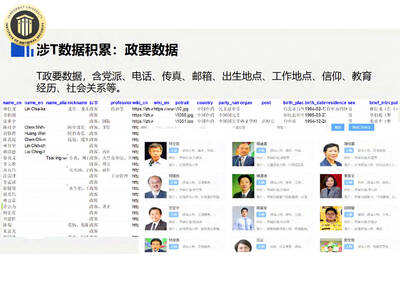
NETWORK-MAPPING PROJECT: The database contains 170 detailed files of Taiwanese politicians and about 23 million records of household registration data in Taiwan China has developed a network-mapping project targeting political figures and parties in Taiwan to monitor public opinion during elections and to craft tailored influence campaigns aimed at dividing Taiwanese society, according to documents leaked by Chinese technology firm GoLaxy (中科天璣). The documents, collected by Taipei-based Doublethink Lab, showed a database was specifically created to gather detailed information on Taiwanese political figures, including their political affiliations, job histories, birthplaces, residences, education, religion and a brief biography about them. Several notable Taiwanese politicians are in the database, including President William Lai (賴清德), former president Tsai Ing-wen (蔡英文), Minister of Foreign Affairs Lin Chia-lung (林佳龍),
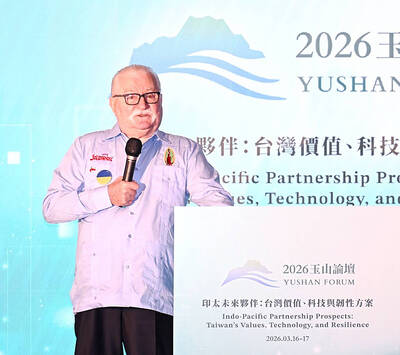
RECOGNITION: Former Fijian prime minister Mahendra Chaudhry said that Taiwan’s New Southbound Policy serves as a stabilizing force in the Indo-Pacific region Taiwan can lead the unification of the Chinese people, Nobel Peace Prize laureate and former Polish president Lech Walesa said in Taipei yesterday, adding that as the world order is changing, peaceful discussion would find good solutions, and that the use of force and coercion would always fail. Walesa made the remarks during his keynote address at a luncheon of the Yushan Forum in Taipei, titled “Indo-Pacific Partnership Prospects: Taiwan’s Values, Technology and Resilience,” organized by the Taiwan-Asia Exchange Foundation with the Ministry of Foreign Affairs. Walesa said that he had been at the forefront of a big peaceful revolution and “if
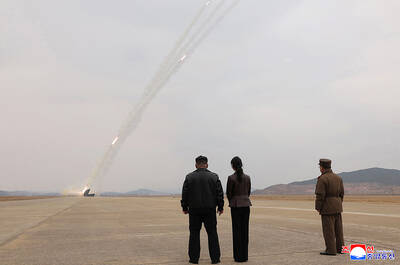
North Korea tested nuclear-capable rocket launchers, state media reported yesterday, a day after Seoul detected the launch of about 10 ballistic missiles. The test comes after South Korean and US forces launched their springtime military drills, due to run until Thursday. North Korean leader Kim Jong-un on Saturday oversaw the testing of the multiple rocket launcher system (MRLS), the Korean Central News Agency (KCNA) said. The test involved 12 600mm-caliber ultra-precision multiple rocket launchers and two artillery companies, it said. Kim said the drill gave Pyongyang’s enemies, within the 420km striking range, a sense of “uneasiness” and “a deep understanding

North Korea yesterday fired about 10 ballistic missiles to the sea toward Japan, the South Korean Joint Chiefs of Staff (JCS) said, days after Pyongyang warned of “terrible consequences” over ongoing South Korea-US military drills. Pyongyang recently dashed hopes of a diplomatic thaw with Seoul, Washington’s security ally, describing its latest peace efforts as a “clumsy, deceptive farce.” Seoul’s military detected “around 10 ballistic missiles launched from the Sunan area in North Korea toward the East Sea [Sea of Japan] at around 1:20pm,” JCS said in a statement, referring to South Korea’s name for the body of water. The missiles


 RSS
RSS