


A delegation led by US Undersecretary of State for Economic Growth, Energy and the Environment Keith Krach arrived in Taipei yesterday afternoon for a three-day visit.
Krach is to attend tomorrow’s memorial service for former president Lee Teng-hui (李登輝), who died on July 30 at the age of 97, Ministry of Foreign Affairs spokeswoman Joanne Ou (歐江安) said in a statement after Krach’s arrival, adding that Taiwan early last month had expressed the hope that the US would send a high-ranking official to attend.
Other members of the delegation include US Assistant Secretary of State for Democracy, Human Rights and Labor Robert Destro, US Assistant Secretary for Global Markets and Director-General of the US and Foreign Commercial Service Ian Steff, US Ambassador-at-Large for Global Women’s Issues Kelley Currie and former US assistant secretary of defense for Indo-Pacific security affairs Randall Schriver, she said.
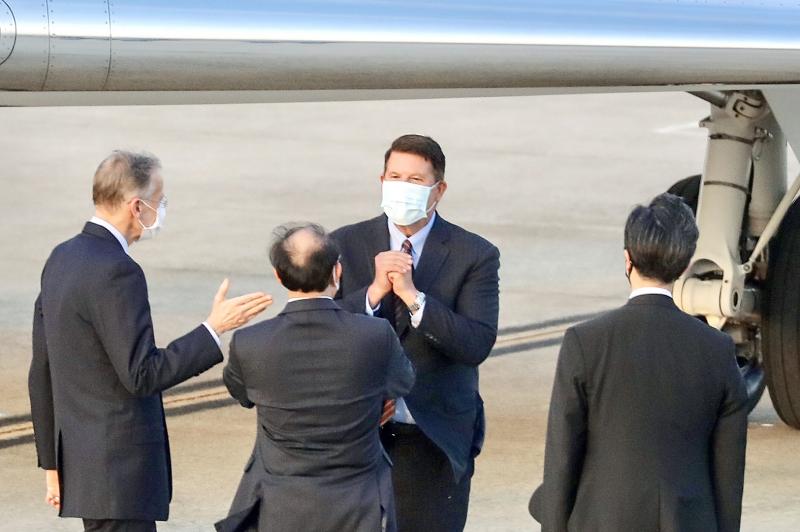
Photo: Pei Chen, AFP
They are to meet President Tsai Ing-wen (蔡英文), Premier Su Tseng-chang (蘇貞昌), Minister of Foreign Affairs Joseph Wu (吳釗燮) and other government officials to exchange opinions about bilateral ties related to the economy, supply chain security, democracy and other issues related to the Indo-Pacific region, Ou said.
It has also been reported that Krach plans to host a new dialogue — whose establishment was first announced by the US on Aug. 31.
The government and the American Institute in Taiwan had refrained from confirming the schedule for Krach’s visit until the US Department of State issued a statement on Wednesday.
The ministry’s statement confirmed Krach’s attendance at Lee’s memorial service, but did not mention the dialogue.
The confirmation came unusually late. The announcement of US Secretary of Health and Human Services Alex Azar’s visit last month was issued four days prior to his arrival.
Asked about the dialogue, Wu said that it has many aspects, and Taiwan and the US are still deliberating the details.
The government would discuss those issues with Krach during his visit to make the necessary preparations for the dialogue, he said, while reaffirming the close ties of the two nations.
The Chinese-language Apple Daily yesterday reported that the US had been irritated by Taiwan’s trumpeting of Krach’s visit and it mistakenly relating the economic dialogue to potential talks about a bilateral trade agreement, which is to be undertaken by the US trade representative.
This caused the US to delay confirming Krach’s schedule and to change his public events into closed-door meetings, the report added.
The ministry denied the claims, saying that they were speculation and did not reflect the truth.
While the dialogue would not take place, there would be “preparatory talks” today, a government official said on condition of anonymity.
Taiwan and the US would take the opportunity to discuss issues related to supply chain restructuring, technology, 5G and energy development, Executive Yuan spokesman Ting Yi-ming (丁怡銘) said.
Separately, Chinese Nationalist Party (KMT) Chairman Johnny Chiang (江啟臣) criticized Tsai’s administration for being opaque about the reasons for Krach’s visit.
The public had expected Azar’s visit to come with a promise of COVID-19 vaccines, but after his departure Tsai instead announced the lifting of restrictions on US pork and beef imports, he said.
Likewise, people expected Krach to start the economic dialogue or trade agreement talks, but then rumors about the US mulling more arms sales to Taiwan have emerged, provoking questions about the real purpose of the trip, he added.
Foreign relations should not consist of backroom deals, Chiang said, calling on the government to be more transparent about Krach’s visit and to report to the legislature.
Additional reporting by CNA, Lee Hsin-fang and Chen Yun
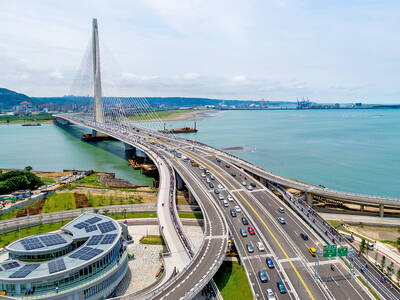
The Ministry of Transportation and Communications yesterday inaugurated the Danjiang Bridge across the Tamsui River in New Taipei City, saying that the structure would be an architectural icon and traffic artery for Taiwan. Feted as a major engineering achievement, the Danjiang Bridge is 920m long, 211m tall at the top of its pylon, and is the longest single-pylon asymmetric cable-stayed bridge in the world, the government’s Web site for the structure said. It was designed by late Iraqi-British architect Zaha Hadid. The structure, with a maximum deck of 70m, accommodates road and light rail traffic, and affords a 200m navigation channel for boats,
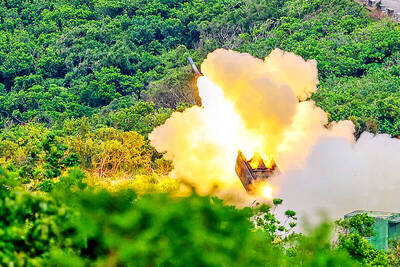
PRECISION STRIKES: The most significant reason to deploy HIMARS to outlying islands is to establish a ‘dead zone’ that the PLA would not dare enter, a source said A High Mobility Artillery Rocket System (HIMARS) would be deployed to Penghu County and Dongyin Island (東引) in Lienchiang County (Matsu) to force the Chinese military to retreat at least 100km from the coastline, a military source said yesterday. Taiwan has been procuring HIMARS and Army Tactical Missile Systems (ATACMS) from the US in batches. Once all batches have been delivered, Taiwan would possess 111 HIMARS units and 504 ATACMS, which have a range of 300km. Considering that “offense is the best defense,” the military plans to forward-deploy the systems to outlying islands such as Penghu and Dongyin so that
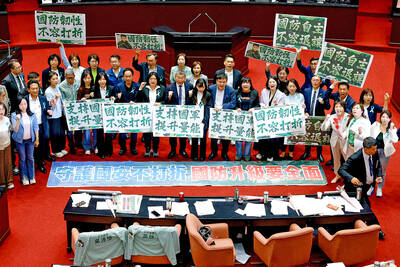
WHAT WAS ALL THAT FOR? Jaw Shaw-kong said that Cheng Li-wen had pushed for more drastic cuts and attacked him, just for the outcome to be nearly identical to his bill The legislature yesterday passed a supplementary budget bill to fund the purchase of separate packages of US military equipment, with the combined amount of spending capped at NT$780 billion (US$24.8 billion). The Chinese Nationalist Party (KMT) and Taiwan People’s Party (TPP) used their legislative majority to pass the bill, which runs until 2033 and has two main funding provisions. One was for NT$300 billion of arms sales already approved by the US for Taiwan on Dec. 17 last year, the other was for NT$480 billion for another arms package expected to be announced by Washington. The bill, which fell short of the NT$1.25
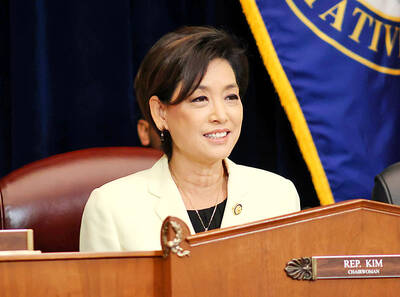
‘CLEAR MESSAGE’: The bill would set up an interagency ‘tiger team’ to review sanctions tools and other economic options to help deter any Chinese aggression toward Taiwan US Representative Young Kim has introduced a bill to deter Chinese aggression against Taiwan, calling for an interagency “tiger team” to preplan coordinated sanctions and economic measures in response to possible Chinese military or political action against Taiwan. “[Chinese President] Xi Jinping [習近平] has directed the People’s Liberation Army to be ready to invade Taiwan by 2027. China has a plan. America should have one too,” Kim said in a news release on Thursday last week. She introduced the “Deter PRC [People’s Republic of China] aggression against Taiwan act” to “ensure the US has a coordinated sanctions strategy ready should


 RSS
RSS