


The Chinese Nationalist Party (KMT) is considering boycotting the annual cross-Taiwan Strait Forum unless China Central Television (CCTV) apologizes and offers an explanation for a headline suggesting that the party was “suing for peace,” a senior KMT official said yesterday.
The KMT had on Tuesday announced that former legislative speaker Wang Jin-pyng (王金平) would lead a KMT delegation to the forum, which is to open on Saturday in Xiamen, China.
However, a headline shown by CCTV, a mouthpiece of the Chinese government, during a program hosted by Li Hong (李紅) read: “With the [Taiwan] Strait on the brink of war, this man [Wang] is coming to the mainland to sue for peace.”
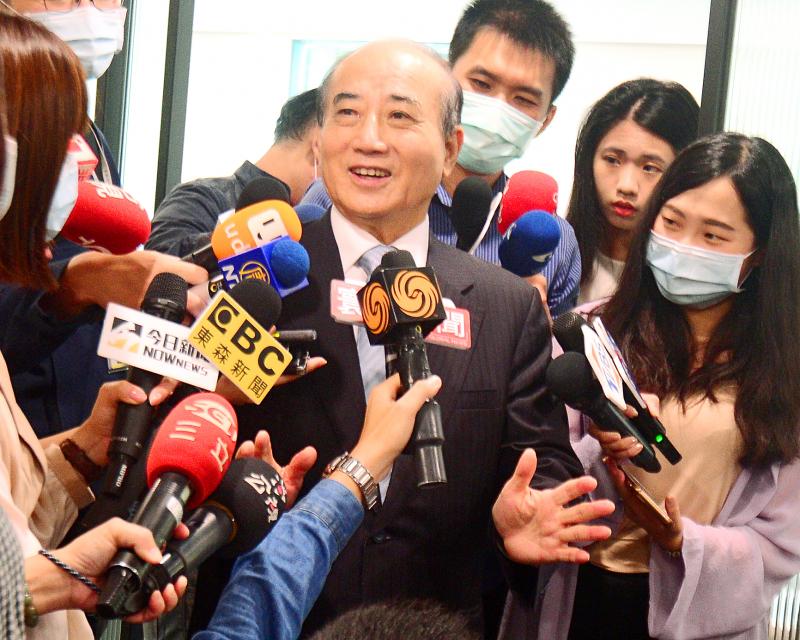
Photo: Wang Yi-sung, Taipei Times
Following the broadcast, KMT Chairman Johnny Chiang (江啟臣) said on Facebook that the description is unacceptable and calls for an apology from the parties involved.
The footage was removed from CCTV’s Web site after the KMT protested the TV program.
KMT caucus whip Lin Wei-chou (林為洲) late of Friday said on Facebook that “if China is so unfriendly toward us, then we need not attend the forum or go there carrying the Republic of China [ROC] flag. There is no ‘1992 consensus’ without the ROC’s existence.”
KMT Taipei City Councilor Yu Shu-hui (游淑慧) asked on Facebook: “Why should we attend the forum if we are being labeled like this?”
CCTV represents China’s official government stance, “so such derision has already put us in an awkward position... Do we have to attend the forum under any circumstances?” she asked.
In response to media queries yesterday, Chiang said the forum is for dialogue, not to “sue for peace,” adding that pursuing peace is the main objective of attending the forum.
“Working to reduce tensions between the two sides, and ensuring peace and security across the Strait: these are our duties as Taiwan’s largest opposition party, but this must not be vilified as ‘suing for peace,’ as we cannot accept such a description,” he added.
A senior party official said that Chiang, Wang and KMT Secretary-General Lee Chien-lung (李乾龍) would make a decision soon.
“However, Beijng’s reporting of Wang as suing for peace has damaged our friendship,” the official said.
The KMT would seek an apology from Li and might not send a delegation to the forum if Li does not apologize, they added.
“However, if Wang wants to participate [in the forum] in his personal capacity, then the KMT could not say no,” the official said.
Democratic Progressive Party spokeswoman Yen Juo-fang (顏若芳) said that “the KMT is still under the delusion that it might receive an apology from China, because it needs a good reason to attend. The KMT’s groveling behavior is like discarding one’s self-respect, and has harmed Taiwan’s national sovereignty and the mutual friendship. Surrendering its self-respect only confirms the ‘suing for peace’ description.”
New Power Party caucus whip Chiu Hsieng-chih (邱顯智) said that China has been using the forum to further its “united front” campaign.
“So the KMT should stop attending and instead defend Taiwan’s sovereignty,” he said.
“Especially with Chinese military aircraft encroaching on Taiwan’s airspace, attending the forum would really harm Taiwan,” Chiu said.
Taiwan People’s Party caucus convener Jang Chyi-lu (張其祿) also urged the KMT to boycott the forum, “as the forum is a tool for China’s propaganda purposes, and it is not appropriate for the KMT to participate.”
Additional reporting by Huang Hsin-po, Chung Li-hua and CNA
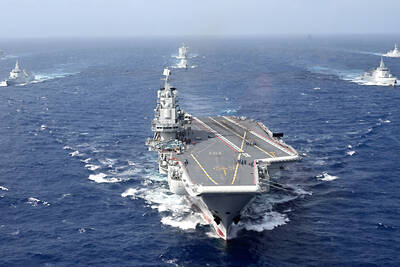
PROVOCATIVE: Chinese Deputy Ambassador to the UN Sun Lei accused Japan of sending military vessels to deliberately provoke tensions in the Taiwan Strait China denounced remarks by Japan and the EU about the South China Sea at a UN Security Council meeting on Monday, and accused Tokyo of provocative behavior in the Taiwan Strait and planning military expansion. Ayano Kunimitsu, a Japanese vice foreign minister, told the Council meeting on maritime security that Tokyo was seriously concerned about the situation in the East China and South China seas, and reiterated Japan’s opposition to any attempt to change the “status quo” by force, and obstruction of freedom of navigation and overflight. Stavros Lambrinidis, head of the EU delegation to the UN, also highlighted South China Sea
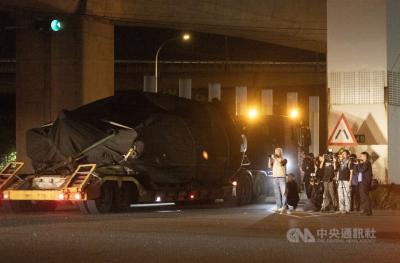
The final batch of 28 M1A2T Abrams tanks purchased from the US arrived at Taipei Port last night and were transported to the Armor Training Command in Hsinchu County’s Hukou Township (湖口), completing the military’s multi-year procurement of 108 of the tanks. Starting at 12:10am today, reporters observed more than a dozen civilian flatbed trailers departing from Taipei Port, each carrying an M1A2T tank covered with black waterproof tarps. Escorted by military vehicles, the convoy traveled via the West Coast Expressway to the Armor Training Command, with police implementing traffic control. The army operates about 1,000 tanks, including CM-11 Brave Tiger
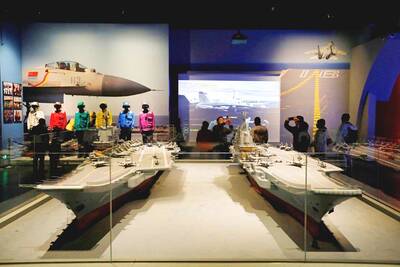
China on Wednesday teased in a video an aircraft carrier that could be its fourth, and the first using nuclear power, while making an allusion to Taiwan and vowing to further build up its islands, as it looks to boost maritime power, secure resources and bolster territorial claims. The video, issued on the eve of the 77th founding anniversary of the Chinese People’s Liberation Army Navy, featured fictional officers with names that are homophones of three commissioned aircraft carriers, the Liaoning (遼寧), Shandong (山東) and Fujian (福建). Titled Into the Deep, it showed a 19-year-old named “Hejian” (何劍) joining the group, sparking
Taiwan Semiconductor Manufacturing Co (TSMC, 台積電), the world’s largest contract chipmaker, said it expects its 2-nanometer (2nm) chip capacity to grow at a compound annual rate of 70 percent from this year to 2028. The projection comes as five fabs begin volume production of 2-nanometer chips this year — two in Hsinchu and three in Kaohsiung — TSMC senior vice president and deputy cochief operating officer Cliff Hou (侯永清) said at the company’s annual technology symposium in Silicon Valley, California, last week. Output in the first year of 2-nanometer production, which began in the fourth quarter of last year, is expected to


 RSS
RSS