


The Ministry of Economic Affairs yesterday announced that imported masks would have to be approved by the ministry after an investigation revealed another case of alleged fraud.
The investigation had revealed that Haw Ping Co (豪品國際實業), based in Yuanlin (員林), Changhua County, had imported 7.2 million industrial-grade masks from China and sold them as medical-grade masks made in Taiwan, the ministry said.
It was the nation’s second case of fraud after New Taipei City-based Carry Hi-tech Co (加利科技) was found to have supplied the government’s mask rationing system with industrial-grade masks made in China.
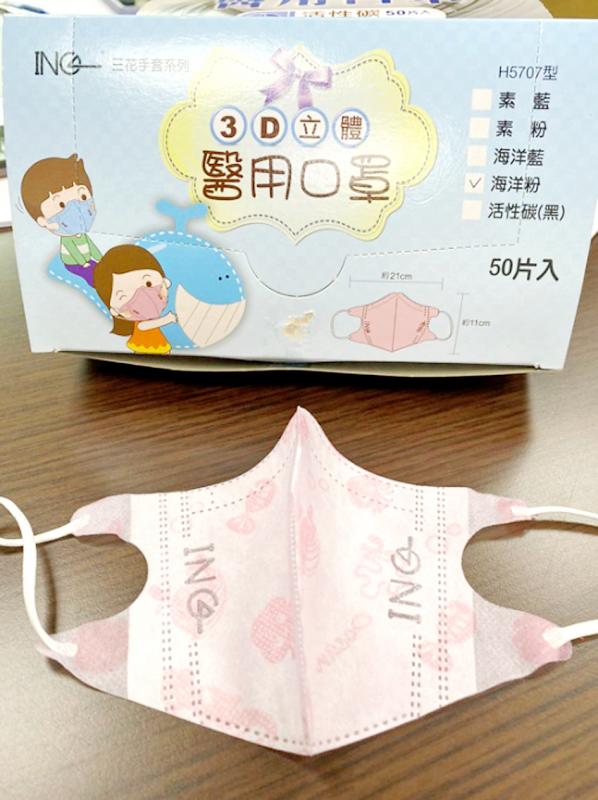
Photo courtesy of the Ministry of Economic Affairs via CNA
While Haw Ping is also a member of the mask “national team,” Minister of Economic Affairs Wang Mei-hua (王美花) said that the investigation had showed that the Chinese masks were not sold through the government’s rationing system.
“We stepped up our investigations after the Carry Hi-tech case and found that Haw Ping was importing an unusual number of masks,” Wang told reporters at a news conference in Taipei.
“After visiting retailers, we found that Haw Ping was selling three-dimensional face masks that it does not have the equipment to make in Taiwan,” she said.
Of the 7.2 million industrial-grade masks the company imported from China, about 3 million remain in its warehouses, meaning 4 million have likely been sold, she said.
The number of masks imported from China has increased and last month alone 80 million masks were imported to Taiwan, mostly industrial-grade masks made in China, Wang said.
The ministry was not proposing banning the import of all industrial-grade masks from China over concerns it would inconvenience those who want them for legitimate uses, but starting on Wednesday next week, all imports of masks would have to be preapproved by the ministry, she said.
The ministry would track imported masks to ensure they are properly labeled at the point of sale, she added.
“This way we can control how many are coming in and we can demand weekly updates from the businesses of where they are going. We need to ensure Chinese masks are not being sold as masks made in Taiwan and that industrial-grade masks are not being sold as medical-grade masks,” Wang said.
She urged businesses and consumers not to buy loose masks not in packaging.
“Stay away from improperly packaged masks because you do not know where they came from,” she said.
The Bureau of Foreign Trade is to announce the details of obtaining import approval for masks on Monday next week and all imports would have to be approved starting the following Wednesday, the ministry said.
As an additional measure of security, all medical-grade masks made in Taiwan from Thursday next week must carry the “Made in Taiwan” and “MD” stamps to prove their provenance, it said.
The government began requisitioning all domestically produced medical-grade masks on Jan. 31 and implemented a rationing program on Feb. 6.
While consumers can now buy unlimited numbers of masks on the open market, the option of buying nine masks every 14 days at a set price remains for those who have a National Health Insurance card.
Additional reporting by CNA

The National Chungshan Institute of Science and Technology yesterday showcased its locally developed variants of the Vision 60 robotic patrol dog, which it plans to deploy on the nation’s outlying territories in the South China Sea. The variants were produced under the Joint Lab project — created by the institute and domestic companies — and assembled with domestically produced motors, lenses and artificial intelligence (AI) systems alongside licensed tech from the US, Missile and Rocket Systems Research Division deputy director Jen Kuo-kang (任國光) told the media event at a military base in Taipei’s Dazhi (大直) area. Taiwan has built up its strengths

RIGHT DIRECTION: Taiwan’s efforts to prevent forced labor include a proposal to ‘fully prohibit’ employers from withholding workers’ documents, an official said Taiwan is to establish a mechanism to restrict imports of goods linked to forced labor, the Executive Yuan said yesterday, after the US proposed imposing additional tariffs on Taiwanese goods over labor concerns. “The Ministry of Labor and the Ministry of Economic Affairs are to establish an interministerial review procedure,” Executive Yuan spokesperson Michelle Lee (李慧芝) said at a news briefing in Taipei. “The government is to use the Foreign Trade Act [貿易法] as the legal basis to restrict imports of goods produced with forced labor” and bring its supply chain governance more in line with international standards on human rights, resilience

NOT IMMEDIATE: Taiwan has a chance to appeal the proposed 10 percent tariff before it starts, while other countries face a 12.5 percent tariff from the trade office Taiwan is among 60 economies determined by the US to have failed to impose or enforce a ban on the importation of goods produced with forced labor, according to a notice released on Tuesday by the Office of the US Trade Representative (USTR), which proposed imposing an additional 10 percent or more tariff on them. The USTR in a statement said that following an investigation, it had determined under Section 301 of the Trade Act of 1974 that the failure of the 60 economies to impose and effectively enforce a prohibition on the importation of goods produced with forced labor is
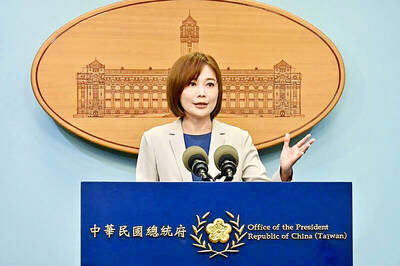
TIT-FOR-TAT: The US allegedly revoked the visa of a Chinese national working at Xinhua News Agency in the US in response to Beijing’s expulsion of Vivian Wang The Presidential Office yesterday condemned China for expelling a New York Times correspondent from Beijing following the newspaper’s interview with President William Lai (賴清德), saying the move highlighted Beijing’s suppression of press freedom and its threat to international news media. Taiwan has noted a series of recent incidents in which Beijing used similar tactics to “threaten and pressure international media outlets and journalists,” Presidential Office spokeswoman Karen Kuo (郭雅慧) said in a statement. “This concerns not only press freedom and freedom of expression, but also the safety of journalists, and Taiwan and relevant partners are paying close attention to the situation,” she


 RSS
RSS