


“Surgical” masks made in Taiwan must bear the imprints “MD” and “Made in Taiwan” by the end of this month, the Central Epidemic Command Center (CECC) said yesterday, as it reported another imported case of COVID-19, a Taiwanese woman who returned from France.
To ensure that people can identify masks that have been produced domestically, the Ministry of Health and Welfare has asked local manufacturers to print “MD” — for “medical” — and “Made in Taiwan” on every flat mask they produce, starting in two weeks at the earliest, said Centers for Disease Control (CDC) Deputy Director-General Chuang Jen-hsiang (莊人祥), the CECC’s spokesman.
The announcement comes amid concerns about the quality of masks imported from China
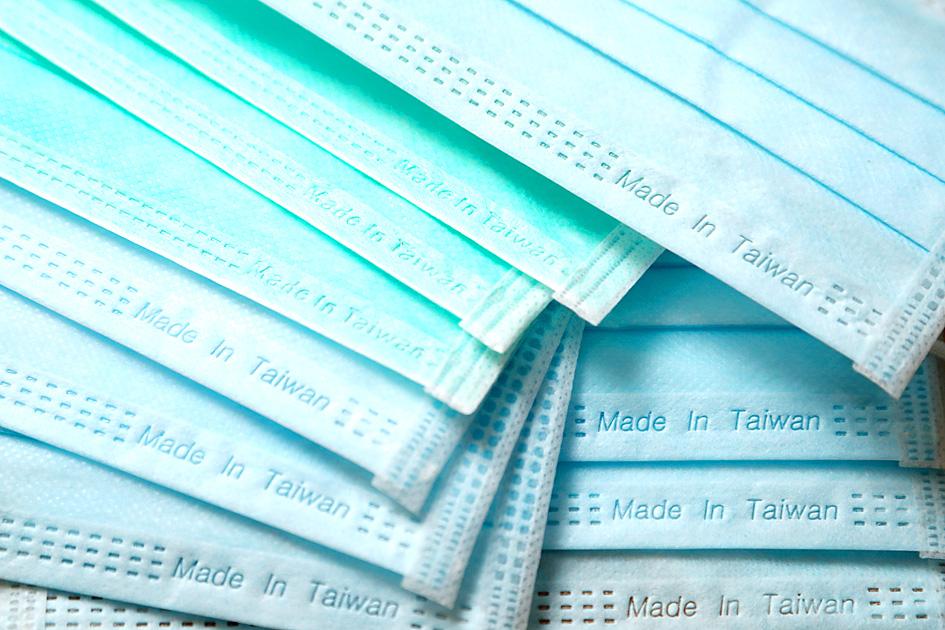
Photo: CNA
Reports last week said that New Taipei City-based Carry Hi-tech (加利科技) had been bundling in non-medical-grade masks from China with the medical-grade ones for sale through the government’s mask rationing system.
After an investigation was launched into the company’s products, the government announced that masks imprinted with the words “Carry mask” bought through the rationing system could be exchanged for new ones before Friday.
Chuang said 1,875,872 “Carry mask” masks had been exchanged between Friday last week and Monday.
As for concerns about a CECC report on Sunday that the Customs Administration had seized more than 830,000 imported masks labeled as “Made in Taiwan,” Chuang said the agency yesterday confirmed that 842,505 falsely labeled masks had been seized between Aug. 10 and Saturday.
The recipients included 68 firms and 512 people, none of whom are members of the “national team” of companies that provide masks for the rationing system, he said.
He said the latest imported case of COVID-19 is a woman in her 20s who works in France and returned on Sunday.
She developed a headache and sore muscles on Aug. 30 and was diagnosed with the flu when she sought treatment in France, but her symptoms improved after taking medication, Chuang said.
Upon arrival in Taiwan, she told airport quarantine officers that she had a runny nose, so she was tested for COVID-19 and taken to a centralized quarantine facility, he added.
Her test results yesterday showed she was positive, making her the nation’s 495th confirmed case of COVID-19, and the 21 passengers who sat near her on her flight have been put under home isolation, he said.
Of the nation’s confirmed cases, 475 people have been released from isolation and seven have died.

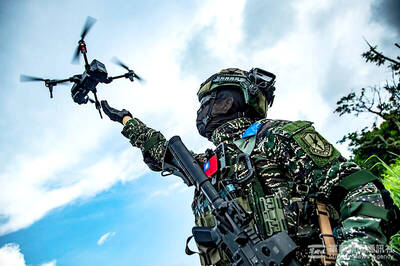
RESILIENCE: Taiwan plays a key role in semiconductors, energy, information infrastructure and advanced manufacturing, AIT Director Raymond Greene said Taiwan’s continued investment in deterrence and resilience remains vital, especially in uncrewed systems and other emerging technologies, American Institute in Taiwan (AIT) Director Raymond Greene said yesterday. Greene made the remarks at the annual National Strategic Summit on Supply Chain Resilience held by the Research Institute for Democracy, Society and Emerging Technology (DSET), a government-backed think tank. As Taiwan last year became the US’ fourth-largest trading partner and supply chain security is becoming more important, cooperation in emerging technologies continues to deepen between the two countries, he said. The US is committed to accelerating innovation, building key infrastructure, strengthening cooperation

The National Chungshan Institute of Science and Technology yesterday showcased its locally developed variants of the Vision 60 robotic patrol dog, which it plans to deploy on the nation’s outlying territories in the South China Sea. The variants were produced under the Joint Lab project — created by the institute and domestic companies — and assembled with domestically produced motors, lenses and artificial intelligence (AI) systems alongside licensed tech from the US, Missile and Rocket Systems Research Division deputy director Jen Kuo-kang (任國光) told the media event at a military base in Taipei’s Dazhi (大直) area. Taiwan has built up its strengths

RIGHT DIRECTION: Taiwan’s efforts to prevent forced labor include a proposal to ‘fully prohibit’ employers from withholding workers’ documents, an official said Taiwan is to establish a mechanism to restrict imports of goods linked to forced labor, the Executive Yuan said yesterday, after the US proposed imposing additional tariffs on Taiwanese goods over labor concerns. “The Ministry of Labor and the Ministry of Economic Affairs are to establish an interministerial review procedure,” Executive Yuan spokesperson Michelle Lee (李慧芝) said at a news briefing in Taipei. “The government is to use the Foreign Trade Act [貿易法] as the legal basis to restrict imports of goods produced with forced labor” and bring its supply chain governance more in line with international standards on human rights, resilience

NOT IMMEDIATE: Taiwan has a chance to appeal the proposed 10 percent tariff before it starts, while other countries face a 12.5 percent tariff from the trade office Taiwan is among 60 economies determined by the US to have failed to impose or enforce a ban on the importation of goods produced with forced labor, according to a notice released on Tuesday by the Office of the US Trade Representative (USTR), which proposed imposing an additional 10 percent or more tariff on them. The USTR in a statement said that following an investigation, it had determined under Section 301 of the Trade Act of 1974 that the failure of the 60 economies to impose and effectively enforce a prohibition on the importation of goods produced with forced labor is


 RSS
RSS