


Japan yesterday marked the 75th anniversary of its surrender in World War II, with Emperor Naruhito expressing “deep remorse” over his country’s wartime actions at a somber annual ceremony curtailed by the COVID-19 pandemic.
Naruhito pledged to reflect on the war’s events and expressed the hope that the tragedy would never be repeated.
There was no word of apology from Japanese Prime Minister Shinzo Abe, who gave thanks for the sacrifices of the Japanese war dead, but had nothing to say about the suffering of Japan’s neighbors.

Photo: EPA-EFE
“Reflecting on our past and bearing in mind the feelings of deep remorse, I earnestly hope that the ravages of war will never be repeated,” Naruhito said in a short speech at the event in Tokyo marking the 75th anniversary of Japan’s surrender on Aug. 15, 1945.
Amid virus fears and worries about the fading memories of the fast-aging war generation, about 500 participants, reduced from 6,200 last year, mourned the dead with a minute of silence. Masks were required, and there was no singing of the Kimigayo national anthem.
Naruhito has promised to follow in the footsteps of his father, who devoted his 30-year career to making amends for a war fought in the name of Hirohito, the current emperor’s grandfather.
Abe has increasingly sought to whitewash Japan’s brutal past since taking office in December 2012.
He has not acknowledged Japan’s wartime hostilities during Aug. 15 speeches, which had previously been a nearly 20-year tradition that began with the 1995 apology of then-Japanese prime minister Tomiichi Murayama.
Abe, in a largely domestic-focused speech, said the peace that Japan enjoys today is built on the sacrifices of those who died in the war.
He pledged that Japan would reflect on lessons from history and would not repeat the war devastation.
He listed damage inflicted on Japan and its people, including the US atomic bombings of Hiroshima and Nagasaki, massive firebombings of Tokyo and the fierce battle of Okinawa.
Abe pledged to play a greater role in tackling global problems.
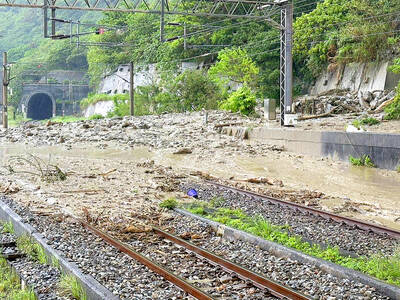
ROLLER-COASTER RIDE: More than five earthquakes ranging from magnitude 4.4 to 5.5 on the Richter scale shook eastern Taiwan in rapid succession yesterday afternoon Back-to-back weather fronts are forecast to hit Taiwan this week, resulting in rain across the nation in the coming days, the Central Weather Administration said yesterday, as it also warned residents in mountainous regions to be wary of landslides and rockfalls. As the first front approached, sporadic rainfall began in central and northern parts of Taiwan yesterday, the agency said, adding that rain is forecast to intensify in those regions today, while brief showers would also affect other parts of the nation. A second weather system is forecast to arrive on Thursday, bringing additional rain to the whole nation until Sunday, it
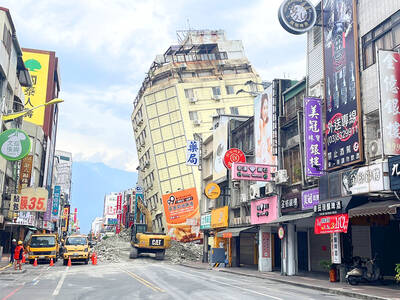
LANDSLIDES POSSIBLE: The agency advised the public to avoid visiting mountainous regions due to more expected aftershocks and rainfall from a series of weather fronts A series of earthquakes over the past few days were likely aftershocks of the April 3 earthquake in Hualien County, with further aftershocks to be expected for up to a year, the Central Weather Administration (CWA) said yesterday. Based on the nation’s experience after the quake on Sept. 21, 1999, more aftershocks are possible over the next six months to a year, the agency said. A total of 103 earthquakes of magnitude 4 on the local magnitude scale or higher hit Hualien County from 5:08pm on Monday to 10:27am yesterday, with 27 of them exceeding magnitude 5. They included two, of magnitude

CONDITIONAL: The PRC imposes secret requirements that the funding it provides cannot be spent in states with diplomatic relations with Taiwan, Emma Reilly said China has been bribing UN officials to obtain “special benefits” and to block funding from countries that have diplomatic ties with Taiwan, a former UN employee told the British House of Commons on Tuesday. At a House of Commons Foreign Affairs Committee hearing into “international relations within the multilateral system,” former Office of the UN High Commissioner for Human Rights (OHCHR) employee Emma Reilly said in a written statement that “Beijing paid bribes to the two successive Presidents of the [UN] General Assembly” during the two-year negotiation of the Sustainable Development Goals. Another way China exercises influence within the UN Secretariat is

Taiwan’s first drag queen to compete on the internationally acclaimed RuPaul’s Drag Race, Nymphia Wind (妮妃雅), was on Friday crowned the “Next Drag Superstar.” Dressed in a sparkling banana dress, Nymphia Wind swept onto the stage for the final, and stole the show. “Taiwan this is for you,” she said right after show host RuPaul announced her as the winner. “To those who feel like they don’t belong, just remember to live fearlessly and to live their truth,” she said on stage. One of the frontrunners for the past 15 episodes, the 28-year-old breezed through to the final after weeks of showcasing her unique


 RSS
RSS