


Kaohsiung City Councilor Jane Lee (李眉蓁), the Chinese Nationalist Party’s (KMT) candidate for the Kaohsiung mayoral by-election, yesterday said that she would give up her master’s degree from National Sun Yat-sen University following allegations that she plagiarized her thesis.
She said she would also ask the Kaohsiung City Election Commission to remove the degree from the column in the election bulletin where candidates’ education backgrounds are listed.
The by-election is scheduled for Aug. 15 and the commission said that it was nearly finished printing the election bulletins.

Photo: CNA
However, the Kaohsiung-based university said that the Degree Conferral Act (學位授予法) has no regulations covering voluntary relinquishment of a degree.
Lee’s case is being reviewed by outside experts, it said, adding that if it is found that she breached academic ethics, her degree might be revoked.
Her thesis adviser might also be punished if a dereliction of duty is determined, the university said.
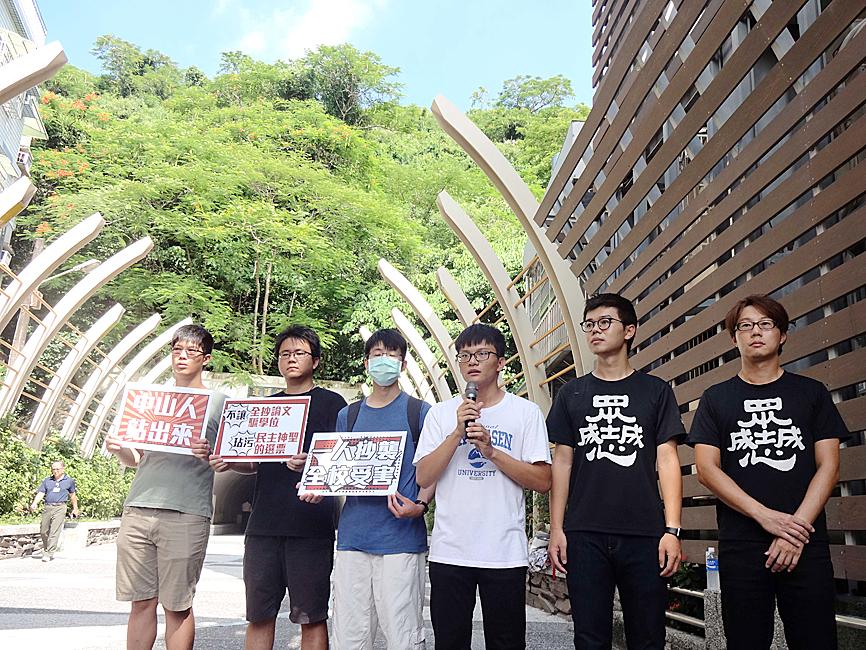
Photo: CNA
The KMT said in a statement that it supported Lee in “bravely facing” her mistake and giving up her degree.
“All political workers should examine themselves by the same standard,” the party said.
“As an academic, I cannot accept academic plagiarism,” KMT Chairman Johnny Chiang (江啟臣) wrote on Facebook.
“This standard has never changed,” whether I was an educator, a lawmaker or the leader of a political party, he said.
“As a political worker, integrity is a standard that cannot be compromised,” he said.
National Dong Hwa University Vice President Chu Chin-peng (朱景鵬), who was a member of the oral exam committee that examined Lee’s thesis, yesterday said that he would cooperate with any investigation.
The two other members of the committee were Lin Teh-chang (林德昌), former director of Sun Yat-sen’s Institute of China and Asia-Pacific Studies, and Chao Su-cheng (趙甦成), former director of the Chinese Social and Economic Research Institute, which is affiliated to National Chengchi University’s Institute of International Relations.
Meanwhile, Huang Po-hsiang (黃柏翔), a sociology student at Sun Yat-sen, launched a petition to have the school rescind Lee’s degree if the allegations of plagiarism are found to be true.
From 6pm on Wednesday to 9am yesterday, more than 500 students and alumni at the school reportedly signed the petition.
The incident has severely damaged the reputation of the university, Huang added.
Lee on Wednesday had said she would only explain the matter if President Tsai Ing-wen (蔡英文) also clarifies controversy surrounding her doctoral thesis.
Asked for comment on the matter at an event in Taipei yesterday, Tsai said the authenticity of her thesis and doctoral degree have been verified and that her alma mater, the London School of Economics and Political Science, had also offered an explanation.
Tsai said that Lee should face the problem and clearly explain the matter.
Democratic Progressive Party spokeswoman Yen Juo-fang (顏若芳) said that Lee was trying to smear Tsai with groundless insinuations to shift the media focus away from herself.
“Why is the KMT’s mayoral candidate stooping to such a level?” Yen asked.
Additional reporting by Huang Hsu-lei, Ko Yu-hao, Jason Pan and CNA

PROVOCATIVE: Chinese Deputy Ambassador to the UN Sun Lei accused Japan of sending military vessels to deliberately provoke tensions in the Taiwan Strait China denounced remarks by Japan and the EU about the South China Sea at a UN Security Council meeting on Monday, and accused Tokyo of provocative behavior in the Taiwan Strait and planning military expansion. Ayano Kunimitsu, a Japanese vice foreign minister, told the Council meeting on maritime security that Tokyo was seriously concerned about the situation in the East China and South China seas, and reiterated Japan’s opposition to any attempt to change the “status quo” by force, and obstruction of freedom of navigation and overflight. Stavros Lambrinidis, head of the EU delegation to the UN, also highlighted South China Sea

The final batch of 28 M1A2T Abrams tanks purchased from the US arrived at Taipei Port last night and were transported to the Armor Training Command in Hsinchu County’s Hukou Township (湖口), completing the military’s multi-year procurement of 108 of the tanks. Starting at 12:10am today, reporters observed more than a dozen civilian flatbed trailers departing from Taipei Port, each carrying an M1A2T tank covered with black waterproof tarps. Escorted by military vehicles, the convoy traveled via the West Coast Expressway to the Armor Training Command, with police implementing traffic control. The army operates about 1,000 tanks, including CM-11 Brave Tiger
Taiwan Semiconductor Manufacturing Co (TSMC, 台積電), the world’s largest contract chipmaker, said it expects its 2-nanometer (2nm) chip capacity to grow at a compound annual rate of 70 percent from this year to 2028. The projection comes as five fabs begin volume production of 2-nanometer chips this year — two in Hsinchu and three in Kaohsiung — TSMC senior vice president and deputy cochief operating officer Cliff Hou (侯永清) said at the company’s annual technology symposium in Silicon Valley, California, last week. Output in the first year of 2-nanometer production, which began in the fourth quarter of last year, is expected to

Taiwan’s drone exports surged past US$100 million in the first quarter, exceeding last year’s full-year total, with the Czech Republic emerging as the largest buyer, the Ministry of Economic Affairs said. Exports of complete drones reached US$115.85 million in the period, about 1.2 times the total recorded for all of last year, the ministry said in a report. Exports to the Czech Republic accounted for about US$100 million, far outpacing other markets. Poland, last year’s top destination, recorded about US$11.75 million in the first quarter. Taiwan’s drone exports have expanded rapidly in the past few years, with last year’s total


 RSS
RSS