


President Tsai Ing-wen (蔡英文) yesterday inaugurated the nation’s newest research vessel at a shipyard in Keelung as she vowed to make Taiwan a prosperous and sustainable maritime country.
The 2,155-tonne R/V New Ocean Researcher 1, one of three ships commissioned by the Ministry of Science and Technology from CSBC Corp, Taiwan (台船), was built at a cost of nearly NT$646 million (US$21.86 million) and is to take over the mission of the R/V Ocean Researcher I, which stopped operations earlier this year.
It is part of the new research fleet, along with the R/V New Ocean Researcher 2 and the R/V New Ocean Researcher 3 — also built by CSBC and inaugurated last year — and the R/V Legend, built by a Singaporean shipbuilder and inaugurated in 2018.
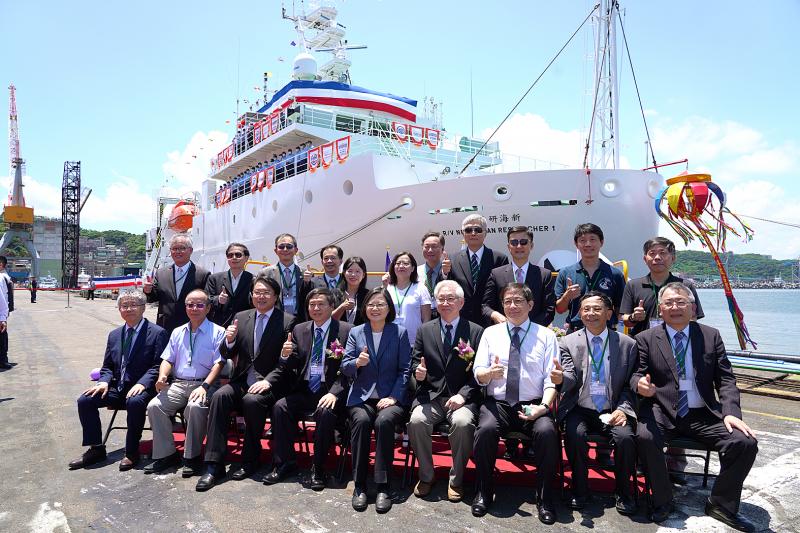
Photo courtesy of the Ministry of Science and Technology via CNA
Yesterday was a big day for the nation, as the R/V New Ocean Researcher 1, built by a domestic shipbuilder, was finally inaugurated after years of planning, Tsai told a ceremony at CSBC’s Keelung shipyard.
The ship would embark on trips to Guam and Palau to survey typhoon genesis hotspots in the western Pacific, as well as the Mariana Trench and the North Equatorial Current, under the ministry’s “Sailing to the Blue Sea” program, Tsai said.
The surveys would advance people’s understanding of the environment, improve natural disaster response, and allow the nation to contribute to the global community and promote sustainable development in the region, she said.
As a nation surrounded by waters, Taiwan is intimately tied to the ocean in many aspects, but for a long period, Taiwanese lacked oceanic education and turned their backs on the ocean, Tsai said, citing remarks by author Liao Hung-chi (廖鴻基), whose books focus on the ocean.
However, society has renewed its understanding of the ocean, thanks to efforts by the previous research vessels over the past three decades, she said, adding that the new fleet would expand the scope of research on existing foundations.
“Let us build a prosperous and sustainable maritime country,” Tsai said, as she wished the new ship smooth sailing.
The “Sailing to the Blue Sea” program encourages marine research in distant seas, Deputy Minister of Science and Technology Lin Minn-tsong (林敏聰) said.
With the ships using state-of-the-art instruments, the ministry aims to establish a “four-dimensional “observation network to deepen the nation’s understanding of the marine environment and weather conditions to promote a sustainable marine environment, he said.
The R/V New Ocean Researcher 1, which is to be transferred from the ministry to National Taiwan University’s Institute of Oceanography for management, is scheduled to visit Guam in December, but the plan is subject to change due to the COVID-19 pandemic, institute director Jan Sen (詹森) said.
The institute plans to install a Doppler radar to collect meteorological data within a 150km radius vertically and horizontally, he said, adding that such radar systems are only found on Australian, Japanese and US research vessels.
The ship’s state-of-the-art instruments include shallow and deep-sea multibeam echosounders that would allow scientists to produce high-resolution 3D maps of sea floors, Jan said.
The institute also displayed several instruments that could be deployed on the vessel, including a data buoy for ocean and weather observations, a Seaglider autonomous underwater vehicle and a remotely operated vehicle.
Building the research ships to complex scientific instrument specifications was a challenge for CSBC, which was used to constructing large commercial ships, chairman Cheng Wen-lon (鄭文隆) said.
After the R/V Ocean Researcher V shipwreck in 2014, CSBC was required to adopt stricter safety standards used for passenger ships when building the research ships, he added.
Another CSBC member said the company might face fines for its delay in transferring the ship and that it is negotiating about related matters with the ministry.
Lin said the ministry would handle the matter according to its contract with the firm.

Japan has deployed long-range missiles in a southwestern region near China, the Japanese defense minister said yesterday, at a time when ties with Beijing are at their lowest in recent years. The missiles were installed in Kumamoto in the southern region of Kyushu, as Japan is attempting to shore up its military capacity as China steps up naval activity in the East China Sea. “Standoff defense capabilities enable us to counter the threat of enemy forces attempting to invade our country ... while ensuring the safety of our personnel,” Japanese Minister of Defense Shinjiro Koizumi said. “This is an extremely important initiative for
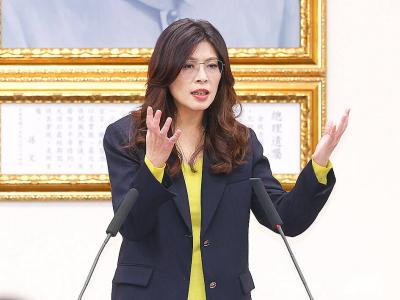
Chinese Nationalist Party (KMT) Chairwoman Cheng Li-wun (鄭麗文) today accepted an invitation from Chinese President Xi Jinping (習近平) to lead a delegation to China next month, saying she hopes to promote the peaceful development of cross-strait relations and bring stability to the Taiwan Strait. “I am grateful and happy to accept this invitation,” Cheng said in a statement from the KMT chairperson’s office. Cheng said she hopes both sides can work together to promote the peaceful development of cross-strait relations, enhance exchange and cooperation, bring stability to the Taiwan Strait and improve people’s livelihoods. At today's news conference, Cheng said any efforts to

MORE POPULAR: Taiwan Pass sales increased by 59 percent during the first quarter compared with the same period last year, the Tourism Administration said The Tourism Administration yesterday said that it has streamlined the Taiwan Pass, with two versions available for purchase beginning today. The tourism agency has made the pass available to international tourists since 2024, allowing them to access the high-speed rail, Taiwan Railway Corp services, four MRT systems and four Taiwan Tourist Shuttles. Previously, five types of Taiwan Pass were available, but some tourists have said that the offerings were too complicated. The agency said only two types of Taiwan Pass would be available, starting from a three-day pass with the high-speed rail and a three-day pass with Taiwan Railway Corp. The former costs NT$2,800

The nation’s fastest supercomputer, Nano 4 (晶創26), is scheduled to be launched in the third quarter, and would be used to train large language models in finance and national defense sectors, the National Center for High-Performance Computing (NCHC) said. The supercomputer, which would operate at about 86.05 petaflops, is being tested at a new cloud computing center in the Southern Taiwan Science Park in Tainan. The exterior of the server cabinet features chip circuitry patterns overlaid with a map of Taiwan, highlighting the nation’s central position in the semiconductor industry. The center also houses Taiwania 2, Taiwania 3, Forerunner 1 and


 RSS
RSS