


Authorities in central China yesterday blasted a dam to release surging waters behind it amid widespread flooding across the country that has claimed scores of lives.
The dam on the Chuhe River in Anhui Province was destroyed with explosives early in the morning, after which the water level was expected to drop by 70cm, state broadcaster China Central Television reported.
Water levels on many rivers, including the Yangtze, have been unusually high this year because of torrential rains.
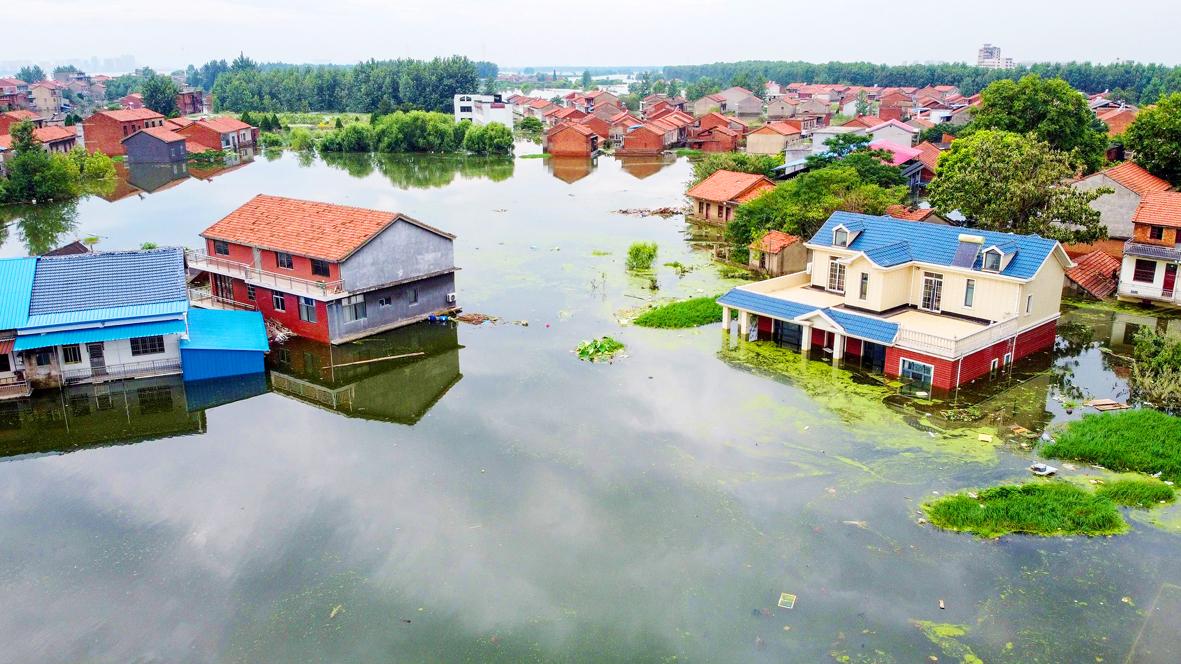
Photo: AFP
Blasting dams and embankments to discharge water was an extreme response employed during China’s worst floods in the past few years in 1998, when more than 2,000 people died and almost 3 million homes were destroyed.
Last week, the Three Gorges Dam on the Yangtze opened three floodgates as the water level behind the massive dam rose more than 15m above flood level.
Another flood crest is expected to arrive at the dam tomorrow.
Elsewhere, soldiers and workers have been testing the strength of embankments and shoring them up with sandbags and rocks.
On Saturday, firefighters and others finished filling in a 188m break on Poyang Lake, China’s largest freshwater lake, that had caused widespread flooding across 15 villages and agricultural fields in Jiangxi Province. More than 14,000 people were evacuated.
Seasonal flooding strikes large parts of China annually, especially in its central and southern regions, but has been especially severe this summer.
More than 150 people have died or are missing in flooding and landslides brought on by the torrential rains — 23 of them since Thursday alone.
About 1.8 million people have been evacuated and direct losses attributed to flooding are estimated at more than 49 billion yuan (US$7 billion), according to the Ministry of Emergency Management.
Major cities have been spared so far, but concern has risen over Wuhan and other downstream metropolises that are home to tens of millions of people.
Separately yesterday, the Chinese government raised the flood alert level in the Huai River region in the country’s east from Level III to Level II, the second-highest on its four-tier scale, after days of torrential downpours and amid expectations of further heavy rainfall.
Ten reservoirs on the Huai River have seen water levels exceeding warning levels by as much as 6.85m, according to the Huai River Commission of China’s Ministry of Water Resources.
Additional reporting by Reuters
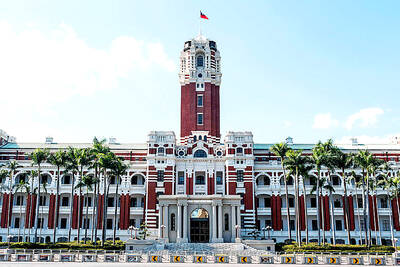
SECURITY: Taipei presses the US for arms supplies, saying the arms sales are not only a reflection of the US security commitment to Taiwan but also serve as a mutual deterrent against regional threats Taiwan is committed to preserving the cross-strait “status quo” and contributing to regional peace and stability, the Presidential Office said yesterday. “It is an undeniable fact that the Republic of China is a sovereign and independent democratic nation,” Presidential Office spokeswoman Karen Kuo (郭雅慧) reiterated, adding that Beijing has no right to claim sovereignty over Taiwan. The statements came after US President Donald Trump warned against Taiwanese independence. Trump wrapped up a state visit to Beijing on Friday, during which Chinese President Xi Jinping (習近平) had pressed him not to support Taiwan. Taiwan depends heavily on US security backing to deter China from carrying
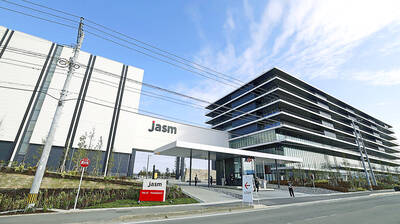
The subsidiary of Taiwan Semiconductor Manufacturing Co (TSMC, 台積電) in Kumamoto, Japan, turned a profit in the first quarter of this year, marking the first time the first fab of the unit has become profitable since mass production started at the end of 2024. According to the contract chipmaker’s financial statement released on Friday, Japan Advanced Semiconductor Manufacturing Inc (JASM), a joint venture running the fab in Kumamoto, posted NT$951 million (US$30.19 million) in profit in the January-to-March period, compared with a loss of NT$1.39 billion in the previous quarter, and a loss of NT$3.25 billion in the first quarter of

RESOLUTE BACKING: Two Republican senators are planning to introduce legislation that would impose immediate sanctions on China if it attempts to invade Taiwan US House of Representatives Speaker Mike Johnson on Sunday reaffirmed US congressional support for Taiwan, saying the US and “all freedom-loving people” have a stake in preventing China from seizing Taiwan by force. Johnson made the remarks in an interview with Fox News Sunday on US President Donald Trump’s summit with Chinese President Xi Jinping (習近平) last week. In an interview that aired on Friday on Fox News, just as Trump wrapped up a high-stakes visit to China, he said he has yet to green-light a new US$14 billion arms package to Taiwan and that it “depends on China.” “It’s a very good
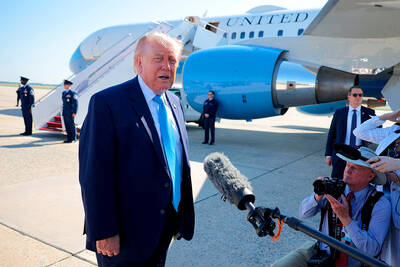
US President Donald Trump yesterday said he would speak to President William Lai (賴清德) as his administration considers whether to move ahead with a US$14 billion weapons sale to Taiwan — a potential arms deal that has drawn criticism from China. “Well, I’ll speak to him. I speak to everybody,” Trump told reporters yesterday when asked if he had any plans to call his counterpart, although he did not offer a time frame for when such a conversation could take place. Trump previously said he would speak to the person “that’s running Taiwan,” without specifying who he meant. “We have that situation very


 RSS
RSS