


Kaohsiung Mayor Han Kuo-yu (韓國瑜) on his last day in office yesterday emphasized that he would not accept any position or participate in any organization after leaving office.
Speaking at a farewell concert organized by the city government, Han bowed to his aides and supporters, and thanked them for their full support during his time in office.
According to the Civil Servants Election and Recall Act (公職人員選舉罷免法), Han and the members of the municipal government team must vacate their positions within seven days of the recall election, which took place on Saturday last week.
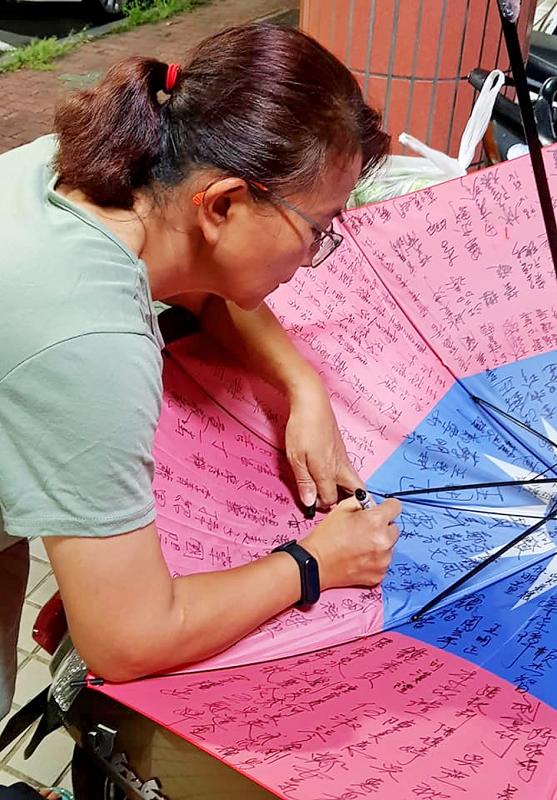
Photo: Ko Yu-hao, Taipei Times
More than 97 percent of the ballots were cast in favor of recalling Han.
Over the past 18 months, Han said that his team members outperformed past city administrations, but polls always showed that he was trailing — so he blamed no one but himself.
These people have been the most hardworking public servants, even though they received the least public support, he added.
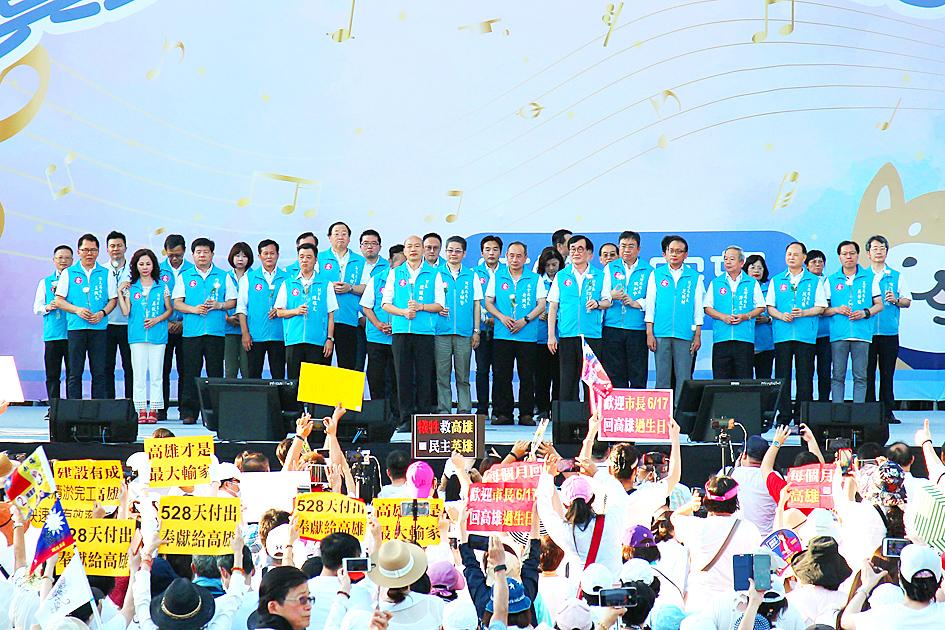
Photo: Lee Hui-chou, Taipei Times
Police estimated that more than 18,000 people attended the farewell concert on a grassy area next to the Fengshan Administration Center, and many cheered for Han through tears as he told them goodbye.
Han also led his team and supporters in expressing condolences for the death of Kaohsiung City Council Speaker Hsu Kun-yuan (許崑源), a Chinese Nationalist Party (KMT) member.
Hsu was found dead after falling from his 17th-floor apartment several hours after Han’s recall election.
Hsu’s death struck him with overwhelming sadness, Han said, but what made his heart break even more were untrue remarks online about Hsu’s death.
He was apparently referring to what Democratic Progressive Party Taipei City Councilor Liang Wen-chieh (梁文傑) wrote on Facebook, which linked Hsu’s death to underground betting.
Liang quickly deleted the post afterward and apologized more than once for making “baseless accusations.”
In other news, Han’s supporters are quarreling among themselves over tomorrow’s planned rally in Taipei, after allegations that groups supporting unification with China organized the event as “united front” work for Beijing.
A well-known figure among Han’s supporters, Kaohsiung vendor Wu Yu-chuan (吳育全), yesterday said that he would not attend the rally, and urged his friends not to go.
Many in Han’s camp had backed holding a rally, but over the past few days, the organizers’ motives and political agenda have been called into question.
“The rally’s organizers have a different political agenda,” Wu said, after media reports alleged that tomorrow’s event has been backed by pro-unification groups, possibly with financial support from China.
The rally was not organized by Han’s supporters, Wu said, adding that Han has distanced himself from it, so it would be an issue for him to participate.
The media quoted the online political forum TaiwanHandout as saying that the main rally organizers are three self-described heads of small political groups: Huang Cheng-chung (黃正忠) of the Median Voters Party, Chou Ke-chi (周克琦) of the Third Force 333 Party and Chang Tsai-ming (張采明) of the Economy Party.
Observers have said that the three organizations, which are registered as political parties to nominate their own candidates in elections, have as their charters unifying with China and pushing back against the Taiwan independence movement.
Huang, a retired army officer and long-time KMT member, was a hardcore supporter of Han’s mayoral and presidential campaigns over the past two years.
“I ask Han Kuo-yu to come out with courage — Han must not abandon his supporters,” Huang said yesterday, adding that in quitting and running away, Han and Wu have “no guts.”
Right-wing political scientist Laura Fernandez on Sunday won Costa Rica’s presidential election by a landslide, after promising to crack down on rising violence linked to the cocaine trade. Fernandez’s nearest rival, economist Alvaro Ramos, conceded defeat as results showed the ruling party far exceeding the threshold of 40 percent needed to avoid a runoff. With 94 percent of polling stations counted, the political heir of outgoing Costa Rican President Rodrigo Chaves had captured 48.3 percent of the vote compared with Ramos’ 33.4 percent, the Supreme Electoral Tribunal said. As soon as the first results were announced, members of Fernandez’s Sovereign People’s Party
MORE RESPONSIBILITY: Draftees would be expected to fight alongside professional soldiers, likely requiring the transformation of some training brigades into combat units The armed forces are to start incorporating new conscripts into combined arms brigades this year to enhance combat readiness, the Executive Yuan’s latest policy report said. The new policy would affect Taiwanese men entering the military for their compulsory service, which was extended to one year under reforms by then-president Tsai Ing-wen (蔡英文) in 2022. The conscripts would be trained to operate machine guns, uncrewed aerial vehicles, anti-tank guided missile launchers and Stinger air defense systems, the report said, adding that the basic training would be lengthened to eight weeks. After basic training, conscripts would be sorted into infantry battalions that would take
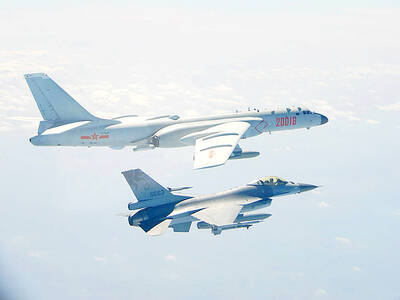
GROWING AMBITIONS: The scale and tempo of the operations show that the Strait has become the core theater for China to expand its security interests, the report said Chinese military aircraft incursions around Taiwan have surged nearly 15-fold over the past five years, according to a report released yesterday by the Democratic Progressive Party’s (DPP) Department of China Affairs. Sorties in the Taiwan Strait were previously irregular, totaling 380 in 2020, but have since evolved into routine operations, the report showed. “This demonstrates that the Taiwan Strait has become both the starting point and testing ground for Beijing’s expansionist ambitions,” it said. Driven by military expansionism, China is systematically pursuing actions aimed at altering the regional “status quo,” the department said, adding that Taiwan represents the most critical link in China’s
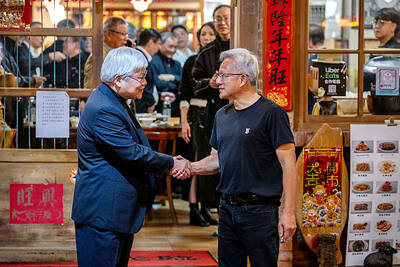
‘REALLY PROUD’: Nvidia would not be possible without Taiwan, Huang said, adding that TSMC would be increasing its capacity by 100 percent Nvidia Corp CEO Jensen Huang (黃仁勳) on Saturday praised and lightly cajoled his major Taiwanese suppliers to produce more to help power strong demand for artificial intelligence (AI), capping a visit to the country of his birth, where he has been mobbed by adoring fans at every step. Speaking at an impromptu press conference in the rain outside a Taipei restaurant, where he had hosted suppliers for a “trillion-dollar dinner,” named after the market capitalization of those firms attending, Huang said this would be another good year for business. “TSMC needs to work very hard this year because I need a lot


 RSS
RSS