


In a bid to persuade more people to pursue a career in farming, lawmakers yesterday passed the Farmers’ Pension Act (農民退休儲金條例), which requires farmers and the government to deposit equal amounts of money in a dedicated account as a pension fund for farmers.
The act stipulates that to qualify for the pension scheme, an insured person must be engaged in agricultural work, have joined the Farmers’ Health Insurance program and not be receiving any other pension.
A motion sponsored by Democratic Progressive Party Legislator Chen Ting-fei (陳亭妃) to allow farmers to allocate between 1 percent and 10 percent of the minimum wage — currently NT$23,800 — to the account each month and have the Council of Agriculture match the sum passed after garnering a majority.
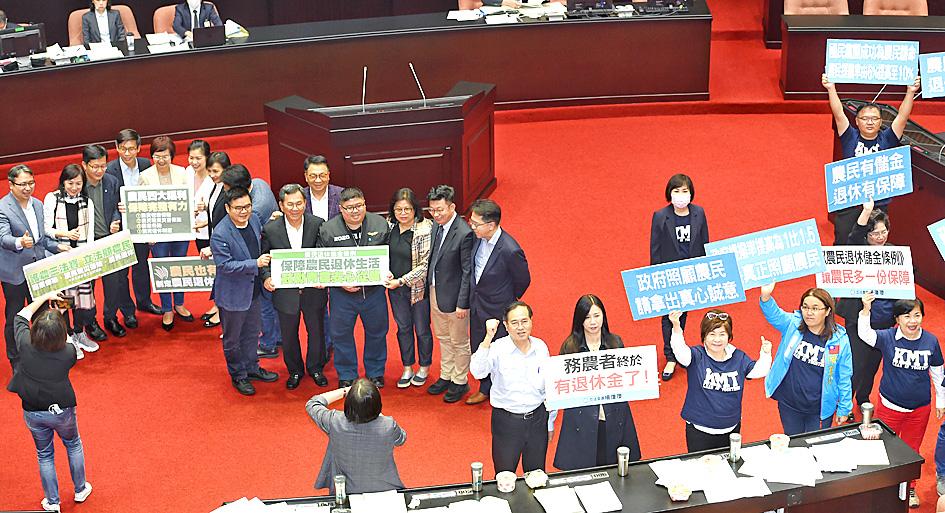
Photo: Fang Pin-chao, Taipei Times
To guarantee the fund’s profitability, the savings would be eligible for an interest rate of no less than that offered for fixed bank deposits of up to two years, the act states.
In cross-caucus talks, the council proposed that farmers younger than 50 be allowed to deposit 6 percent of the minimum wage, while those aged 50 and older would be allowed to allocate up to 10 percent, with both sums matched by the council.
The proposal was eventually scrapped at yesterday’s plenary session.
The Chinese Nationalist Party (KMT) proposed that farmers be allowed to deposit up to 10 percent of the minimum wage each month and that the council should deposit 1.15 times the amount saved by farmers in the account, but that proposal was struck down in a vote.
Farmers covered by the scheme would start receiving monthly pension payments when they turn 65, the act states.
Those receiving subsidies under the Farmers’ Health Insurance program because they are mentally or physically disabled can start receiving monthly pension payments before they turn 65, it states.
The act complements the Farmer Health Insurance Act (農民健康保險法) and the Farmers’ Insurance Act (農業保險法) as the last mile to completing a welfare system for farmers, Chen said.
Pension payments would be issued on top of a subsidy for older farmers, giving them an extra layer of protection after retirement, she said.
Passage of the Farmers’ Pension Act fulfills President Tsai Ing-wen’s (蔡英文) election campaign promise to better protect farmers, she added.
Trial balances provided by the council based on a 6 percent allocation rate and profitability of 3 percent showed that a farmer would receive NT$26,000 per month, including the existing subsidy, if they contribute to the program from age 30 to 65.
Insured people could receive even more in the final version of the act, as it has a higher 10 percent allocation ceiling.
The council plans to ask 60,000 farmers to join the fund in its first year and gradually raise that number to 450,000 to match the number of people covered by the Farmers’ Health Insurance program.

Japan has deployed long-range missiles in a southwestern region near China, the Japanese defense minister said yesterday, at a time when ties with Beijing are at their lowest in recent years. The missiles were installed in Kumamoto in the southern region of Kyushu, as Japan is attempting to shore up its military capacity as China steps up naval activity in the East China Sea. “Standoff defense capabilities enable us to counter the threat of enemy forces attempting to invade our country ... while ensuring the safety of our personnel,” Japanese Minister of Defense Shinjiro Koizumi said. “This is an extremely important initiative for
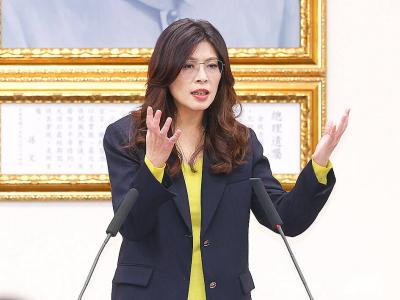
Chinese Nationalist Party (KMT) Chairwoman Cheng Li-wun (鄭麗文) today accepted an invitation from Chinese President Xi Jinping (習近平) to lead a delegation to China next month, saying she hopes to promote the peaceful development of cross-strait relations and bring stability to the Taiwan Strait. “I am grateful and happy to accept this invitation,” Cheng said in a statement from the KMT chairperson’s office. Cheng said she hopes both sides can work together to promote the peaceful development of cross-strait relations, enhance exchange and cooperation, bring stability to the Taiwan Strait and improve people’s livelihoods. At today's news conference, Cheng said any efforts to

MORE POPULAR: Taiwan Pass sales increased by 59 percent during the first quarter compared with the same period last year, the Tourism Administration said The Tourism Administration yesterday said that it has streamlined the Taiwan Pass, with two versions available for purchase beginning today. The tourism agency has made the pass available to international tourists since 2024, allowing them to access the high-speed rail, Taiwan Railway Corp services, four MRT systems and four Taiwan Tourist Shuttles. Previously, five types of Taiwan Pass were available, but some tourists have said that the offerings were too complicated. The agency said only two types of Taiwan Pass would be available, starting from a three-day pass with the high-speed rail and a three-day pass with Taiwan Railway Corp. The former costs NT$2,800

The nation’s fastest supercomputer, Nano 4 (晶創26), is scheduled to be launched in the third quarter, and would be used to train large language models in finance and national defense sectors, the National Center for High-Performance Computing (NCHC) said. The supercomputer, which would operate at about 86.05 petaflops, is being tested at a new cloud computing center in the Southern Taiwan Science Park in Tainan. The exterior of the server cabinet features chip circuitry patterns overlaid with a map of Taiwan, highlighting the nation’s central position in the semiconductor industry. The center also houses Taiwania 2, Taiwania 3, Forerunner 1 and


 RSS
RSS