


The Criminal Investigation Bureau (CIB) yesterday said that it has launched an investigation into a suspected cyberattack on the Presidential Office, after some members of the media on Friday received what the office said were altered documents pertaining to two meetings last month between President Tsai Ing-wen (蔡英文) and Premier Su Tseng-chang (蘇貞昌).
On Friday night, an e-mail account named “ser lo” sent members of the media on the Presidential Office’s contact list two e-mails containing several files.
The files were purportedly documents prepared by aides for two meetings between Tsai and Su on selecting members of Tsai’s second-term Cabinet.
Photo: Betsy Joles, Bloomberg
Also attached was a purported assessment report on vice president-elect William Lai (賴清德) from early last year, when he competed against Tsai in the Democratic Progressive Party’s presidential primary.
The Presidential Office later on Friday said that the documents were doctored, calling them “fake news.”
The same account yesterday sent another two e-mails to the same members of the media containing files that purportedly detailed how Tsai was divvying up the spoils of office in planning her new Cabinet, as well as a supposed assessment report on how to defeat Lai during the primary.
The bureau yesterday confirmed that the Presidential Office had reported the incident, saying that it had begun an investigation into the incident.
Commenting on the incident, Taiwan People’s Party Legislator Ann Kao (高虹安) said that the Presidential Office should check its record of logins to its e-mail servers from off-site Internet protocol addresses.
The Presidential Office should launch an internal investigation primarily focused on those who have access to its e-mail server to determine if anyone has lost their login information, has been hacked or is leaking information, said Kao, who holds a doctorate in computer science and information engineering from the University of Cincinnati and was vice president of Hon Hai Technology Group’s (鴻海科技集團) Industrial Big Data Office from 2018 to this year.
Hackers might have breached the entire Presidential Office mail server, or someone on the inside either leaked the e-mail contacts or provided user account information to hackers, she said.
Additional reporting by CNA

PROVOCATIVE: Chinese Deputy Ambassador to the UN Sun Lei accused Japan of sending military vessels to deliberately provoke tensions in the Taiwan Strait China denounced remarks by Japan and the EU about the South China Sea at a UN Security Council meeting on Monday, and accused Tokyo of provocative behavior in the Taiwan Strait and planning military expansion. Ayano Kunimitsu, a Japanese vice foreign minister, told the Council meeting on maritime security that Tokyo was seriously concerned about the situation in the East China and South China seas, and reiterated Japan’s opposition to any attempt to change the “status quo” by force, and obstruction of freedom of navigation and overflight. Stavros Lambrinidis, head of the EU delegation to the UN, also highlighted South China Sea
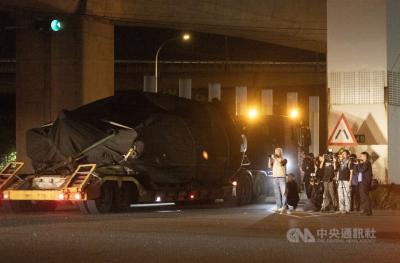
The final batch of 28 M1A2T Abrams tanks purchased from the US arrived at Taipei Port last night and were transported to the Armor Training Command in Hsinchu County’s Hukou Township (湖口), completing the military’s multi-year procurement of 108 of the tanks. Starting at 12:10am today, reporters observed more than a dozen civilian flatbed trailers departing from Taipei Port, each carrying an M1A2T tank covered with black waterproof tarps. Escorted by military vehicles, the convoy traveled via the West Coast Expressway to the Armor Training Command, with police implementing traffic control. The army operates about 1,000 tanks, including CM-11 Brave Tiger
Taiwan Semiconductor Manufacturing Co (TSMC, 台積電), the world’s largest contract chipmaker, said it expects its 2-nanometer (2nm) chip capacity to grow at a compound annual rate of 70 percent from this year to 2028. The projection comes as five fabs begin volume production of 2-nanometer chips this year — two in Hsinchu and three in Kaohsiung — TSMC senior vice president and deputy cochief operating officer Cliff Hou (侯永清) said at the company’s annual technology symposium in Silicon Valley, California, last week. Output in the first year of 2-nanometer production, which began in the fourth quarter of last year, is expected to

Taiwan’s drone exports surged past US$100 million in the first quarter, exceeding last year’s full-year total, with the Czech Republic emerging as the largest buyer, the Ministry of Economic Affairs said. Exports of complete drones reached US$115.85 million in the period, about 1.2 times the total recorded for all of last year, the ministry said in a report. Exports to the Czech Republic accounted for about US$100 million, far outpacing other markets. Poland, last year’s top destination, recorded about US$11.75 million in the first quarter. Taiwan’s drone exports have expanded rapidly in the past few years, with last year’s total


 RSS
RSS