


The Central Epidemic Command Center (CECC) yesterday confirmed two new cases of COVID-19: a student who returned from the US and another crew member of the navy supply ship Panshih (磐石), bringing the nation’s total number of cases to 438.
Minister of Health and Welfare Chen Shih-chung (陳時中), who heads the center, said the imported case (No. 437) is a woman in her 30s who had studied in the US since Jan. 30 and returned to Taiwan on April 9, without symptoms.
She was first placed under 14-day home quarantine and then under home isolation on April 11 after it was learned that she was on the same flight from New York as Case No. 383, who sat one row behind her, Chen said.
Photo: George Tsorng, Taipei Times
The woman had developed a runny nose on April 15, but did not report it at the time because she thought it was only an allergy, he said.
She contacted the local health department on Monday last week about having a runny and stuffy nose, three days after her quarantine order had ended, he said.
Her first COVID-19 test came back as a “weak positive,” so the woman was hospitalized in a negative-pressure isolation ward and tested again on Thursday and Friday, Chen said.
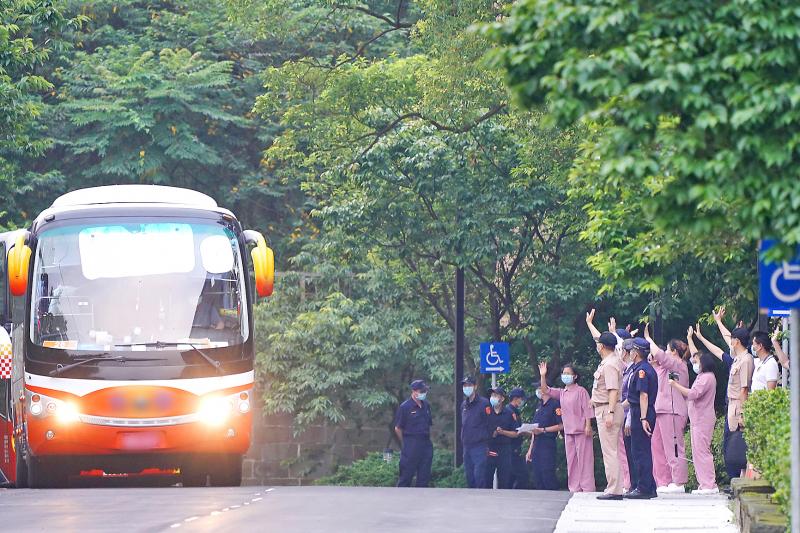
Photo: CNA
A fourth test taken on Saturday came back positive yesterday, he said.
He added that she has not developed any COVID-19 symptoms, but is being isolated in the hospital.
Centers for Disease Control (CDC) Deputy Director-General Chuang Jen-hsiang (莊人祥) said that the woman first thought her runny nose was caused by chopping onions.
She has a background in medical education and wore a mask when she went out between April 25 and Monday last week, he said.
Chen also announced that the 14-day home isolation or quarantine period for people who had close contact with infected crew from the Panshih has ended, but they are required to perform self-health management for another seven days and report any suspected symptoms.
The Panshih, the frigate Kang Ding (康定) and guided-missile frigate Yueh Fei (岳飛) were part of a “Friendship Flotilla” that visited Palau from March 12 to 15, returned to Kaohsiung on April 9 and disembarked on April 15.
All 744 navy personnel aboard the three ships were recalled and put under 14-day centralized quarantine on April 18, after the first crew member was confirmed to have the virus.
Thirty-one people aboard the Panshih tested positive between April 18 and 25, and another four tested positive in a second testing on Sunday.
Sailors, officers and cadets from the Kang Ding and Yueh Fei crew were yesterday released from quarantine, while 345 from the Panshih had to undergo another round of tests.
The test results came back yesterday evening, with another crew member testing positive, Chuang said, adding that they have been taken to hospital and isolated.
Three crew members, who had earlier tested positive, were among those tested yesterday.
They have recovered and been discharged from hospital, Chuang said.
The 344 Panshih crew members who tested negative left the quarantine facilities last night, but would continue to perform self-health management at home for seven days, he said.
Chen said the cluster of cases on the Panshih was mainly caused by the ship’s narrow spaces and the crew’s frequent exposure to each other during the voyage.
The infection rate on the ship of about 9.5 percent — 36 cases among 377 people — is relatively low compared with aircraft carriers and cruise ships from other nations, possibly because the crew had been ordered to wear masks and those who had a fever during the voyage were isolated, the health minister told reporters.

‘NO SECURITY RISK’: The Railway Bureau reassured the public that the technicians’ activities were limited to technical guidance and did not involve sensitive systems The Railway Bureau yesterday said it had invited eight Chinese technicians to assist with an airport MRT construction project. The bureau issued the confirmation after an Internet user said Chinese nationals had entered the construction zone of Taiwan Taoyuan International Airport’s Terminal 3 project. They asked why “individuals from an enemy state” were allowed access to such a major national infrastructure project, which raised serious concerns over Taiwan’s industrial safety, sensitive systems and information security. The bureau’s Northern Region Engineering Branch Office said subcontractor Taiwan Handle Industrial Co (台灣手把工業) of the Taoyuan airport MRT’s “Contract No. CU05 Project A14 Station Civil, MEP &

A US uncrewed surface vessel (USV) encountered multiple Chinese warships during an autonomous transit of the Taiwan Strait, US defense company Seasats said in a statement on Wednesday. Seasats announced that a Lightfish USV had completed the first autonomous transit of the Taiwan Strait. Over five days, the USV traversed the entire length of the Strait while constantly monitoring surface vessel traffic, the company said. The Lightfish encountered multiple Chinese warships, one of which was a Chinese People’s Liberation Army Navy (PLAN) Type 056 corvette, it said. The Chinese vessels were operating “well within Taiwan’s exclusive economic zone without transmitting their identity via the
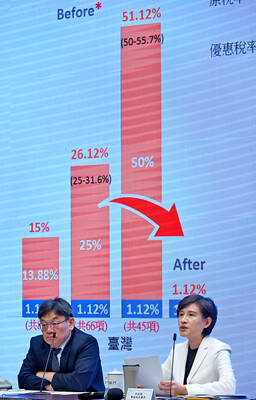
GREATER REACH? Auto parts and wood products would face tariffs of up to 15%, matching those targeting the EU, Japan and South Korea, Vice Premier said The US has announced that preferential tariff treatment for Taiwan’s non-semiconductor Section 232 goods would take effect retroactively from May 1, the Executive Yuan said yesterday. The US government yesterday posted a notice on the Federal Register’s public inspection Web site previewing tariff concessions for Taiwan under a memorandum of understanding (MOU) on Taiwan-US investment after two months of negotiations. The MOU signed on Jan. 15 stipulated three major preferential tariff arrangements: a 15 percent “reciprocal” tariff rate for Taiwan without stacking most-favored nation (MFN) rates; preferential Section 232 treatment for semiconductors and related products; and preferential Section 232 treatment for non-semiconductor
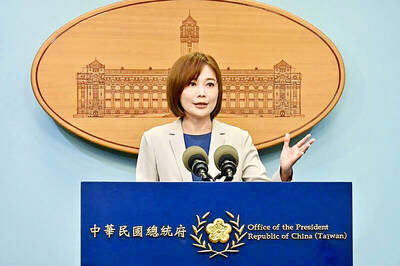
TIT-FOR-TAT: The US allegedly revoked the visa of a Chinese national working at Xinhua News Agency in the US in response to Beijing’s expulsion of Vivian Wang The Presidential Office yesterday condemned China for expelling a New York Times correspondent from Beijing following the newspaper’s interview with President William Lai (賴清德), saying the move highlighted Beijing’s suppression of press freedom and its threat to international news media. Taiwan has noted a series of recent incidents in which Beijing used similar tactics to “threaten and pressure international media outlets and journalists,” Presidential Office spokeswoman Karen Kuo (郭雅慧) said in a statement. “This concerns not only press freedom and freedom of expression, but also the safety of journalists, and Taiwan and relevant partners are paying close attention to the situation,” she


 RSS
RSS