


The government has donated 500,000 masks to Canada, while at least 120,000 Taiwanese have joined a humanitarian aid initiative by donating their share of masks to other countries through a mobile application to help them contain the COVID-19 pandemic.
Vice Minister of Foreign Affairs Miguel Tsao (曹立傑) handed over the donations to Canadian Trade Office in Taipei Executive Director Jordan Reeves at a ceremony in Taipei on Wednesday last week, the Ministry of Foreign Affairs said in a news release yesterday.
The masks are to be to distributed to front-line healthcare workers and First Nations peoples, with 400,000 going to the Canadian government, 50,000 to Ontario, and 25,000 each to Alberta and British Columbia, it said.
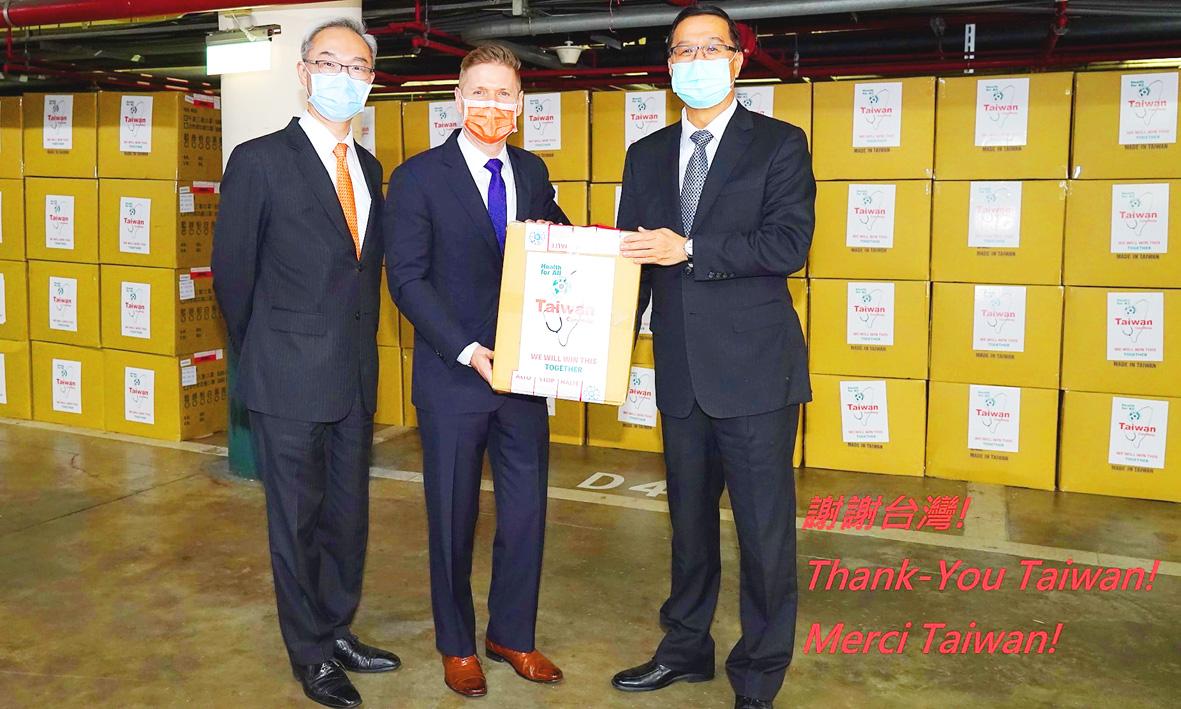
Photo taken from the Canadian Trade Office in Taipei's Facebook page
The Canadian government last week said that about 1 million KN95 respirators — which it considered a viable alternative to N95 masks — purchased from China failed to meet the required filtering standards and would not be distributed to healthcare workers, the Globe and Mail reported on Thursday last week.
Excluding the gift to Canada, Taiwan this month has donated more than 18 million masks to 15 diplomatic allies, the US, 19 European nations, countries targeted by the government’s New Southbound Policy, Latin America and Caribbean countries, and Japan.
In addition, at least 120,000 Taiwanese have agreed to donate their unused share of masks — nine adult masks or 10 children’s masks per 14 days — to other countries through a mobile app, Minister of Health and Welfare Chen Shih-chung (陳時中) said yesterday.
The app, developed by the National Health Insurance Administration, allows members of the public to make the donation by clicking “respond to humanitarian aid” on the app, which Chen, who heads the Central Epidemic Command Center, unveiled on Monday.
Taiwan now produces nearly 17 million masks per day, up from a daily output of 1.8 million in January, 3.2 million in February, 10 million in the middle of last month and 15 million at the beginning of this month, Ministry of Economic Affairs data showed.
Daily production is expected to reach 19 million in about two weeks after the government conscripts 22 more mask production lines from the private sector, Minister of Economic Affairs Shen Jong-chin (沈榮津) said yesterday.
President Tsai Ing-wen (蔡英文) has said that daily mask production could reach 20 million.
While the price of melt-blown nonwoven fabric — the key material used in making medical masks — in other countries has jumped to 10 times higher than that before the pandemic, the economics ministry said it has more than 19 tonnes of such fabric every day to support the daily production of nearly 20 million masks.
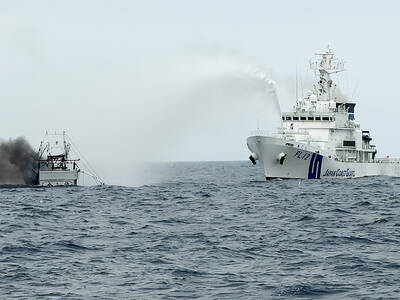
CREDIT-GRABBER: China said its coast guard rescued the crew of a fishing vessel that caught fire, who were actually rescued by a nearby Taiwanese boat and the CGA Maritime search and rescue operations do not have borders, and China should not use a shipwreck to infringe upon Taiwanese sovereignty, the Coast Guard Administration (CGA) said yesterday. The coast guard made the statement in response to the China Coast Guard (CCG) saying it saved a Taiwanese fishing boat. The Chuan Yu No. 6 (全漁6號), a fishing vessel registered in Keelung, on Thursday caught fire and sank in waters northeast of Diaoyutai Islands (釣魚台). The vessel left Keelung’s Badouzih Fishing Harbor (八斗子漁港) at 3:35pm on Sunday last week, with seven people on board — a 62-year-old Taiwanese captain surnamed Chang (張) and six
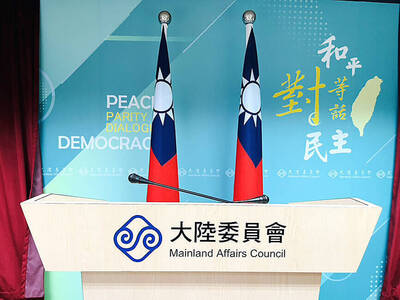
RISKY BUSINESS: The ‘incentives’ include initiatives that get suspended for no reason, creating uncertainty and resulting in considerable losses for Taiwanese, the MAC said China’s “incentives” failed to sway sentiment in Taiwan, as willingness to work in China hit a record low of 1.6 percent, a Ministry of Labor survey showed. The Directorate-General of Budget, Accounting and Statistics (DGBAS) also reported that the number of Taiwanese workers in China has nearly halved from a peak of 430,000 in 2012 to an estimated 231,000 in 2024. That marked a new low in the proportion of Taiwanese going abroad to work. The ministry’s annual survey on “Labor Life and Employment Status” includes questions respondents’ willingness to seek employment overseas. Willingness to work in China has steadily declined from

LEVERAGE: China did not ‘need to fire a shot’ to deny Taiwan airspace over Africa when it owns ‘half the continent’s debt,’ a US official said, calling it economic warfare The EU has raised concerns about overflight rights following the delay of President William Lai’s (賴清德) planned state visit to the Kingdom of Eswatini after three African nations denied overflight clearance for his charter at the last minute. Taiwanese allies Paraguay and Saint Kitts and Nevis, as well as several US lawmakers and the Inter-Parliamentary Alliance on China (IPAC) condemned China for allegedly pressuring the countries. Lai was scheduled to fly directly to Taiwan’s only African ally from yesterday to Sunday to celebrate the 40th anniversary of King Mswati III’s accession and his 58th birthday, but Seychelles, Mauritius and Madagascar suddenly revoked
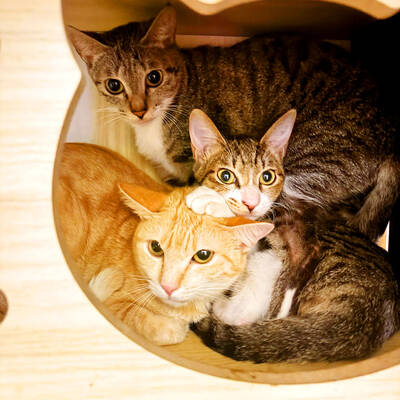
The number of pet cats in Taiwan surpassed that of pet dogs for the first time last year, reaching 1,742,033, a 32.8 percent increase from 2023, the Ministry of Agriculture said yesterday, citing a survey. By contrast, the number of pet dogs declined slightly by 1.2 percent over the same period to 1,462,528, the ministry said. Despite the shift, households with dogs still slightly outnumber those with cats by 1.2 percent. However, while the number of households with multiple dogs has remained relatively stable, households keeping more than two cats have increased, contributing to the overall rise in the feline population. The trend


 RSS
RSS