


The Central Epidemic Command Center (CECC) yesterday announced three new cases of COVID-19, all of them imported, bringing the nation’s total number of confirmed cases to 385.
Minister of Health and Welfare Chen Shih-chung (陳時中), who heads the center, said that two of the cases were tested at the airport upon their arrival in Taiwan and the other was under mandatory home quarantine.
Case No. 383 is a man in his 60s who works in the US and had sought treatment for an upset stomach, loss of appetite and a fever in the US, Chen said.
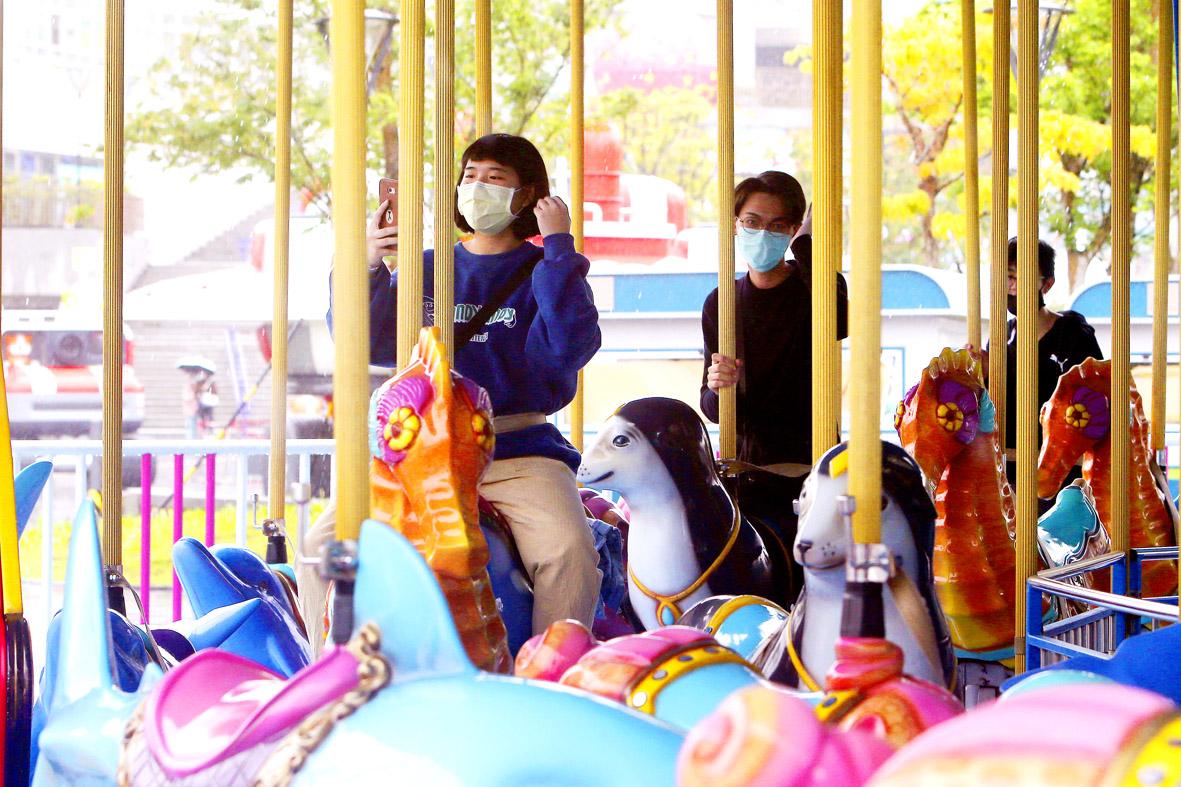
Photo: AP / Chiang Ying-ying
Case No. 384 is a man in his 70s who lives in the US and started coughing up phlegm on Friday last week, he said.
Both men returned to Taiwan on Friday, reported their health conditions to airport quarantine officers, were reported for testing and their test results came out positive yesterday, Chen said.
Case No. 385 is a woman in her 20s who studied in France, returned to Taiwan on Friday last week and was put under home quarantine, he said.
The next day, she developed a runny and stuffy nose and a fever, and was arranged for testing and treatment by the local health department, Chen said.
A total of 385 cases — 331 imported and 54 domestic — have been confirmed in Taiwan, Chen said, adding that they include six deaths and 99 people discharged from hospital after treatment, with the rest still hospitalized.
Asked about an article published in the New England Journal of Medicine suggesting that more than two-thirds of severely ill COVID-19 patients saw their conditions improve after being treated with the experimental antiviral drug remdesivir, CECC advisory specialist panel convener Chang Shan-chwen (張上淳) said that it seems to be the most promising drug for treating COVID-19 so far.
He said the article analyzed the effects of remdesivir compassionate use for people with severe COVID-19 in Europe, Japan and the US, which suggested that the mortality was 13 percent after completing remdesivir treatment and 18 percent among patients receiving invasive ventilation.
The effects of remdesivir seem positive compared with another study, which suggested that the mortality rate of patients with severe COVID-19 in the UK is nearly 50 percent, Chang said.
The drug has also been used on nine patients in Taiwan, and so far the effects have been good, including a patient who was taken off a ventilator after being treated with remdesivir, he said.
Chen also said that many people are concerned about whether COVID-19 patients who have experienced abnormalities in their senses of taste or smell can recover from the symptom.
An analysis of 37 patients in northern Taiwan who have been discharged from hospitals showed that 11 of them had experienced the symptom, Chen said.
Most of them experienced a loss of or abnormalities in their senses of taste and smell, while only a few experienced one abnormal sense.
Most of them recovered after seven to 10 days, he said.
However, two people have not fully recovered two to three weeks after they were discharged, he said.

CREDIT-GRABBER: China said its coast guard rescued the crew of a fishing vessel that caught fire, who were actually rescued by a nearby Taiwanese boat and the CGA Maritime search and rescue operations do not have borders, and China should not use a shipwreck to infringe upon Taiwanese sovereignty, the Coast Guard Administration (CGA) said yesterday. The coast guard made the statement in response to the China Coast Guard (CCG) saying it saved a Taiwanese fishing boat. The Chuan Yu No. 6 (全漁6號), a fishing vessel registered in Keelung, on Thursday caught fire and sank in waters northeast of Diaoyutai Islands (釣魚台). The vessel left Keelung’s Badouzih Fishing Harbor (八斗子漁港) at 3:35pm on Sunday last week, with seven people on board — a 62-year-old Taiwanese captain surnamed Chang (張) and six

RISKY BUSINESS: The ‘incentives’ include initiatives that get suspended for no reason, creating uncertainty and resulting in considerable losses for Taiwanese, the MAC said China’s “incentives” failed to sway sentiment in Taiwan, as willingness to work in China hit a record low of 1.6 percent, a Ministry of Labor survey showed. The Directorate-General of Budget, Accounting and Statistics (DGBAS) also reported that the number of Taiwanese workers in China has nearly halved from a peak of 430,000 in 2012 to an estimated 231,000 in 2024. That marked a new low in the proportion of Taiwanese going abroad to work. The ministry’s annual survey on “Labor Life and Employment Status” includes questions respondents’ willingness to seek employment overseas. Willingness to work in China has steadily declined from

LEVERAGE: China did not ‘need to fire a shot’ to deny Taiwan airspace over Africa when it owns ‘half the continent’s debt,’ a US official said, calling it economic warfare The EU has raised concerns about overflight rights following the delay of President William Lai’s (賴清德) planned state visit to the Kingdom of Eswatini after three African nations denied overflight clearance for his charter at the last minute. Taiwanese allies Paraguay and Saint Kitts and Nevis, as well as several US lawmakers and the Inter-Parliamentary Alliance on China (IPAC) condemned China for allegedly pressuring the countries. Lai was scheduled to fly directly to Taiwan’s only African ally from yesterday to Sunday to celebrate the 40th anniversary of King Mswati III’s accession and his 58th birthday, but Seychelles, Mauritius and Madagascar suddenly revoked

The number of pet cats in Taiwan surpassed that of pet dogs for the first time last year, reaching 1,742,033, a 32.8 percent increase from 2023, the Ministry of Agriculture said yesterday, citing a survey. By contrast, the number of pet dogs declined slightly by 1.2 percent over the same period to 1,462,528, the ministry said. Despite the shift, households with dogs still slightly outnumber those with cats by 1.2 percent. However, while the number of households with multiple dogs has remained relatively stable, households keeping more than two cats have increased, contributing to the overall rise in the feline population. The trend


 RSS
RSS