


Taiwan, as a responsible member of the international community, is to offer humanitarian assistance to nations hardest hit by the COVID-19 pandemic by sending them masks and medicine, as well as sharing with them an electronic system that the government has been using to track down people that need to be quarantined, President Tsai Ing-wen (蔡英文) said yesterday.
With the nation’s daily production having reached 13 million masks and soon to reach 15 million, the government is to donate 10 million masks to medical personnel in nations most severely affected by the coronavirus, Tsai said at the Presidential Office in Taipei.
The nation would donate more masks when production capacity permits, she added.
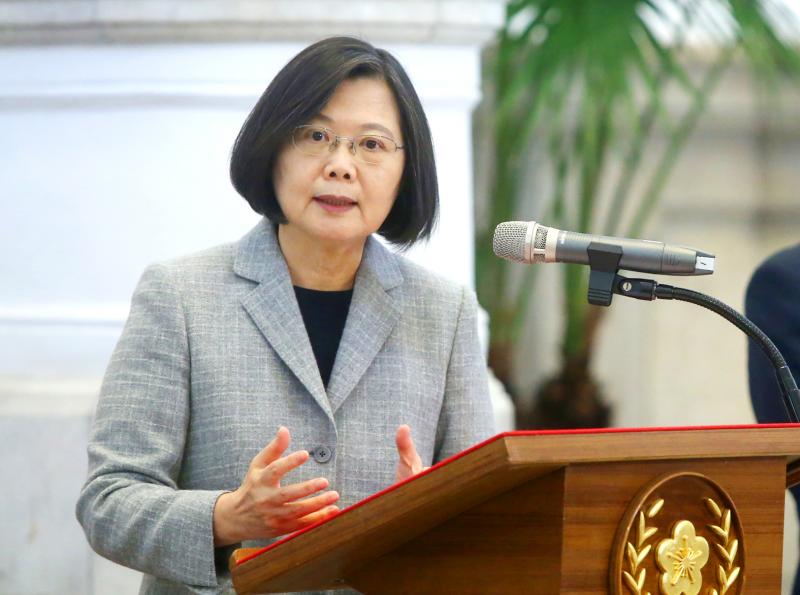
Photo: CNA
With a number of clinical reports concluding that quinine can help treat patients with mild symptoms, the government has asked pharmaceutical companies to increase production of the medication so that it can contribute to the supplies of nations in need, Tsai said.
The nation is also to provide technological support, by sharing with other nations a system that uses “big data” to accurately locate people that have come into close contact with those that have tested positive for COVID-19, effectively curbing the spread of the coronavirus, she said.
When the outbreak first occurred, Taiwan had formed a “national team” to combat COVID-19, which is now ready to join the international community in an all-out effort to fight the pandemic, she added.
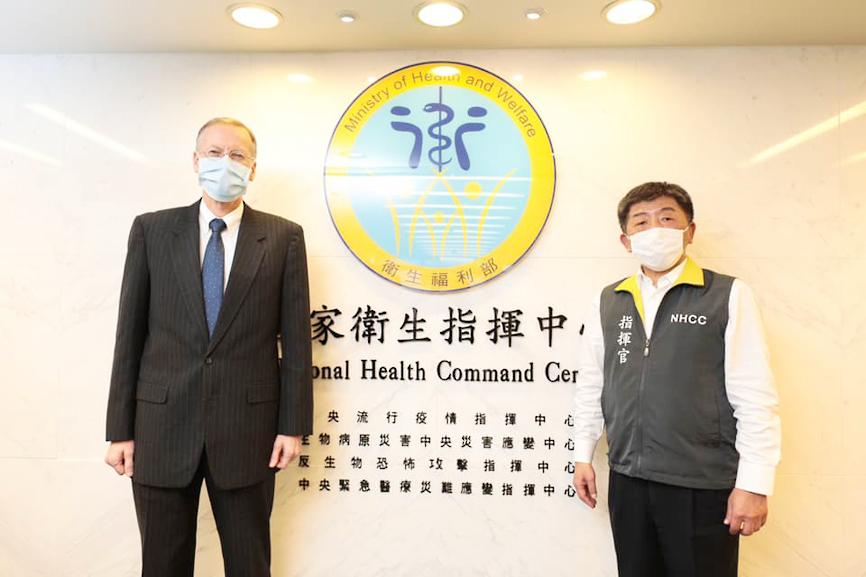
Photo courtesy of American Institute in Taiwan
Taiwan will step up its cooperation with other nations and not sit idly by while the global fight against the coronavirus continues, Tsai said, adding that the nation is already helping its diplomatic allies, enabling their citizens to acquire medical supplies locally.
“Taiwan can help, and Taiwan is helping,” Tsai said.
The Ministry of Foreign Affairs in a statement said that the nation is to make a one-time donation of 2 million masks to the US on top of a weekly donation of 100,000 previously announced.
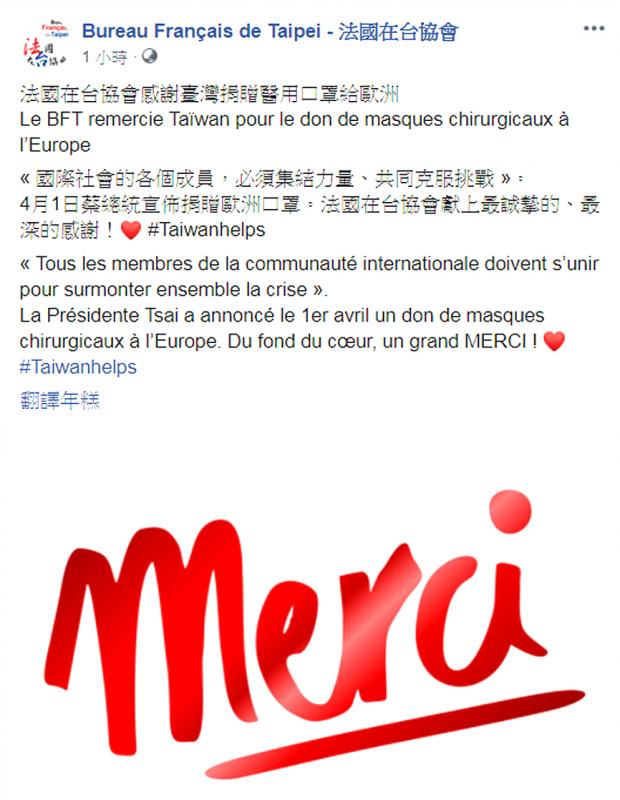
Photo: screen grab from Facebook
The nation is to donate 7 million masks to the most-affected nations in the EU, as well as to the UK and Switzerland, it said.
It is also to donate 1 million masks to its diplomatic allies, it added.
Academia Sinica and the nation’s leading vaccine companies have entered into talks with the US, the EU, Canada and the Czech Republic on collaborating to develop testing kits and vaccines, the ministry said.
The ministry has collaborated with private firms to donate ventilators, ventilator filters, masks and disinfectant to hospitals in the Czech Republic, it said, while Catholic groups have donated goggles, masks, endotracheal tubes and mucus extractors to Italy.
The British Office Taipei, the Netherlands Trade and Investment Office, the French Office in Taipei and the Polish Office in Taipei thanked the nation for its help on social media.
“#Taiwanhelps is the new hashtag,” European Economic and Trade Office in Taiwan Director Filip Grzegorzewski yesterday wrote on Twitter, also thanking Taiwan.
The American Institute in Taiwan (AIT) shared photographs of AIT Director Brent Christensen meeting Minister of Health and Welfare Chen Shih-chung (陳時中) with the comment: “Taiwan is a real friend.”
In related news, the Taipei Economic and Cultural Office in Prague and the Czech Economic and Cultural Office in Taipei issued a joint statement listing eight areas of bilateral cooperation on COVID-19.
Additional reporting by Lin Chia-nan

PROVOCATIVE: Chinese Deputy Ambassador to the UN Sun Lei accused Japan of sending military vessels to deliberately provoke tensions in the Taiwan Strait China denounced remarks by Japan and the EU about the South China Sea at a UN Security Council meeting on Monday, and accused Tokyo of provocative behavior in the Taiwan Strait and planning military expansion. Ayano Kunimitsu, a Japanese vice foreign minister, told the Council meeting on maritime security that Tokyo was seriously concerned about the situation in the East China and South China seas, and reiterated Japan’s opposition to any attempt to change the “status quo” by force, and obstruction of freedom of navigation and overflight. Stavros Lambrinidis, head of the EU delegation to the UN, also highlighted South China Sea
The final batch of 28 M1A2T Abrams tanks purchased from the US arrived at Taipei Port last night and were transported to the Armor Training Command in Hsinchu County’s Hukou Township (湖口), completing the military’s multi-year procurement of 108 of the tanks. Starting at 12:10am today, reporters observed more than a dozen civilian flatbed trailers departing from Taipei Port, each carrying an M1A2T tank covered with black waterproof tarps. Escorted by military vehicles, the convoy traveled via the West Coast Expressway to the Armor Training Command, with police implementing traffic control. The army operates about 1,000 tanks, including CM-11 Brave Tiger
Taiwan Semiconductor Manufacturing Co (TSMC, 台積電), the world’s largest contract chipmaker, said it expects its 2-nanometer (2nm) chip capacity to grow at a compound annual rate of 70 percent from this year to 2028. The projection comes as five fabs begin volume production of 2-nanometer chips this year — two in Hsinchu and three in Kaohsiung — TSMC senior vice president and deputy cochief operating officer Cliff Hou (侯永清) said at the company’s annual technology symposium in Silicon Valley, California, last week. Output in the first year of 2-nanometer production, which began in the fourth quarter of last year, is expected to
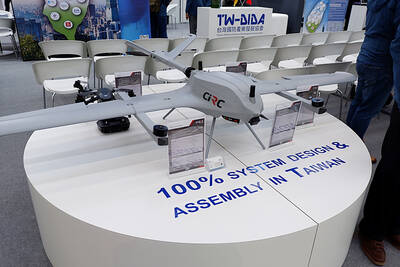
Taiwan’s drone exports surged past US$100 million in the first quarter, exceeding last year’s full-year total, with the Czech Republic emerging as the largest buyer, the Ministry of Economic Affairs said. Exports of complete drones reached US$115.85 million in the period, about 1.2 times the total recorded for all of last year, the ministry said in a report. Exports to the Czech Republic accounted for about US$100 million, far outpacing other markets. Poland, last year’s top destination, recorded about US$11.75 million in the first quarter. Taiwan’s drone exports have expanded rapidly in the past few years, with last year’s total


 RSS
RSS