


World leaders were yesterday set to hold online crisis talks on the COVID-19 pandemic that has forced 3 billion people into lockdown and claimed more than 21,000 lives.
With the disease tearing around the globe at a terrifying pace, warnings are multiplying over its economic consequences, with experts saying it could cause more damage than the Great Depression.
Amid squabbling between the leaders of China and the US over who is to blame, UN Secretary-General Antonio Guterres called for the world to act together to halt the menace.

Photo: AFP
“COVID-19 is threatening the whole of humanity,” Guterres said. “Global action and solidarity are crucial. Individual country responses are not going to be enough.”
The global lockdown — which also took in India’s huge population this week — tightened further yesterday when Russia announced it was grounding all international flights, while Moscow’s mayor ordered the closure of cafes, shops and parks.
Tokyo’s millions of citizens have been told to stay at home and tourism-dependent Thailand has shuttered its borders.
Economists say the restrictions imposed around the world could cause the biggest recession in modern history.
“The G20 economies will experience an unprecedented shock in the first half of this year and will contract in 2020 as a whole,” ratings agency Moody’s said.
The leaders of the G20 major economies were due to hold a virtual meeting later yesterday in the shadow of such dire predictions.
“As the world confronts the COVID-19 pandemic, and the challenges to healthcare systems and the global economy, we convene this extraordinary G20 summit to unite efforts towards a global response,” Saudi Arabian King Salman wrote on Twitter.
Saudi Arabia holds the rotating G20 presidency.
WHO Director-General Tedros Adhanom Ghebreyesus said richer nations needed to offer support to low and middle-income countries.
The devastating effect on poorer nations was laid bare when the Philippines announced that nine front-line doctors had died after contracting COVID-19.
Three large Manila hospitals this week said that they had reached capacity and would no longer accept new coronavirus cases.
Hundreds of medical staff are undergoing 14-day self-quarantines after suspected exposure, the hospitals said.
The death toll from the coronavirus, which emerged in Wuhan, China, last year, continued to grow, with the US becoming the sixth nation to hit four figures.
Almost 1,050 people are now known to have died in the US, with nearly 70,000 infections, Johns Hopkins University data showed.
Globally, the number of infections is closing in on half a million.
The rocketing infection rate in the US has sparked a rush to buy weapons, gun store owners said, with customers panicking about societal breakdown.
“A lot of people are buying shotguns, handguns, AR-15 [semi-automatic rifles], everything,” said Tiffany Teasdale, who sells guns in Washington state. “A lot of people are scared that someone is going to break into their home ... to steal cash, their toilet paper, their bottled water, their food.”
About half of the US population is under lockdown, but US President Donald Trump said that he would decide soon whether unaffected parts of the nation could get back to work.
The White House has repeatedly lashed out at Beijing over the disease.
US Secretary of State Mike Pompeo on Wednesday said that the G7 were united against China’s “disinformation” campaign.
A Chinese Ministry of Foreign Affairs spokesman had infuriated Washington by suggesting on Twitter that US troops had taken the coronavirus to Wuhan.
“Every one of the nations that were at that meeting this morning was deeply aware of the disinformation campaign that the Chinese Communist Party is engaged in to try and deflect from what has really taken place,” Pompeo told reporters.

National Taiwan University (NTU) yesterday said it disqualified a person from an entrance examination for using AI smart glasses to cheat, along with two others for making untruthful statements in their curriculum vitae. The three applicants were given null scores, Taiwan’s highest-ranked university said, calling on prospective students to be honest in the admissions process. NTU registrar Lee Hung-sen (李宏森) said that the cheating applicant wore a hat and thick-rimmed glasses to the second written exam for medical school, claiming that they felt cold. Suspicions were aroused when the applicant stared oddly at the test for long stretches while steadily bringing the paper
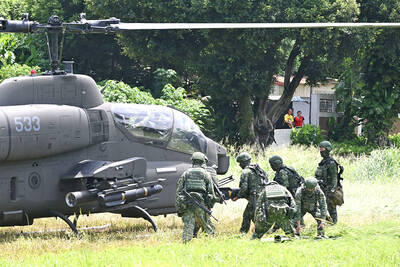
MILITARY ISSUES: A partisan divide between the Cabinet and the legislature ‘raised questions about Taiwan’s ability to adequately fund its defense,’ the report said Taiwan’s defense budget, military personnel numbers and resilience are challenges to its ability to meet national defense goals, the US Naval Institute said in a report published on Tuesday. In response to the perception of a growing military threat posed by China, Taiwan has embarked on an effort to enhance the capabilities needed to deter an attempt by Beijing to annex the nation by force, the institute said in the US Congressional Research Service report, titled Taiwan: Defense and Military Issues, which was filed on Thursday last week. Taiwan’s defense budget increased by about 7.5 percent from 2024 to last year, it

66 FIGHTER JETS: The aircraft is likely undergoing preparations for its transfer to Taiwan — a significant step forward in the nation’s modernization program, a lawmaker said The first of Taiwan’s order of F-16V Block 70 aircraft has been sighted in Texas ahead of delivery, Democratic Progressive Party (DPP) Legislator Wang Ting-yu (王定宇) said. Taiwan’s first F-16V Block 70 two-seat aircraft, tail number 6831, was seen flying from Lockheed Martin’s production facility in Greenville, South Carolina, to Naval Air Station Joint Reserve Base Fort Worth in Texas, Wang wrote on Facebook yesterday. The plane is likely undergoing preparations for its transfer to Taiwan, marking a significant step forward in the Republic of China Air Force’s modernization program, Wang said, citing military analysts. The F-16V Block 70 is a new-build version

NOT JUST NUMBERS: What matters to intelligence work is crucial, reliable information, so even a few credible leads can be highly valuable to national security, a legislator said The National Security Bureau (NSB) yesterday said it has finished the establishment of an information-reporting channel for Chinese nationals, the aim of which is to broaden intelligence gathering on China’s political, military, economic and social developments. Chinese nationals can submit information on the Web page, https://report.nsb.gov.tw, the NSB said in a statement. The move aims to expand the bureau’s diverse intelligence sources and is pursuant to the National Intelligence Services Act (國家情報工作法), it said, adding that it referenced practices adopted by intelligence agencies in the US, the UK and Israel. An increasing number of people are approaching Taiwanese agencies to provide information, as


 RSS
RSS