


Taiwan warned the WHO and China about possible human-to-human transmission of the new coronavirus at the end of last year, but the global health body did not make it public, the Ministry of Foreign Affairs said yesterday.
Department of International Organizations Director-General Bob Chen (陳龍錦) made the remark at a news briefing in Taipei, when asked about statements made by US Department of State spokeswoman Morgan Ortagus.
“Dec. 31— that’s the same day Taiwan first tried to warn WHO of human-human transmission. Chinese authorities meanwhile silenced doctors and refused to admit human-human transmission until Jan. 20, with catastrophic consequences,” Ortagus wrote on Twitter yesterday.
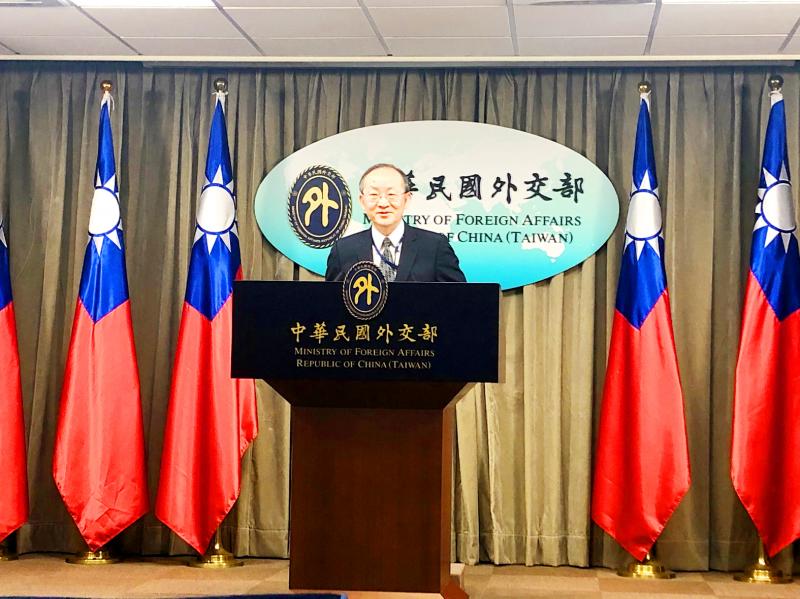
Photo: Lu Yi-hsuan, Taipei Times
Her tweet was in response to a post by Chinese Ministry of Foreign Affairs spokeswoman Hua Chunying (華春瑩), who wrote that the Wuhan Municipal Health Commission had issued a notice about the virus on Dec. 31 last year.
The commission’s notice reported 27 cases, including seven severe ones, in Wuhan, but said that no obvious transmission among people had been observed.
The Centers for Disease Control on Dec. 31 last year did ask China and the WHO’s International Health Regulations contact for information about the abnormal outbreak of pneumonia in Wuhan, while the ministry’s representative office in Geneva, Switzerland, also contacted the WHO secretariat, Chen said.
On the same day, the centers started implementing onboard inspections on direct flights from Wuhan landing in Taiwan, he said.
The WHO later replied that it received the message and would transfer it to other experts, but did not make it public, he said.
There are e-mail records of the communication between the centers and the WHO, he added.
Taiwan’s disease prevention strategy was predicated on the concept that the virus could be transmitted among people, ministry spokeswoman Joanne Ou (歐江安) said.
The nation thanks the US and other like-minded nations for their support, and would work with the global community to contain the virus, she said.
Meanwhile, the WHO secretariat is still evaluating whether to convene the 73rd session of the World Health Assembly from May 17 to 21, turn it into a virtual meeting or postpone it until autumn, Chen said.
Although it is almost impossible for WHO Director-General Tedros Adhanom Ghebreyesus to invite Taiwan to join the assembly as an observer, the ministry would continue to push for Taiwan’s participation in the meeting, he said.
In other developments, British Secretary of Foreign and Commonwealth Affairs Dominic Raab has advised all Britons who are usually based in the UK to return home soon, given the rapidly changing situation regarding travel restrictions and flights, the British Office Taipei said in a statement.
The advice does not apply to Britons who are residents in Taiwan.
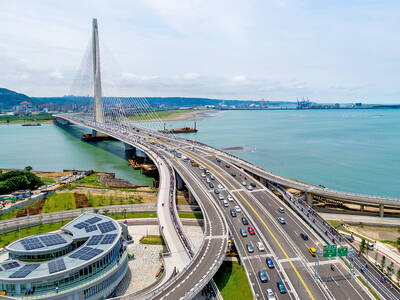
The Ministry of Transportation and Communications yesterday inaugurated the Danjiang Bridge across the Tamsui River in New Taipei City, saying that the structure would be an architectural icon and traffic artery for Taiwan. Feted as a major engineering achievement, the Danjiang Bridge is 920m long, 211m tall at the top of its pylon, and is the longest single-pylon asymmetric cable-stayed bridge in the world, the government’s Web site for the structure said. It was designed by late Iraqi-British architect Zaha Hadid. The structure, with a maximum deck of 70m, accommodates road and light rail traffic, and affords a 200m navigation channel for boats,
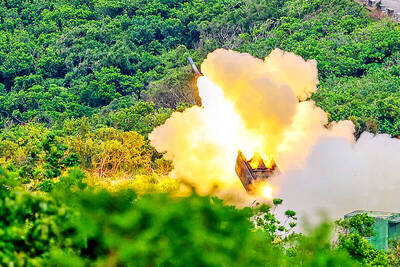
PRECISION STRIKES: The most significant reason to deploy HIMARS to outlying islands is to establish a ‘dead zone’ that the PLA would not dare enter, a source said A High Mobility Artillery Rocket System (HIMARS) would be deployed to Penghu County and Dongyin Island (東引) in Lienchiang County (Matsu) to force the Chinese military to retreat at least 100km from the coastline, a military source said yesterday. Taiwan has been procuring HIMARS and Army Tactical Missile Systems (ATACMS) from the US in batches. Once all batches have been delivered, Taiwan would possess 111 HIMARS units and 504 ATACMS, which have a range of 300km. Considering that “offense is the best defense,” the military plans to forward-deploy the systems to outlying islands such as Penghu and Dongyin so that

WHAT WAS ALL THAT FOR? Jaw Shaw-kong said that Cheng Li-wen had pushed for more drastic cuts and attacked him, just for the outcome to be nearly identical to his bill The legislature yesterday passed a supplementary budget bill to fund the purchase of separate packages of US military equipment, with the combined amount of spending capped at NT$780 billion (US$24.8 billion). The Chinese Nationalist Party (KMT) and Taiwan People’s Party (TPP) used their legislative majority to pass the bill, which runs until 2033 and has two main funding provisions. One was for NT$300 billion of arms sales already approved by the US for Taiwan on Dec. 17 last year, the other was for NT$480 billion for another arms package expected to be announced by Washington. The bill, which fell short of the NT$1.25

‘CLEAR MESSAGE’: The bill would set up an interagency ‘tiger team’ to review sanctions tools and other economic options to help deter any Chinese aggression toward Taiwan US Representative Young Kim has introduced a bill to deter Chinese aggression against Taiwan, calling for an interagency “tiger team” to preplan coordinated sanctions and economic measures in response to possible Chinese military or political action against Taiwan. “[Chinese President] Xi Jinping [習近平] has directed the People’s Liberation Army to be ready to invade Taiwan by 2027. China has a plan. America should have one too,” Kim said in a news release on Thursday last week. She introduced the “Deter PRC [People’s Republic of China] aggression against Taiwan act” to “ensure the US has a coordinated sanctions strategy ready should


 RSS
RSS