


This year’s Tokyo Olympics looked likely to be the first to be postponed since the modern Games began in the 19th century, as Canada’s national team pulled out and Japan’s prime minister said that a delay might be unavoidable due to the COVID-19 pandemic.
Japanese Prime Minister Shinzo Abe yesterday told parliament that the Olympics, set to start in July, would have to be postponed if safety cannot be guaranteed for spectators and athletes.
His comments came a day after the International Olympic Committee (IOC) said that it would decide within four weeks how to handle the event amid the outbreak, with a delay being an option.
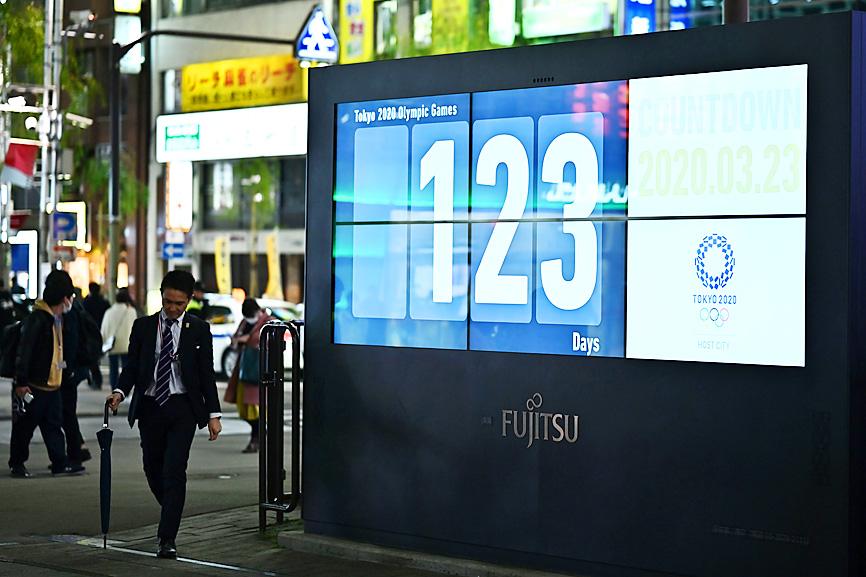
Photo: AFP
After weeks of avoiding direct mention of scuttling the schedule, Abe changed his tone and said if the full Games could not be held in an environment where everyone feels safe, “a decision will have to be made to postpone it.”
He added that cancelation was not an option and that he wanted an IOC decision to be made as soon as possible.
The Tokyo Olympic Committee echoed the tone, with committee president Yoshiro Mori saying organizers would discuss different scenarios for the Games within four weeks, ruling out a cancelation.
The aim is to hold the event this year, even with a delay, he said.
Abe added that he might have to communicate his own thoughts directly to IOC president Thomas Bach, saying the world was not ready to hold an Olympics.
If the Olympics are called off, it would be the biggest event to be halted by the COVID-19 outbreak.
The last time an Olympics was canceled was in 1944 due to World War II, and the Games have never been delayed by as long as a year under the auspices of the IOC, which was established in 1894.
The 1940 Games were initially postponed, but then canceled.
Several nations are calling for the Olympics to be pushed back until at least next year.
That would cause logistical nightmares, but would be far less painful than cancelation for the host, sponsors, broadcasters and others that have tens of billions of dollars invested in the event.
Earlier, the Canadian Olympic Committee and Canadian Paralympic Committee “urgently” called on the IOC and other organizers to postpone the event by a year.
“While we recognize the inherent complexities around a postponement, nothing is more important than the health and safety of our athletes,” they said. “We are in the midst of a global health crisis that is far more significant than sport.”
Other major sporting federations and political leaders have also called on the IOC and Japanese organizers to postpone the Games, with the pandemic already wrecking training for athletes.
The Australian Olympic Committee yesterday said that its athletes should prepare for the event to be held next year, while World Athletics said that it was “ready to work with the IOC and all sport on an alternative date.”
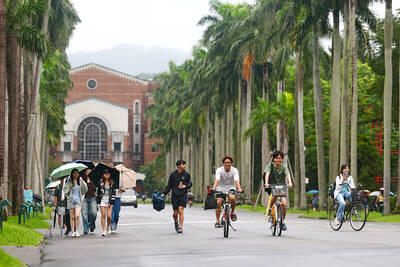
National Taiwan University (NTU) yesterday said it disqualified a person from an entrance examination for using AI smart glasses to cheat, along with two others for making untruthful statements in their curriculum vitae. The three applicants were given null scores, Taiwan’s highest-ranked university said, calling on prospective students to be honest in the admissions process. NTU registrar Lee Hung-sen (李宏森) said that the cheating applicant wore a hat and thick-rimmed glasses to the second written exam for medical school, claiming that they felt cold. Suspicions were aroused when the applicant stared oddly at the test for long stretches while steadily bringing the paper
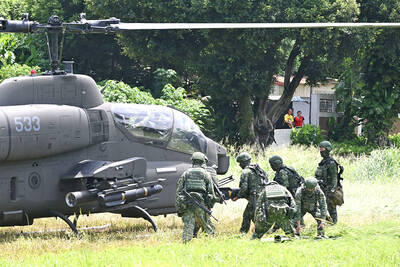
MILITARY ISSUES: A partisan divide between the Cabinet and the legislature ‘raised questions about Taiwan’s ability to adequately fund its defense,’ the report said Taiwan’s defense budget, military personnel numbers and resilience are challenges to its ability to meet national defense goals, the US Naval Institute said in a report published on Tuesday. In response to the perception of a growing military threat posed by China, Taiwan has embarked on an effort to enhance the capabilities needed to deter an attempt by Beijing to annex the nation by force, the institute said in the US Congressional Research Service report, titled Taiwan: Defense and Military Issues, which was filed on Thursday last week. Taiwan’s defense budget increased by about 7.5 percent from 2024 to last year, it
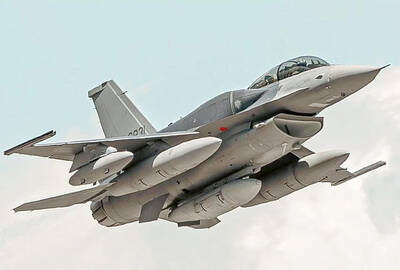
66 FIGHTER JETS: The aircraft is likely undergoing preparations for its transfer to Taiwan — a significant step forward in the nation’s modernization program, a lawmaker said The first of Taiwan’s order of F-16V Block 70 aircraft has been sighted in Texas ahead of delivery, Democratic Progressive Party (DPP) Legislator Wang Ting-yu (王定宇) said. Taiwan’s first F-16V Block 70 two-seat aircraft, tail number 6831, was seen flying from Lockheed Martin’s production facility in Greenville, South Carolina, to Naval Air Station Joint Reserve Base Fort Worth in Texas, Wang wrote on Facebook yesterday. The plane is likely undergoing preparations for its transfer to Taiwan, marking a significant step forward in the Republic of China Air Force’s modernization program, Wang said, citing military analysts. The F-16V Block 70 is a new-build version

NOT JUST NUMBERS: What matters to intelligence work is crucial, reliable information, so even a few credible leads can be highly valuable to national security, a legislator said The National Security Bureau (NSB) yesterday said it has finished the establishment of an information-reporting channel for Chinese nationals, the aim of which is to broaden intelligence gathering on China’s political, military, economic and social developments. Chinese nationals can submit information on the Web page, https://report.nsb.gov.tw, the NSB said in a statement. The move aims to expand the bureau’s diverse intelligence sources and is pursuant to the National Intelligence Services Act (國家情報工作法), it said, adding that it referenced practices adopted by intelligence agencies in the US, the UK and Israel. An increasing number of people are approaching Taiwanese agencies to provide information, as


 RSS
RSS