


There is a “huge” difference between Chinese warplanes flying around Taiwan and intruding into its airspace, and the former should not be deemed provocative, Chinese Nationalist Party (KMT) Legislator Wu Sz-huai (吳斯懷) said, calling on the Ministry of National Defense not to mislead the public.
Just as US aircraft flying by the nation should not be deemed provocative, neither should Chinese aircraft, Wu wrote in a question to the Executive Yuan on Wednesday last week.
Any assumption that such moves are provocative lacks a legal basis, and the ministry should avoid “crying wolf” and causing panic, said Wu, a retired lieutenant general.
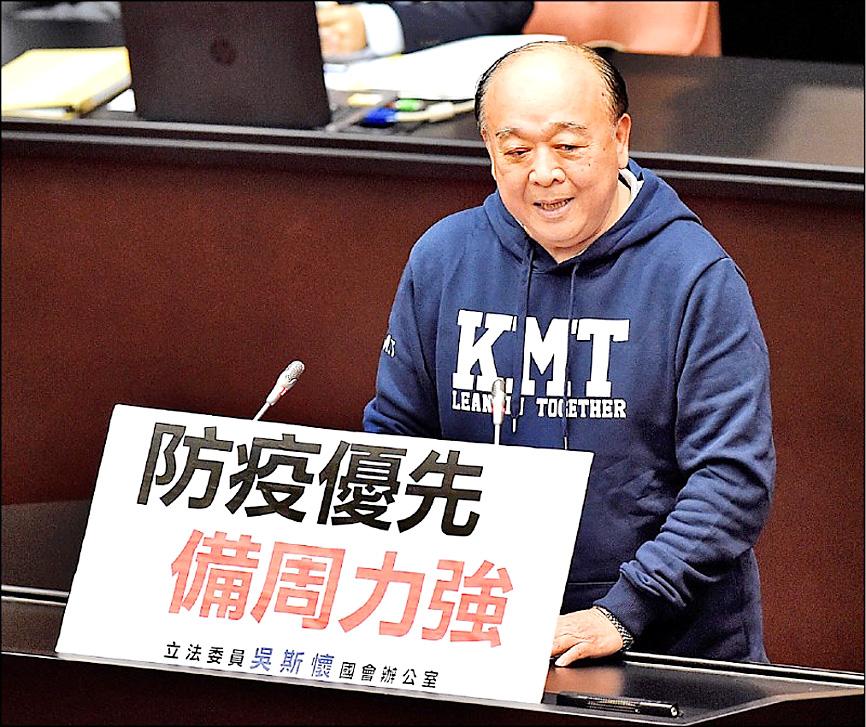
Photo: Chung Lee-hua, Taipei Times
The Chinese People’s Liberation Army Air Force has since last month flown its warplanes near Taiwan’s airspace four times and in one incident locked on to a Taiwanese F-16.
The ministry yesterday said that the Chinese Communist Party has never renounced the use of force to annex Taiwan and has unilaterally changed the “status quo” in the Taiwan Strait.
Apart from the four drills directed at Taiwan, China on March 31 last year flew two warplanes past the median line of the Taiwan Strait, breaking a tacit agreement between Taipei and Beijing, the ministry said, adding that these incidents are all evidence of Chinese browbeating and provocation.
The ministry said that it has faithfully and dutifully passed on the facts and has by no means misled the public.
Wu last month called Chinese warplanes’ fly-bys “very unwise and inappropriate,” only to change his tone in a question addressed to the Executive Yuan later that month.
Wu on Wednesday last week wrote to the Executive Yuan, saying: “A correct understanding of national defense will improve the public’s notion of the issue. Conversely, misinformation would sow panic.”
Apart from the one incident in which Chinese aircraft crossed the median line of the Taiwan Strait, the other Chinese fly-bys last month involved aircraft participating in long-distance drills, he said.
US bombers and marine patrol aircraft last month also flew near Taiwan, including off the east coast, Oluanpi (鵝鑾鼻) and once near the median line of the Taiwan Strait, he added.
He cited international law for defending Chinese fly-bys, which did not intrude into the nation’s airspace, even though the concept only applies to vessels.
The median line of the Taiwan Strait is a supposed border unilaterally drawn by the US under the Sino-American Mutual Defense Treaty, Wu said, adding that most of the line is in international waters.
The line has served as a military demarcation adhered to by both sides of the Taiwan Strait based on a tacit agreement, he said.
Instead of emphasizing Chinese fly-bys, the ministry should focus on the formations employed by the Chinese People’s Liberation Army Navy in joint military exercises, as well as its ability to neutralize the effects of attacks, he added.

Right-wing political scientist Laura Fernandez on Sunday won Costa Rica’s presidential election by a landslide, after promising to crack down on rising violence linked to the cocaine trade. Fernandez’s nearest rival, economist Alvaro Ramos, conceded defeat as results showed the ruling party far exceeding the threshold of 40 percent needed to avoid a runoff. With 94 percent of polling stations counted, the political heir of outgoing Costa Rican President Rodrigo Chaves had captured 48.3 percent of the vote compared with Ramos’ 33.4 percent, the Supreme Electoral Tribunal said. As soon as the first results were announced, members of Fernandez’s Sovereign People’s Party
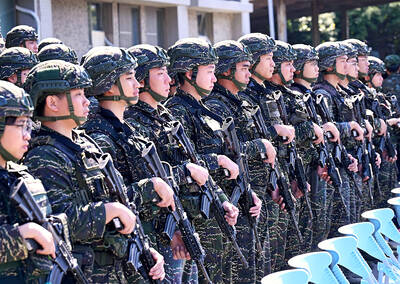
MORE RESPONSIBILITY: Draftees would be expected to fight alongside professional soldiers, likely requiring the transformation of some training brigades into combat units The armed forces are to start incorporating new conscripts into combined arms brigades this year to enhance combat readiness, the Executive Yuan’s latest policy report said. The new policy would affect Taiwanese men entering the military for their compulsory service, which was extended to one year under reforms by then-president Tsai Ing-wen (蔡英文) in 2022. The conscripts would be trained to operate machine guns, uncrewed aerial vehicles, anti-tank guided missile launchers and Stinger air defense systems, the report said, adding that the basic training would be lengthened to eight weeks. After basic training, conscripts would be sorted into infantry battalions that would take
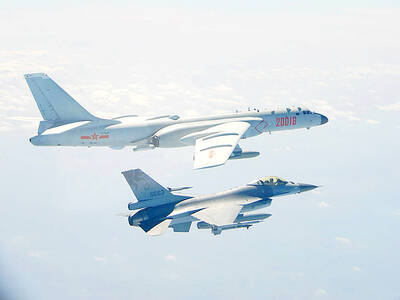
GROWING AMBITIONS: The scale and tempo of the operations show that the Strait has become the core theater for China to expand its security interests, the report said Chinese military aircraft incursions around Taiwan have surged nearly 15-fold over the past five years, according to a report released yesterday by the Democratic Progressive Party’s (DPP) Department of China Affairs. Sorties in the Taiwan Strait were previously irregular, totaling 380 in 2020, but have since evolved into routine operations, the report showed. “This demonstrates that the Taiwan Strait has become both the starting point and testing ground for Beijing’s expansionist ambitions,” it said. Driven by military expansionism, China is systematically pursuing actions aimed at altering the regional “status quo,” the department said, adding that Taiwan represents the most critical link in China’s
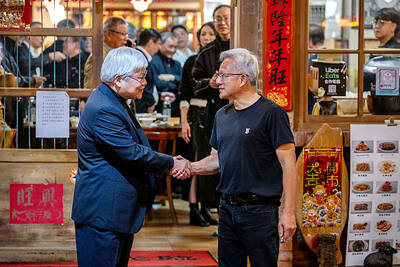
‘REALLY PROUD’: Nvidia would not be possible without Taiwan, Huang said, adding that TSMC would be increasing its capacity by 100 percent Nvidia Corp CEO Jensen Huang (黃仁勳) on Saturday praised and lightly cajoled his major Taiwanese suppliers to produce more to help power strong demand for artificial intelligence (AI), capping a visit to the country of his birth, where he has been mobbed by adoring fans at every step. Speaking at an impromptu press conference in the rain outside a Taipei restaurant, where he had hosted suppliers for a “trillion-dollar dinner,” named after the market capitalization of those firms attending, Huang said this would be another good year for business. “TSMC needs to work very hard this year because I need a lot


 RSS
RSS