


The Chinese ambassador to Estonia last month accused the Baltic nation’s intelligence service of having a “Cold War mindset” for labeling China a threat, warning that its “distorted” conclusions damaged bilateral relations.
Four weeks later, Estonian officials took part in a videoconference hosted by the Chinese Ministry of Foreign Affairs, in which the Asian country’s health officials shared their experience in fighting the COVID-19 pandemic.
The Estonians found the materials “very professional and targeted,” and sought to distribute them widely, an account of the call posted by the Chinese embassy in Tallinn said.
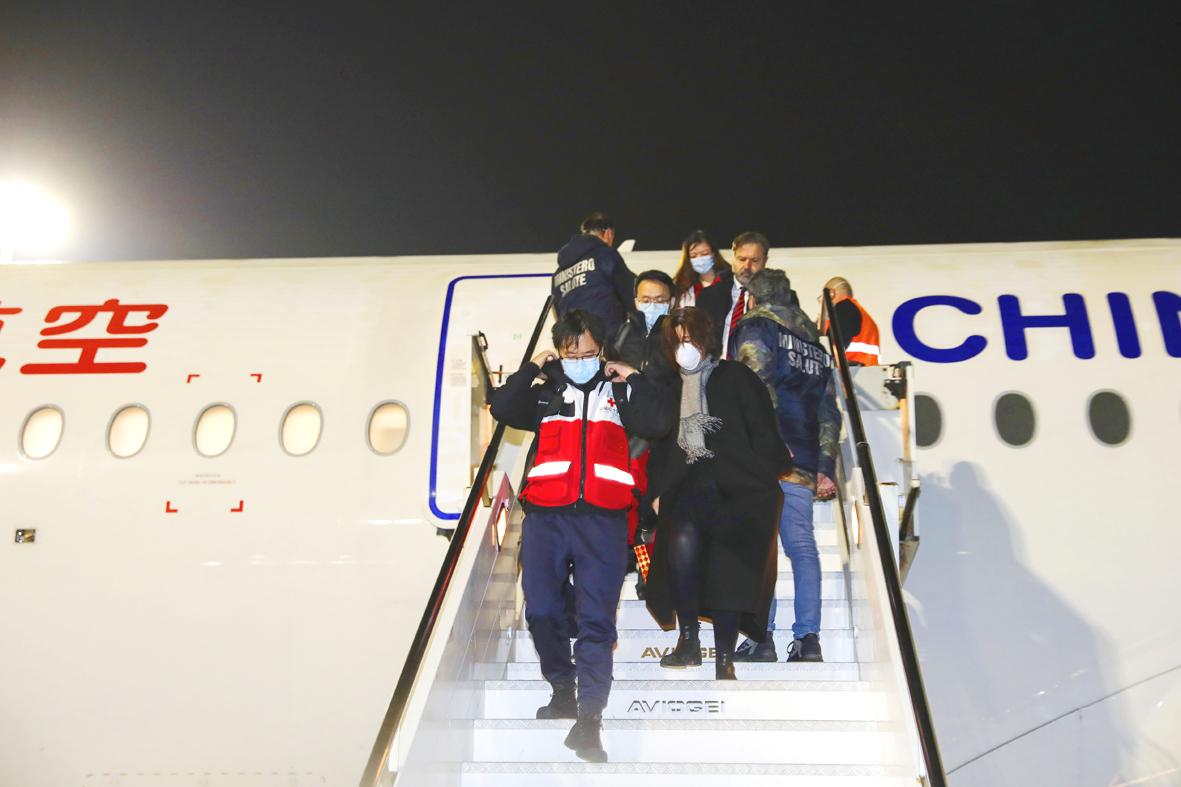
Photo: AP
“Estonia hopes to strengthen exchanges and cooperation with China to fight against COVID-19,” it said.
As Europe becomes the epicenter of the coronavirus, Beijing is stepping up its outreach to individual governments there.
That is coming at the very moment that the US — and in some cases the EU — is seen to be turning away. The result is a battle for hearts and minds that China seems to be winning, at least for the moment.
“It’s great that China has this availability and that it is currently in a position to offer this kind of help,” Berlin-based Mercator Institute for China Studies analyst Lucrezia Poggetti said.
Aid is much needed, but in supplying it, China is consciously exercising its soft power, she said.
“There is a major propaganda push at play on the side of the Chinese with some willing enablers on the European side,” Poggetti said.
For China, the outreach to Europe is part of an effort to claw back an international leadership role after early cover-ups helped the virus spread well beyond its borders.
Chinese President Xi Jinping’s (習近平) government has sought to silence critics, including reporters and online commentators, and it has also spread conspiracy theories about where the virus originated.
Xi this week described China’s mass deployment of medical aid to Europe as an effort to further a “Health Silk Road,” stretching his Belt and Road Initiative.
Along with state help for stricken countries such as Italy, aid is being channeled across the continent by private companies in the name of Beijing, helping to burnish China’s image from France to Ukraine.
China’s ambassador in Athens on Wednesday delivered more than 50,000 protective masks to the Greek minister of health.
The Chinese embassy in Paris has said that help is coming to France, while Bulgaria and Slovenia are also to receive aid.
Xi told Spanish Prime Minister Pedro Sanchez in a call on Tuesday that China would provide support to combat the epidemic.
That same day, an aircraft carrying medical aid from China’s Alibaba Group Holding Ltd (阿里巴巴) and Jack Ma’s (馬雲) foundation arrived at Spain’s Zaragoza Airport, the Chinese embassy said on Twitter.
Alibaba and the Jack Ma Foundation have also been involved in airlifting aid to Belgium and Ukraine, which needs express test kits to detect the coronavirus.
“We agreed with China and we are grateful to them, especially grateful to Jack Ma, as he helped us by financing the US$80 million” cost of the medical kits, Ukrainian President Volodymyr Zelenskiy said on Monday.
Others are turning to China out of desperation. Cyprus, Luxembourg and even Norway, which has the world’s largest sovereign wealth fund, have called on Beijing for support or are considering doing so.
In Lithuania — another Baltic state that fell out with China over a critical security assessment — Lithuanian Minister of Health Aurelijus Veryga said that his government was reaching out to China to buy “several hundred” lung ventilators.
“We don’t want to wait” for joint EU medical supply purchases, Veryga said on Wednesday.
That kind of dependence on China is a warning sign for some.
“This crisis has showed how exposed we in Romania and in Europe are to imports from China,” Romanian Minister of Economy, Energy and the Business Environment Virgil Popescu said this week, adding that the government in Bucharest aims to encourage domestic production of healthcare products as a result.
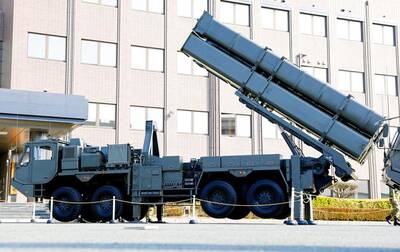
Japan has deployed long-range missiles in a southwestern region near China, the Japanese defense minister said yesterday, at a time when ties with Beijing are at their lowest in recent years. The missiles were installed in Kumamoto in the southern region of Kyushu, as Japan is attempting to shore up its military capacity as China steps up naval activity in the East China Sea. “Standoff defense capabilities enable us to counter the threat of enemy forces attempting to invade our country ... while ensuring the safety of our personnel,” Japanese Minister of Defense Shinjiro Koizumi said. “This is an extremely important initiative for
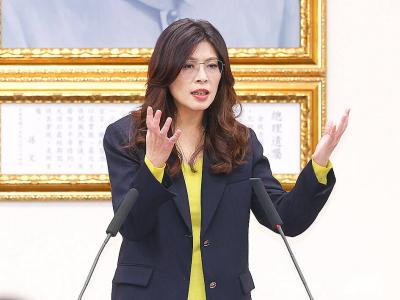
Chinese Nationalist Party (KMT) Chairwoman Cheng Li-wun (鄭麗文) today accepted an invitation from Chinese President Xi Jinping (習近平) to lead a delegation to China next month, saying she hopes to promote the peaceful development of cross-strait relations and bring stability to the Taiwan Strait. “I am grateful and happy to accept this invitation,” Cheng said in a statement from the KMT chairperson’s office. Cheng said she hopes both sides can work together to promote the peaceful development of cross-strait relations, enhance exchange and cooperation, bring stability to the Taiwan Strait and improve people’s livelihoods. At today's news conference, Cheng said any efforts to
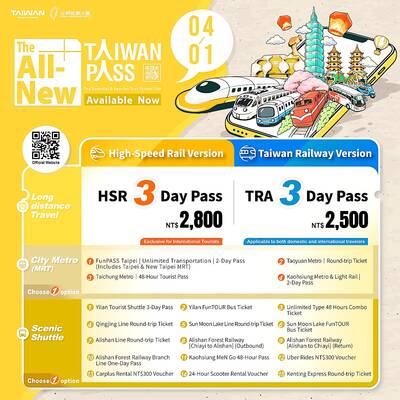
MORE POPULAR: Taiwan Pass sales increased by 59 percent during the first quarter compared with the same period last year, the Tourism Administration said The Tourism Administration yesterday said that it has streamlined the Taiwan Pass, with two versions available for purchase beginning today. The tourism agency has made the pass available to international tourists since 2024, allowing them to access the high-speed rail, Taiwan Railway Corp services, four MRT systems and four Taiwan Tourist Shuttles. Previously, five types of Taiwan Pass were available, but some tourists have said that the offerings were too complicated. The agency said only two types of Taiwan Pass would be available, starting from a three-day pass with the high-speed rail and a three-day pass with Taiwan Railway Corp. The former costs NT$2,800

The nation’s fastest supercomputer, Nano 4 (晶創26), is scheduled to be launched in the third quarter, and would be used to train large language models in finance and national defense sectors, the National Center for High-Performance Computing (NCHC) said. The supercomputer, which would operate at about 86.05 petaflops, is being tested at a new cloud computing center in the Southern Taiwan Science Park in Tainan. The exterior of the server cabinet features chip circuitry patterns overlaid with a map of Taiwan, highlighting the nation’s central position in the semiconductor industry. The center also houses Taiwania 2, Taiwania 3, Forerunner 1 and


 RSS
RSS