


Afghanistan’s rival leaders were each sworn in as president in separate ceremonies yesterday, throwing plans for negotiations with the Taliban into chaos and creating a dilemma for the US as it figures out how to move its peace deal with the Taliban forward.
Afghan President Ashraf Ghani, who last month was declared the winner of the elections in September last year, and his rival, former chief executive Abdullah Abdullah, who alleged fraud in the vote along with the elections complaints commission, have refused to settle their differences.
The two ceremonies were held at the same time, Ghani’s in the presidential palace and Abdullah’s in the Sapedar Palace, which is part of the presidential palace complex, both packed with each rival’s supporters.
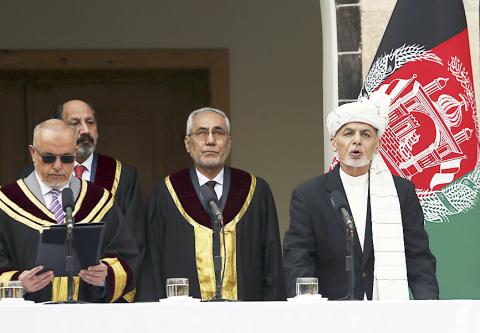
Photo: AP
In a sign of international support for Ghani, his ceremony — aired on state TV — was attended by Washington’s peace envoy Zalmay Khalilzad; General Austin Miller, the head of US forces in Afghanistan, as well as a number of foreign dignitaries including the US embassy’s charge d’affaires and Tadamichi Yamamoto, the UN secretary-general’s personal representative to Afghanistan.
Abdullah inaugurated himself as president minutes after Ghani was sworn into office for a second term, vowing to “safeguard the independence, national sovereignty, territorial integrity” of Afghanistan.
At Abdullah’s inauguration, aired on private Tolo TV, some of the attendees were some of the so-called “jihadi” commanders who allied with the US-led coalition to topple the Taliban in 2001 and participated in the 1990s civil wars, raising fears that the divisions among leaders could lead to violence.
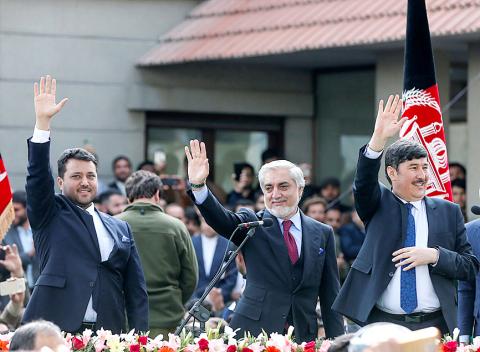
Photo: Reuters
Two blasts were heard during the ceremonies, prompting some people to flee.
Many of those who fled returned to their seats after Ghani’s refusal to leave the podium prompted cheers and applause.
“I have no bulletproof vest on, only my shirt, I will stay even if I have to sacrifice my head,” Ghani told the remaining crowd at his event, as sirens sounded overhead.
The dueling inaugurations took place despite last-minute shuttle diplomacy by Khalilzad, who reportedly went back and forth between the two rivals into the early hours of yesterday.
A senior member of Abdullah’s team, Basir Salangi, told Tolo TV that the US envoy had asked both sides to delay their inaugurations for three days to sort out the stalemate.
Abdullah reportedly said he was ready, but would go ahead with his ceremony if Ghani refused to postpone.
In a tweet, former Afghan deputy foreign minister Jawed Luddin thanked Washington for trying to sort out Afghanistan’s political turmoil while calling the squabbling “a mess.”
“Thank you, USA, for trying to sort out our political crisis — yet again. We know you must be sick of it — as are we Afghans,” he said.
“You and us both had a hand in bringing about the mess that is today’s Afghan politics. But I wish we Afghans felt half as responsible for the mess as you do,” he added.
Intra-Afghan talks are scheduled to be held today in Oslo, Norway.
Additional reporting by AFP

‘NO SECURITY RISK’: The Railway Bureau reassured the public that the technicians’ activities were limited to technical guidance and did not involve sensitive systems The Railway Bureau yesterday said it had invited eight Chinese technicians to assist with an airport MRT construction project. The bureau issued the confirmation after an Internet user said Chinese nationals had entered the construction zone of Taiwan Taoyuan International Airport’s Terminal 3 project. They asked why “individuals from an enemy state” were allowed access to such a major national infrastructure project, which raised serious concerns over Taiwan’s industrial safety, sensitive systems and information security. The bureau’s Northern Region Engineering Branch Office said subcontractor Taiwan Handle Industrial Co (台灣手把工業) of the Taoyuan airport MRT’s “Contract No. CU05 Project A14 Station Civil, MEP &

The National Chungshan Institute of Science and Technology yesterday showcased its locally developed variants of the Vision 60 robotic patrol dog, which it plans to deploy on the nation’s outlying territories in the South China Sea. The variants were produced under the Joint Lab project — created by the institute and domestic companies — and assembled with domestically produced motors, lenses and artificial intelligence (AI) systems alongside licensed tech from the US, Missile and Rocket Systems Research Division deputy director Jen Kuo-kang (任國光) told the media event at a military base in Taipei’s Dazhi (大直) area. Taiwan has built up its strengths
TIT-FOR-TAT: The US allegedly revoked the visa of a Chinese national working at Xinhua News Agency in the US in response to Beijing’s expulsion of Vivian Wang The Presidential Office yesterday condemned China for expelling a New York Times correspondent from Beijing following the newspaper’s interview with President William Lai (賴清德), saying the move highlighted Beijing’s suppression of press freedom and its threat to international news media. Taiwan has noted a series of recent incidents in which Beijing used similar tactics to “threaten and pressure international media outlets and journalists,” Presidential Office spokeswoman Karen Kuo (郭雅慧) said in a statement. “This concerns not only press freedom and freedom of expression, but also the safety of journalists, and Taiwan and relevant partners are paying close attention to the situation,” she

NOT IMMEDIATE: Taiwan has a chance to appeal the proposed 10 percent tariff before it starts, while other countries face a 12.5 percent tariff from the trade office Taiwan is among 60 economies determined by the US to have failed to impose or enforce a ban on the importation of goods produced with forced labor, according to a notice released on Tuesday by the Office of the US Trade Representative (USTR), which proposed imposing an additional 10 percent or more tariff on them. The USTR in a statement said that following an investigation, it had determined under Section 301 of the Trade Act of 1974 that the failure of the 60 economies to impose and effectively enforce a prohibition on the importation of goods produced with forced labor is


 RSS
RSS