


Taipei International Airport (Songshan airport) customs officers yesterday stopped a tourist for carrying an in-flight meal containing meatballs in contravention of the Act for Prevention and Control of Infectious Animal Disease (動物傳染病防治條例).
Council of Agriculture officials were inspecting luggage at the airport when a sniffer dog detected meat in the carry-on luggage of the tourist, who had just arrived from Japan’s Haneda Airport.
Customs officers checked the luggage and found the boxed meal. Council personnel confirmed that it contained pork ingredients after running it through a scan.
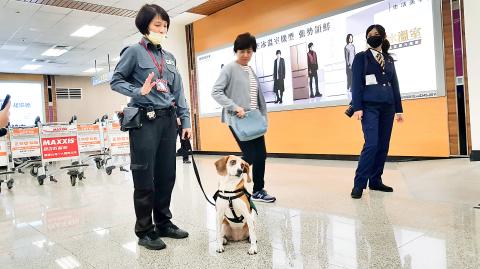
Photo: Chien Hui-ju, Taipei Times
The tourist disposed of the meal and was let off without a fine.
As the spread of African swine fever in Asia does not show any sign of abating, the government is to dispatch 300 additional officials to the nation’s borders to prevent illegal pork imports during the Lunar New Year holiday, Council of Agriculture Minister Chen Chi-chung (陳吉仲) told reporters at the airport.
Flights to the airport mainly arrive from China, South Korea and Japan, Chen said, adding that China and South Korea have been affected by the disease.
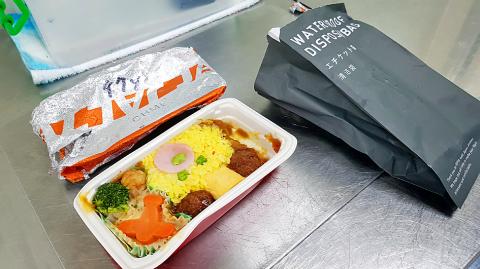
Photo: Chien Hui-ju, Taipei Times
The government would face a tougher challenge containing the virus during this year’s holiday, he added.
Only China had reported an outbreak by the Lunar New Year holiday in February last year, but the disease has since spread to Mongolia, Vietnam, Cambodia, North Korea, Laos, Myanmar, the Philippines, South Korea, East Timor and Indonesia, council data showed.
Nearly 41 percent of Vietnamese pork products intercepted at the border have tested positive for the disease, while the ratio of tainted Chinese pork products is 15 percent, Chen said.
People caught illegally transporting pork products from nations that have reported an outbreak of African swine fever in past three years could face a NT$200,000 (US$6,647) fine for a first contravention and NT$1 million for repeat offenses, he said.
The most common imports during the Lunar New Year holiday are sausage, preserved pork and ham products, which pose a greater risk of transmitting the virus as they do not undergo disinfection under high temperature, he said, adding that the import of pork floss is also banned.
All carry-on and checked luggage of inbound tourists would undergo X-ray scanning at the airport, said Kuo Hsiao-ying (郭小鶯), director of the Songshan quarantine station of the Bureau of Animal and Plant Health Inspection and Quarantine’s Keelung Branch.
During the holiday, 80 flights would arrive from China, 14 from South Korea and 56 from Japan, while nearly 3,700 to 4,700 passengers are expected to arrive at the airport every day, she said.
After passengers disembark from a plane, their checked luggage would go through X-ray scanners, while sniffer dogs would be stationed near the luggage carousels to intercept meat products, she said.
The Coast Guard Administration would inspect fishing boats docked at the nation’s ports during the holiday, Chen added.
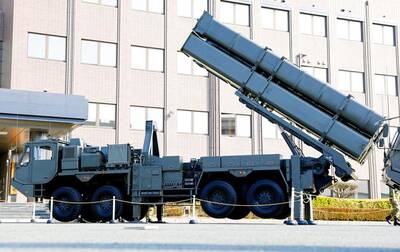
Japan has deployed long-range missiles in a southwestern region near China, the Japanese defense minister said yesterday, at a time when ties with Beijing are at their lowest in recent years. The missiles were installed in Kumamoto in the southern region of Kyushu, as Japan is attempting to shore up its military capacity as China steps up naval activity in the East China Sea. “Standoff defense capabilities enable us to counter the threat of enemy forces attempting to invade our country ... while ensuring the safety of our personnel,” Japanese Minister of Defense Shinjiro Koizumi said. “This is an extremely important initiative for

Chinese Nationalist Party (KMT) Chairwoman Cheng Li-wun (鄭麗文) today accepted an invitation from Chinese President Xi Jinping (習近平) to lead a delegation to China next month, saying she hopes to promote the peaceful development of cross-strait relations and bring stability to the Taiwan Strait. “I am grateful and happy to accept this invitation,” Cheng said in a statement from the KMT chairperson’s office. Cheng said she hopes both sides can work together to promote the peaceful development of cross-strait relations, enhance exchange and cooperation, bring stability to the Taiwan Strait and improve people’s livelihoods. At today's news conference, Cheng said any efforts to
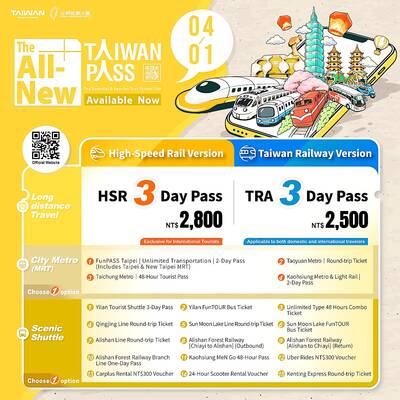
MORE POPULAR: Taiwan Pass sales increased by 59 percent during the first quarter compared with the same period last year, the Tourism Administration said The Tourism Administration yesterday said that it has streamlined the Taiwan Pass, with two versions available for purchase beginning today. The tourism agency has made the pass available to international tourists since 2024, allowing them to access the high-speed rail, Taiwan Railway Corp services, four MRT systems and four Taiwan Tourist Shuttles. Previously, five types of Taiwan Pass were available, but some tourists have said that the offerings were too complicated. The agency said only two types of Taiwan Pass would be available, starting from a three-day pass with the high-speed rail and a three-day pass with Taiwan Railway Corp. The former costs NT$2,800

The nation’s fastest supercomputer, Nano 4 (晶創26), is scheduled to be launched in the third quarter, and would be used to train large language models in finance and national defense sectors, the National Center for High-Performance Computing (NCHC) said. The supercomputer, which would operate at about 86.05 petaflops, is being tested at a new cloud computing center in the Southern Taiwan Science Park in Tainan. The exterior of the server cabinet features chip circuitry patterns overlaid with a map of Taiwan, highlighting the nation’s central position in the semiconductor industry. The center also houses Taiwania 2, Taiwania 3, Forerunner 1 and


 RSS
RSS