


Environmental groups joined forces and braved the rain in Taipei yesterday to march against air pollution and call for measures against it.
The march was co-organized by more than a dozen groups, including Air Clean Taiwan (ACT), South Taiwan Air Clear, the National Federation of Teachers’ Unions, the Alliance for the Rescue of Datan Algae Reefs, the Taiwan Academy of Ecology and the Taiwan Tree Protection Coalition.
Several political parties were also represented at the march, including the New Power Party, the New Party and the Taiwan People’s Party.
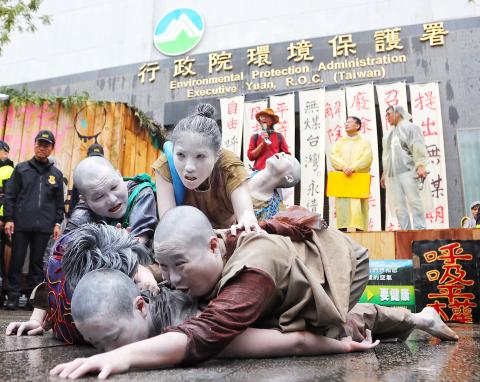
Photo: CNA
At about noon, demonstrators gathered outside the Environmental Protection Administration building, where the vice presidential candidates of the Democratic Progressive Party (DPP) and the Chinese Nationalist Party (KMT) spoke to them before the march began.
The DPP’s candidate, former premier William Lai (賴清德), said that during his premiership from September 2017 to January the Executive Yuan’s National Council for Sustainable Development released the nation’s first Voluntary National Review.
He mentioned a number of proposals, including closer collaboration between the council and private groups and businesses; a reassessment of the Greenhouse Gas Reduction and Management Act (溫室氣體減量及管理法); and the development of a timetable for carbon neutrality in Taiwan, for the future.
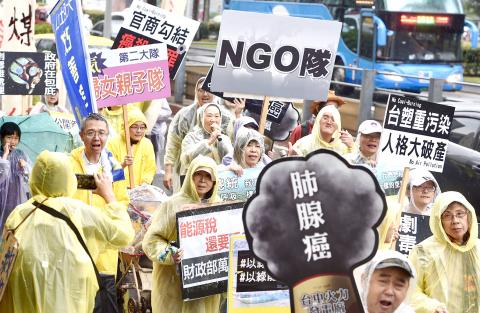
Photo: Peter Lo, Taipei Times
However, some demonstrators demanded “promises” instead of “empty words” as Lai left the scene.
Shortly after Lai’s departure, the KMT’s vice presidential candidate, former premier Simon Chang (張善政), who served during former president Ma Ying-jeou’s (馬英九) second term, spoke to the crowd.
Chang claimed that former Academia Sinica president Lee Yuan-tseh (李遠哲) quoted President Tsai Ing-wen (蔡英文) as saying that “solving [the problem of] air pollution is the next generation’s business.”
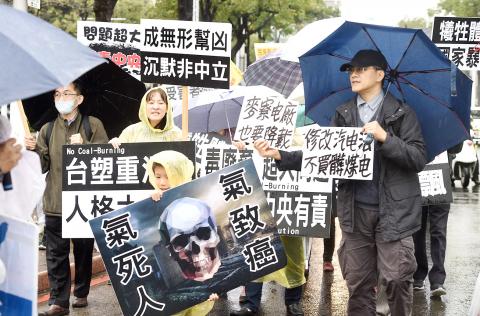
Photo: Peter Lo, Taipei Times
Chang said “we 1,000 percent disagree.”
Chang said his campaign’s energy policy is to “carry out the results of last year’s two referendums.”
“One is to reduce coal-fired power generation each year, and the second is to ‘use nuclear to support green,’” he said. “We also support green energy, but we do not support an impetuous [shift to] green energy.”
However, Chang’s mention of “using nuclear to support green” appeared to upset some demonstrators, who interrupted him by saying they wanted a “nuclear-free homeland.”
After a series of scheduled speeches by group representatives, the demonstrators at about 1:30pm began their march toward Liberty Square, arriving at about 3pm.
They shouted slogans such as “The greater south wants health," “Breathing needs equal rights,” and “Coal-free Taiwan, sustainable health” as they marched.
They also held signs that read, “Nuclear-free, coal-free homeland,” and “Legalized harm, state violence,” among other messages.
For the march, ACT listed four major demands, including the hosting of a “climate conference” and the abolition of the “centralization of energy.”
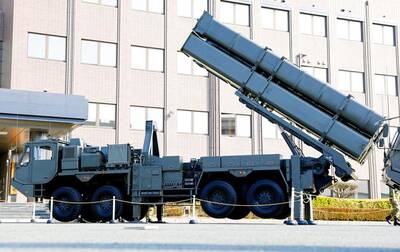
Japan has deployed long-range missiles in a southwestern region near China, the Japanese defense minister said yesterday, at a time when ties with Beijing are at their lowest in recent years. The missiles were installed in Kumamoto in the southern region of Kyushu, as Japan is attempting to shore up its military capacity as China steps up naval activity in the East China Sea. “Standoff defense capabilities enable us to counter the threat of enemy forces attempting to invade our country ... while ensuring the safety of our personnel,” Japanese Minister of Defense Shinjiro Koizumi said. “This is an extremely important initiative for
Chinese Nationalist Party (KMT) Chairwoman Cheng Li-wun (鄭麗文) today accepted an invitation from Chinese President Xi Jinping (習近平) to lead a delegation to China next month, saying she hopes to promote the peaceful development of cross-strait relations and bring stability to the Taiwan Strait. “I am grateful and happy to accept this invitation,” Cheng said in a statement from the KMT chairperson’s office. Cheng said she hopes both sides can work together to promote the peaceful development of cross-strait relations, enhance exchange and cooperation, bring stability to the Taiwan Strait and improve people’s livelihoods. At today's news conference, Cheng said any efforts to

MORE POPULAR: Taiwan Pass sales increased by 59 percent during the first quarter compared with the same period last year, the Tourism Administration said The Tourism Administration yesterday said that it has streamlined the Taiwan Pass, with two versions available for purchase beginning today. The tourism agency has made the pass available to international tourists since 2024, allowing them to access the high-speed rail, Taiwan Railway Corp services, four MRT systems and four Taiwan Tourist Shuttles. Previously, five types of Taiwan Pass were available, but some tourists have said that the offerings were too complicated. The agency said only two types of Taiwan Pass would be available, starting from a three-day pass with the high-speed rail and a three-day pass with Taiwan Railway Corp. The former costs NT$2,800

The nation’s fastest supercomputer, Nano 4 (晶創26), is scheduled to be launched in the third quarter, and would be used to train large language models in finance and national defense sectors, the National Center for High-Performance Computing (NCHC) said. The supercomputer, which would operate at about 86.05 petaflops, is being tested at a new cloud computing center in the Southern Taiwan Science Park in Tainan. The exterior of the server cabinet features chip circuitry patterns overlaid with a map of Taiwan, highlighting the nation’s central position in the semiconductor industry. The center also houses Taiwania 2, Taiwania 3, Forerunner 1 and


 RSS
RSS