


Civil groups yesterday submitted 30,000 petition papers to the Central Election Commission (CEC) in a bid to recall Kaohsiung Mayor Han Kuo-yu (韓國瑜), the Chinese Nationalist Party’s (KMT) presidential candidate.
While only 22,814 petition papers are required in the initial stage of a mayoral recall, the groups have collected nearly 300,000, Wecare Kaohsiung founder Aaron Yin (尹立) said.
Once the CEC confirms their application, they would launch the second stage, for which they would collect at least 228,134 petition papers, the groups said.
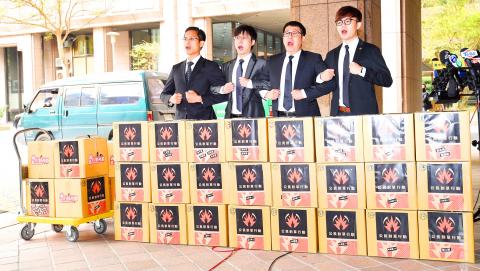
Photo: Liu Hsin-de, Taipei Times
If successful, a recall vote could be expected in May or June, they said.
Wecare Kaohsiung, Citizen Mowing Action and other groups launched a campaign to recall Han on June 27 after the mayor announced earlier that month that he would join the KMT’s presidential primary, Yin said.
Civil groups are recalling Han because he has abandoned his mayoral responsibilities in Kaohsiung, said Chen Kuan-jung (陳冠榮), initiator of the recall.
As mayor, the KMT presidential candidate has achieved little by way of policy results, and has even made multiple sexist and racist remarks, which have “seriously damaged the city’s and the nation’s image,” he said.
Yin said that for the next stage, the groups would form an alliance to recall Han, which would be headed by Citizen Mowing Action spokesman Lee Yi-chieh (李佾潔).
“We are confident that we can collect enough petition papers,” Yin added.
Han said that he thinks the recall campaign is “completely unacceptable,” as it is likely political manipulation.
While he “fully respects” people’s right to recall elected officials, he believes that the ongoing recall campaign would be remembered as a “very, very distorted page in Taiwan’s history of democracy,” Han told reporters in Taipei.
That the recall campaign began in February, just two month after he became mayor, shows that the Democratic Progressive Party (DPP) thinks it owns Kaohsiung, he said, hinting that the DPP might be behind the campaign.
The DPP did a terrible job when they controlled the city government and the “people of Kaohsiung have woken up,” he said.
Han’s campaign office spokeswoman Anne Wang (王淺秋) questioned the legality of the recall campaign, saying that Article 75 of the Civil Servants Election and Recall Act (公職人員選舉罷免法) states that officials cannot be recalled until a year after they are sworn in.
Civil groups might have breached the act by collecting petition papers before Wednesday, the anniversary of Han’s swearing-in ceremony, she said.
There is no law prohibiting the signing of recall petition papers before an official has been in office one year, the commission said, citing a document from the Ministry of the Interior.
The one-year requirement stipulated in Article 75 pertains to the submission of the petition papers to authorities, the commission said.
To recall the mayor, 25 percent of Kaohsiung’s electorate, or about 580,000 people, must vote in favor of recalling him, with the number of “yes” votes exceeding the number of “no” votes.
If passed, it would be the first time that the mayor of a special municipality had been recalled.
Additional reporting by Huang Hsin-po

LEVERAGE: China did not ‘need to fire a shot’ to deny Taiwan airspace over Africa when it owns ‘half the continent’s debt,’ a US official said, calling it economic warfare The EU has raised concerns about overflight rights following the delay of President William Lai’s (賴清德) planned state visit to the Kingdom of Eswatini after three African nations denied overflight clearance for his charter at the last minute. Taiwanese allies Paraguay and Saint Kitts and Nevis, as well as several US lawmakers and the Inter-Parliamentary Alliance on China (IPAC) condemned China for allegedly pressuring the countries. Lai was scheduled to fly directly to Taiwan’s only African ally from yesterday to Sunday to celebrate the 40th anniversary of King Mswati III’s accession and his 58th birthday, but Seychelles, Mauritius and Madagascar suddenly revoked

PROVOCATIVE: Chinese Deputy Ambassador to the UN Sun Lei accused Japan of sending military vessels to deliberately provoke tensions in the Taiwan Strait China denounced remarks by Japan and the EU about the South China Sea at a UN Security Council meeting on Monday, and accused Tokyo of provocative behavior in the Taiwan Strait and planning military expansion. Ayano Kunimitsu, a Japanese vice foreign minister, told the Council meeting on maritime security that Tokyo was seriously concerned about the situation in the East China and South China seas, and reiterated Japan’s opposition to any attempt to change the “status quo” by force, and obstruction of freedom of navigation and overflight. Stavros Lambrinidis, head of the EU delegation to the UN, also highlighted South China Sea
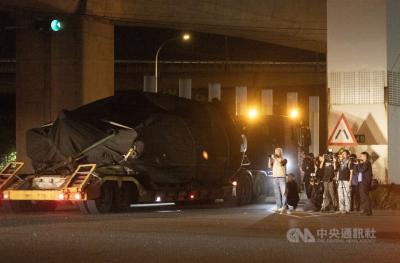
The final batch of 28 M1A2T Abrams tanks purchased from the US arrived at Taipei Port last night and were transported to the Armor Training Command in Hsinchu County’s Hukou Township (湖口), completing the military’s multi-year procurement of 108 of the tanks. Starting at 12:10am today, reporters observed more than a dozen civilian flatbed trailers departing from Taipei Port, each carrying an M1A2T tank covered with black waterproof tarps. Escorted by military vehicles, the convoy traveled via the West Coast Expressway to the Armor Training Command, with police implementing traffic control. The army operates about 1,000 tanks, including CM-11 Brave Tiger
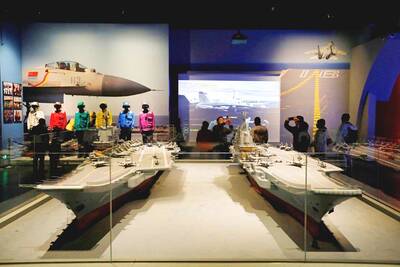
China on Wednesday teased in a video an aircraft carrier that could be its fourth, and the first using nuclear power, while making an allusion to Taiwan and vowing to further build up its islands, as it looks to boost maritime power, secure resources and bolster territorial claims. The video, issued on the eve of the 77th founding anniversary of the Chinese People’s Liberation Army Navy, featured fictional officers with names that are homophones of three commissioned aircraft carriers, the Liaoning (遼寧), Shandong (山東) and Fujian (福建). Titled Into the Deep, it showed a 19-year-old named “Hejian” (何劍) joining the group, sparking


 RSS
RSS