


A Taiwanese YouTuber has had his contract with a Chinese agency canceled after he refused to delete videos in which he addressed President Tsai Ing-wen (蔡英文) as “president.”
YouTuber Potter King (波特王) — who is well-known for his videos in which he hits on girls — published videos to his Facebook page and YouTube channel on Saturday after Tsai visited him at his studio.
In the video King can be seen joking with Tsai in his characteristic way and repeatedly referring to her as “president.”
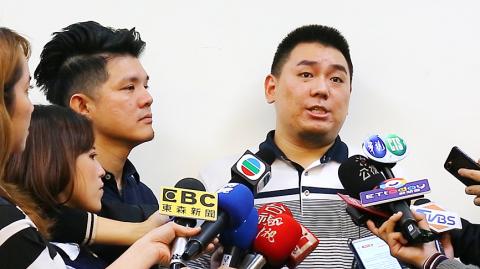
Photo: Lee Hui-chou, Taipei Times
After the videos were published, Papitube — a Chinese agency that manages King’s content for Chinese video platforms — demanded that he remove the videos, while condemning him on its official Weibo account for “inappropriate language and actions.”
As King is away on vacation, his business partner, Juyang Media (聚暘互聯媒體) chief executive Mars Lee, spoke to reporters.
Lee said the video had already been removed from Chinese platforms, and while this would cost the company “millions of New Taiwan dollars ... what we stand for is democracy.”
Reiterating comments he posted earlier on Facebook, Lee said there was “no way he could accept” the demands of the company’s Chinese partner.
“When we first saw [Papitube’s demands], we were quite uncomfortable. First of all, it was their tone — they were ordering us. Secondly, I’ve never been told before that I couldn’t say the word ‘president,’” he said.
He added that he had hoped he could reach more viewers in China, but the incident showed that the situation in China was very different from Taiwan, where viewers themselves could decide whether they liked the company’s videos.
The biggest impact of the cancelation of the contract with Papitube was that the company would reach fewer viewers in China and Malaysia, he said.
“We had a million fans on Weibo after running the account for about a year and a half, but when we tried to use it on Saturday we were logged out and it wouldn’t let us log in,” he said.
Lee said he was asked by Papitube if he wanted to “give up the ‘mainland’ market,” to which he replied: “When you put it like that, I guess so.”
Commenting on the incident, Tsai said that Taiwan is a free country, and it is only a natural and normal thing to do when people address her as president.
“People in Taiwan would find it difficult to accept what happened to King. We are a free and democratic society and everyone can engage in creative arts production. It is also a natural and normal thing to do to address me as president,” Tsai said. “It would be against our cherished democratic values if we cannot talk about the president of Taiwan in an online video.”
Kaohsiung Mayor Han Kuo-yu (韓國瑜), the Chinese Nationalist Party’s (KMT) presidential candidate, on Sunday evening said that politics and economics should be separate.
“Companies in [the] Mainland should not be punishing Potter King. I believe that is wrong,” Han said in a Facebook livestream.
“I am lodging a protest against this and siding with Potter King,” he said, adding that cross-strait exchanges should be conducted in a peaceful manner.
Asked about Tsai’s and Han’s comments that they support King, Lee said: “We don’t want to focus on who supports who. What we support is democracy.”
“Democracy is easy to find in Taiwan, but in other countries it’s very much the opposite,” he said, adding that Taiwanese should protect democracy, which is something that others give up their lives fighting for.
Asked about future plans, Lee said he hoped to expand in Malaysia and the US to “allow many more people to see our content.”
Additional reporting by Shelley Shan and Ann Maxon

‘NO SECURITY RISK’: The Railway Bureau reassured the public that the technicians’ activities were limited to technical guidance and did not involve sensitive systems The Railway Bureau yesterday said it had invited eight Chinese technicians to assist with an airport MRT construction project. The bureau issued the confirmation after an Internet user said Chinese nationals had entered the construction zone of Taiwan Taoyuan International Airport’s Terminal 3 project. They asked why “individuals from an enemy state” were allowed access to such a major national infrastructure project, which raised serious concerns over Taiwan’s industrial safety, sensitive systems and information security. The bureau’s Northern Region Engineering Branch Office said subcontractor Taiwan Handle Industrial Co (台灣手把工業) of the Taoyuan airport MRT’s “Contract No. CU05 Project A14 Station Civil, MEP &

The National Chungshan Institute of Science and Technology yesterday showcased its locally developed variants of the Vision 60 robotic patrol dog, which it plans to deploy on the nation’s outlying territories in the South China Sea. The variants were produced under the Joint Lab project — created by the institute and domestic companies — and assembled with domestically produced motors, lenses and artificial intelligence (AI) systems alongside licensed tech from the US, Missile and Rocket Systems Research Division deputy director Jen Kuo-kang (任國光) told the media event at a military base in Taipei’s Dazhi (大直) area. Taiwan has built up its strengths

TIT-FOR-TAT: The US allegedly revoked the visa of a Chinese national working at Xinhua News Agency in the US in response to Beijing’s expulsion of Vivian Wang The Presidential Office yesterday condemned China for expelling a New York Times correspondent from Beijing following the newspaper’s interview with President William Lai (賴清德), saying the move highlighted Beijing’s suppression of press freedom and its threat to international news media. Taiwan has noted a series of recent incidents in which Beijing used similar tactics to “threaten and pressure international media outlets and journalists,” Presidential Office spokeswoman Karen Kuo (郭雅慧) said in a statement. “This concerns not only press freedom and freedom of expression, but also the safety of journalists, and Taiwan and relevant partners are paying close attention to the situation,” she

NOT IMMEDIATE: Taiwan has a chance to appeal the proposed 10 percent tariff before it starts, while other countries face a 12.5 percent tariff from the trade office Taiwan is among 60 economies determined by the US to have failed to impose or enforce a ban on the importation of goods produced with forced labor, according to a notice released on Tuesday by the Office of the US Trade Representative (USTR), which proposed imposing an additional 10 percent or more tariff on them. The USTR in a statement said that following an investigation, it had determined under Section 301 of the Trade Act of 1974 that the failure of the 60 economies to impose and effectively enforce a prohibition on the importation of goods produced with forced labor is


 RSS
RSS