


The Civil Aeronautics Administration (CAA) yesterday said that it has asked two domestic carriers to offer additional flights to Kinmen and Penghu after Far Eastern Air Transport (FAT, 遠東航空) announced that it is to cease operations today.
There are 500 passengers stranded overseas, the CAA added.
FAT yesterday morning said that its Web site was temporarily shut down for maintenance, which was what happened on Nov. 23, 2016, the day TransAsia Airways terminated its operations.
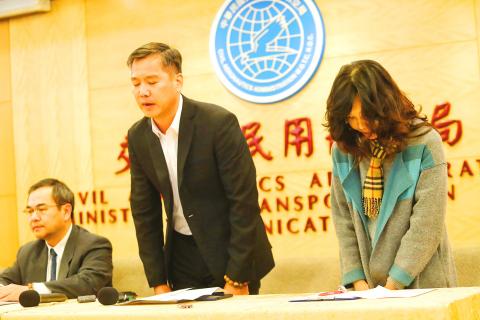
Photo: CNA
“Due to financial losses and difficulties in securing funds for operations, we would stop all aviation services starting Dec. 13,” FAT wrote in a statement yesterday.
“Severance pay for our employees would be calculated until Dec. 13, except those who are to stay at the company to handle the aftermath,” it said. “The human resources department would send employment certificates and documents to cancel employees’ National Health Insurance and labor insurance so they can apply for unemployment compensation.”
At a news conference at CAA headquarters in Taipei yesterday, FAT vice presidents Huang Yu-chi (黃育祺) and Lu Chi-rong (盧紀融) bowed and apologized to the public for any inconvenience.
FAT has a funding gap of about NT$30 million (US$986,647), Huang said.
“Since 2011, people have seen how hard FAT chairman Chang Kang-wei (張綱維) has worked to fund the airline’s operations,” Huang said. “Despite the losses, Chang still hoped to move the company forward and it is a pity that it has to shut down because of funding problems.”
Huang said that even top officials, including himself, had not known until yesterday morning that the company had failed to make mortgage payments.
There had been attempts to contact Chang all morning, but to no avail, he said.
“This is too sudden,” Huang said. “The company has 1,008 employees. We would try to protect employees.”
Asked when he had last seen Chang, Huang said that the chairman’s secretary reported he was in his office on Wednesday morning.
However, Huang himself had not seen him for three weeks, he added.
Although the airline had only temporarily suspended operations and would try to resume operations today, the CAA said that it would not allow FAT to offer flights given its financial problems.
During the news conference, Chang sent a message via the Line messaging app, saying that he was sorry for what happened.
Despite investing more than NT$900 million in the airline, its financial losses deepened due to a decline in cross-strait flights and his misguided trust in false promises by four Chinese con men, Chang said.
They lied about wanting to invest in the firm and charged him high processing fees, he said, adding that the police should investigate.
CAA Deputy Director Fang Chih-wen (方志文) said that the agency has been closely monitoring FAT’s operations since July 2017, particularly its cash flow.
It reminded the airline that it needed sufficient funds to make short-term mortgage payments, Fang said.
The CAA formed an emergency response team at 8am yesterday and asked the company’s management to explain the situation, he said.
FAT has NT$267 million in a consumer protection trust fund, including NT$150 million in cash and NT$117 million in checks, which would be used to refund passengers who have unused tickets, he said.
The unexpected announcement has left 500 people stranded overseas, with 169 passengers in China and 331 elsewhere, Fang said.
The CAA has coordinated with Uni Air (立榮航空) and Mandarin Airlines (華信航空) to offer 16 additional flights to Kinmen and Penghu counties today, he said, adding that they would have adequate capacity to transport people ahead of the Jan. 11 elections and the Lunar New Year holiday at the end of next month.
Founded in 1957, FAT was the nation’s first civil carrier and offered mainly domestic flights. It encountered financial concerns and temporarily suspended operations in 2008, when it was unable to pay aviation fuel charges and aircraft landing fees.
In April 2009, the Taipei District Court approved a company plan to restructure its finances.
Chang took ownership of the airline in October that year and it resumed flights on April 18, 2011.
In May, Chang told a news conference that the airline canceled 31 international flights because the CAA imposed flight hour restrictions on it.
The company was operating normally and had no funding problems, he said at the time.

NO-LIMITS PARTNERSHIP: ‘The bottom line’ is that if the US were to have a conflict with China or Russia it would likely open up a second front with the other, a US senator said Beijing and Moscow could cooperate in a conflict over Taiwan, the top US intelligence chief told the US Senate this week. “We see China and Russia, for the first time, exercising together in relation to Taiwan and recognizing that this is a place where China definitely wants Russia to be working with them, and we see no reason why they wouldn’t,” US Director of National Intelligence Avril Haines told a US Senate Committee on Armed Services hearing on Thursday. US Senator Mike Rounds asked Haines about such a potential scenario. He also asked US Defense Intelligence Agency Director Lieutenant General Jeffrey Kruse

INSPIRING: Taiwan has been a model in the Asia-Pacific region with its democratic transition, free and fair elections and open society, the vice president-elect said Taiwan can play a leadership role in the Asia-Pacific region, vice president-elect Hsiao Bi-khim (蕭美琴) told a forum in Taipei yesterday, highlighting the nation’s resilience in the face of geopolitical challenges. “Not only can Taiwan help, but Taiwan can lead ... not only can Taiwan play a leadership role, but Taiwan’s leadership is important to the world,” Hsiao told the annual forum hosted by the Center for Asia-Pacific Resilience and Innovation think tank. Hsiao thanked Taiwan’s international friends for their long-term support, citing the example of US President Joe Biden last month signing into law a bill to provide aid to Taiwan,
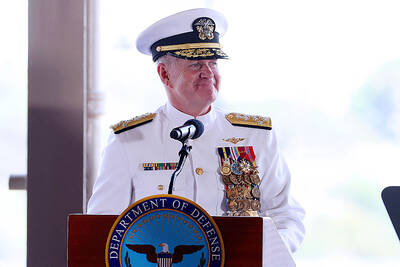
China’s intrusive and territorial claims in the Indo-Pacific region are “illegal, coercive, aggressive and deceptive,” new US Indo-Pacific Commander Admiral Samuel Paparo said on Friday, adding that he would continue working with allies and partners to keep the area free and open. Paparo made the remarks at a change-of-command ceremony at Joint Base Pearl Harbor-Hickam in Hawaii, where he took over the command from Admiral John Aquilino. “Our world faces a complex problem set in the troubling actions of the People’s Republic of China [PRC] and its rapid buildup of forces. We must be ready to answer the PRC’s increasingly intrusive and
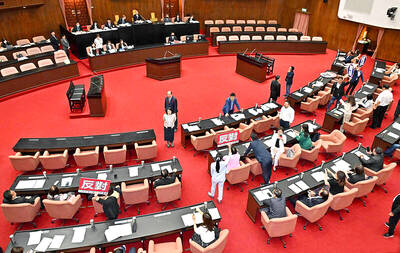
STATE OF THE NATION: The legislature should invite the president to deliver an address every year, the TPP said, adding that Lai should also have to answer legislators’ questions The Chinese Nationalist Party (KMT) yesterday proposed inviting president-elect William Lai (賴清德) to make a historic first state of the nation address at the legislature following his inauguration on May 20. Lai is expected to face many domestic and international challenges, and should clarify his intended policies with the public’s representatives, KMT caucus secretary-general Hung Meng-kai (洪孟楷) said when making the proposal at a meeting of the legislature’s Procedure Committee. The committee voted to add the item to the agenda for Friday, along with another similar proposal put forward by the Taiwan People’s Party (TPP). The invitation is in line with Article 15-2


 RSS
RSS