


Kaohsiung Mayor Han Kuo-yu (韓國瑜) yesterday accused the media of invading his privacy, amid reports that he had purchased a luxury apartment in Taipei in 2011 and questions about how he financed the purchase.
The Chinese Nationalist Party (KMT) presidential candidate purchased a 90 ping (298m2) apartment in Nangang District (南港) for more than NT$70 million (US$2.3 million at the current exchange rate) and sold it in 2015 at a loss of about 3.5 percent, the Chinese-language Next Magazine reported on Wednesday.
Han yesterday fired back on Facebook.
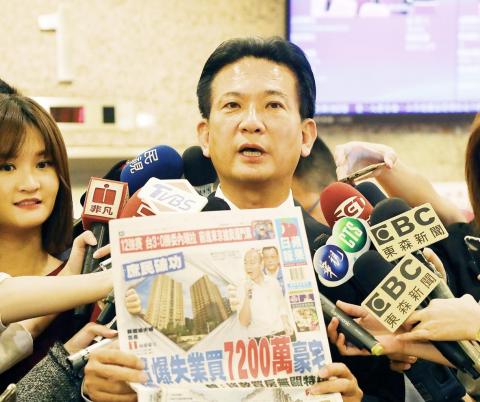
Photo: CNA
“A simple and legal sale has been publicized during this period leading up to the elections at the expense of an individual’s privacy,” he wrote. “I strongly question the motivations of the people who leaked the information.”
He condemned the media interest in a 2011 purchase, saying that he and his wife, Lee Chia-fen (李佳芬), had not been obliged to reveal details of their assets at the time, as neither held public office.
Only Taiwan Fertilizer Co’s (台肥) construction arm and the National Taxation Bureau would have information about the transaction, which raised questions about where the magazine got its information, he said.
Government agencies should investigate any improper leaks of personal information, he told reporters in Hsinchu.
“This is not about me, but about the rights of nation’s 23 million citizens,” Han said.
Han campaign office spokesman Ye Yuan-zhi (葉元之) echoed that concern.
“It is very frightening that such private information from years ago could be obtained by others after Han announced his presidential bid,” Ye said.
Han sold the apartment in 2016 before applying for a mortgage, because he realized that his family could not afford it, and he lost more than NT$2 million in the sale, Ye said.
Responding to Democratic Progressive Party (DDP) Legislator Lin Chun-hsien’s (林俊憲) allegation that Han had used his political connections to demand a 20-year loan of more than NT$14 million from Taiwan Fertilizer to make the 2011 purchase, Ye said the company offered loans to all buyers of its units.
The DPP is apparently attempting to defame Han with rumors, Ye said.
Taiwan Fertilizer yesterday said that had offered a loan to Han and “every buyer who needed it.”
Next Magazine yesterday issued a statement saying that it had obtained information about Han’s Nangang purchase from a combination of sources, including court records, residents in the apartment complex, real-estate agents and people close to the Han family.
It also verified the information with Han’s campaign office spokeswoman Ho Ting-huan (何庭歡) before publishing the story, it said.
“Mayor Han tried to dismiss the media’s responsibility to keep the government in check by labeling the story as an invasion of privacy. That is not the right attitude for any politician who might shoulder the responsibility of running the nation in the future,” the magazine said.
Asked about Han’s Facebook post, Presidential Office Secretary-General Chen Chu (陳菊) said that Han is welcome to provide evidence that the government leaked his personal information.
“We would support the police and prosecutors handling such a case according to strict standards,” she said.
Asked by reporters about Han’s claims, President Tsai Ing-wen (蔡英文) said that claims about the government abusing its power should be supported with evidence.
“A while ago, there was a [purported] tracking device, and we still do not know what happened with that one,” Tsai said, referring to Han’s claim in August that “the state apparatus” might have installed a tracking device on his vehicle.
Additional reporting by Chang Huei-wen
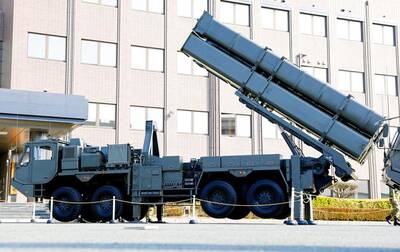
Japan has deployed long-range missiles in a southwestern region near China, the Japanese defense minister said yesterday, at a time when ties with Beijing are at their lowest in recent years. The missiles were installed in Kumamoto in the southern region of Kyushu, as Japan is attempting to shore up its military capacity as China steps up naval activity in the East China Sea. “Standoff defense capabilities enable us to counter the threat of enemy forces attempting to invade our country ... while ensuring the safety of our personnel,” Japanese Minister of Defense Shinjiro Koizumi said. “This is an extremely important initiative for
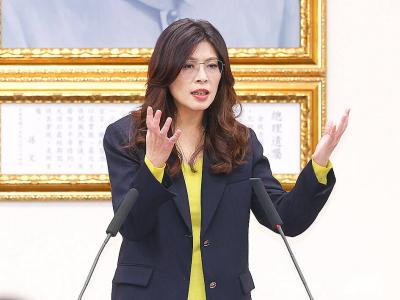
Chinese Nationalist Party (KMT) Chairwoman Cheng Li-wun (鄭麗文) today accepted an invitation from Chinese President Xi Jinping (習近平) to lead a delegation to China next month, saying she hopes to promote the peaceful development of cross-strait relations and bring stability to the Taiwan Strait. “I am grateful and happy to accept this invitation,” Cheng said in a statement from the KMT chairperson’s office. Cheng said she hopes both sides can work together to promote the peaceful development of cross-strait relations, enhance exchange and cooperation, bring stability to the Taiwan Strait and improve people’s livelihoods. At today's news conference, Cheng said any efforts to
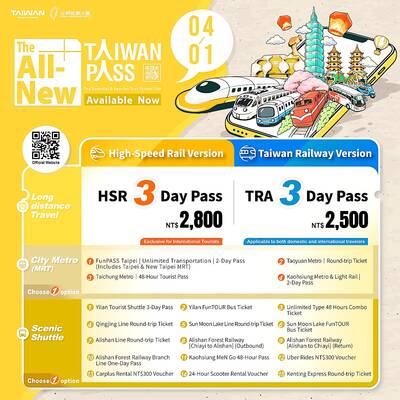
MORE POPULAR: Taiwan Pass sales increased by 59 percent during the first quarter compared with the same period last year, the Tourism Administration said The Tourism Administration yesterday said that it has streamlined the Taiwan Pass, with two versions available for purchase beginning today. The tourism agency has made the pass available to international tourists since 2024, allowing them to access the high-speed rail, Taiwan Railway Corp services, four MRT systems and four Taiwan Tourist Shuttles. Previously, five types of Taiwan Pass were available, but some tourists have said that the offerings were too complicated. The agency said only two types of Taiwan Pass would be available, starting from a three-day pass with the high-speed rail and a three-day pass with Taiwan Railway Corp. The former costs NT$2,800

The nation’s fastest supercomputer, Nano 4 (晶創26), is scheduled to be launched in the third quarter, and would be used to train large language models in finance and national defense sectors, the National Center for High-Performance Computing (NCHC) said. The supercomputer, which would operate at about 86.05 petaflops, is being tested at a new cloud computing center in the Southern Taiwan Science Park in Tainan. The exterior of the server cabinet features chip circuitry patterns overlaid with a map of Taiwan, highlighting the nation’s central position in the semiconductor industry. The center also houses Taiwania 2, Taiwania 3, Forerunner 1 and


 RSS
RSS