


A group in Changhua County is suspected of having defrauded the national treasury of nearly NT$16 million (US$524,023) by printing fake receipts to claim prize money from the Ministry of Finance’s Uniform Invoice Lottery.
Changhua District Prosecutors’ Office Head Prosecutor Wu Yu-hsuan (吳宇軒) on Tuesday led a team of more than 100 people to search and seize hundreds of boxes of blank receipts, printers, allegedly fake receipts and other evidence.
Prosecutors Shih Chiao-wen (施教文) and Lai Cheng-an (賴政安) have been assigned to form a special committee to investigate the case.
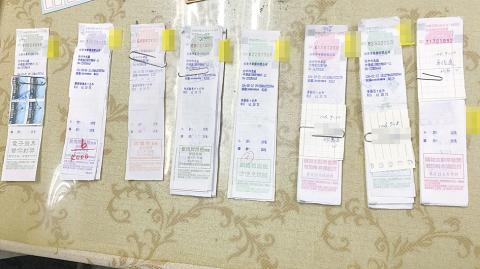
Photo courtesy of the Changhua District Prosecutors’ Office
The office has summoned 12 people, including a man surnamed Lu (盧), 33, who is believed to be a main suspect and has been taken into custody.
Another main suspect, surnamed Tseng (曾), 34, was released on bail of NT$100,000.
The group allegedly set up a fake firm to buy large amounts of blank uniform receipts, the office said.
After the lottery’s winning numbers are announced, the group would take the blank receipts with the winning numbers on them and print fake details of a transaction that had not occurred, it said.
They would then distribute the fake receipts to group members to take to different convenience stores to claim the prizes, the office said.
Since November 2016, the group has redeemed 59,203 receipts for prizes varying from NT$200 to NT$200,000, totaling NT$15,965,800, it said.
From July to August, the group purchased 1.7 million blank receipts from the National Taxation Bureau, spending about NT$244,800, office Deputy Chief Prosecutor Yeh Chien-cheng (葉建成) said.
Including the roughly NT$70,000 for the 5 percent business tax for the seven water filling stations it was using as shell companies, the group spent about NT$310,000 each lottery session for NT$2.2 million in prize money, Yeh said.
From last month to this month, it purchased another 2 million blank receipts, he said, adding that those were seized.
Yeh said he believed that this is the “first case” of people taking advantage of blank receipts to engage in lottery fraud in Taiwan.
Group members are suspected of contravening the Organized Crime Prevention Act (組織犯罪防制條例), the Business Entity Accounting Act (商業會計法) and the Criminal Code, among other laws, he said.
There were concerns that Tseng and Lu could destroy or alter evidence or collude, so the office applied for permission from the court to detain them, he said.
Three other suspects, surnamed Yang (楊), Wu (吳) and Wei (魏), were also released on NT$100,000 bail, he said.
Another seven were released on bail of NT$20,000, he added.
The investigation was spurred by the National Taxation Bureau of the Central Area’s suspicion about the high winning rate of receipts issued by the company.

The National Chungshan Institute of Science and Technology yesterday showcased its locally developed variants of the Vision 60 robotic patrol dog, which it plans to deploy on the nation’s outlying territories in the South China Sea. The variants were produced under the Joint Lab project — created by the institute and domestic companies — and assembled with domestically produced motors, lenses and artificial intelligence (AI) systems alongside licensed tech from the US, Missile and Rocket Systems Research Division deputy director Jen Kuo-kang (任國光) told the media event at a military base in Taipei’s Dazhi (大直) area. Taiwan has built up its strengths

RIGHT DIRECTION: Taiwan’s efforts to prevent forced labor include a proposal to ‘fully prohibit’ employers from withholding workers’ documents, an official said Taiwan is to establish a mechanism to restrict imports of goods linked to forced labor, the Executive Yuan said yesterday, after the US proposed imposing additional tariffs on Taiwanese goods over labor concerns. “The Ministry of Labor and the Ministry of Economic Affairs are to establish an interministerial review procedure,” Executive Yuan spokesperson Michelle Lee (李慧芝) said at a news briefing in Taipei. “The government is to use the Foreign Trade Act [貿易法] as the legal basis to restrict imports of goods produced with forced labor” and bring its supply chain governance more in line with international standards on human rights, resilience
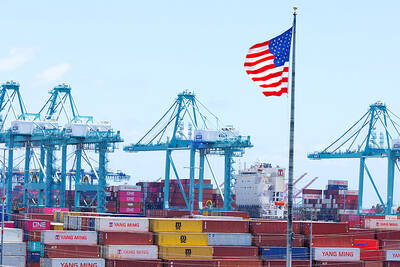
NOT IMMEDIATE: Taiwan has a chance to appeal the proposed 10 percent tariff before it starts, while other countries face a 12.5 percent tariff from the trade office Taiwan is among 60 economies determined by the US to have failed to impose or enforce a ban on the importation of goods produced with forced labor, according to a notice released on Tuesday by the Office of the US Trade Representative (USTR), which proposed imposing an additional 10 percent or more tariff on them. The USTR in a statement said that following an investigation, it had determined under Section 301 of the Trade Act of 1974 that the failure of the 60 economies to impose and effectively enforce a prohibition on the importation of goods produced with forced labor is
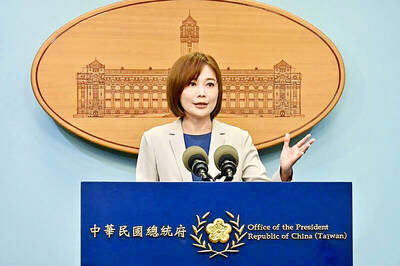
TIT-FOR-TAT: The US allegedly revoked the visa of a Chinese national working at Xinhua News Agency in the US in response to Beijing’s expulsion of Vivian Wang The Presidential Office yesterday condemned China for expelling a New York Times correspondent from Beijing following the newspaper’s interview with President William Lai (賴清德), saying the move highlighted Beijing’s suppression of press freedom and its threat to international news media. Taiwan has noted a series of recent incidents in which Beijing used similar tactics to “threaten and pressure international media outlets and journalists,” Presidential Office spokeswoman Karen Kuo (郭雅慧) said in a statement. “This concerns not only press freedom and freedom of expression, but also the safety of journalists, and Taiwan and relevant partners are paying close attention to the situation,” she


 RSS
RSS