


Hong Kong police yesterday shot a democracy campaigner as the territory was lashed by its worst unrest of the year, hours after Beijing celebrated 70 years of Chinese Communist Party rule with a massive military parade.
It was the first such shooting in nearly four months of increasingly violent protests and threatened to strip the spotlight from China’s carefully choreographed birthday party, designed to underscore its status as a global superpower.
While Chinese President Xi Jinping (習近平) took salutes from about 15,000 troops in the capital, pro-democracy protesters in Hong Kong threw eggs at his portrait, with tens of thousands of people defying police orders to disperse.
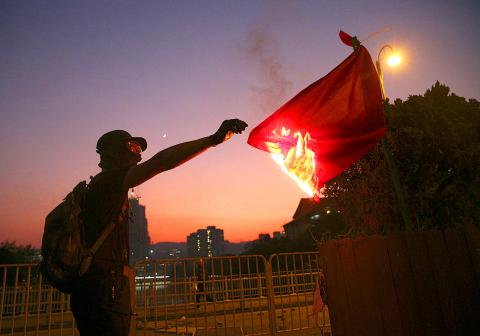
Photo: EPA-EFE
Running battles raged for hours across multiple locations, with some hardcore protesters hurling rocks and gasoline bombs, while police responded for the most part with tear gas, rubber bullets and water cannon.
In Tsuen Wan District, a police officer unloaded his weapon at close range into a young man after his unit was attacked by protesters armed with poles and umbrellas, videos filmed by student reporters showed.
The Hong Kong Police Force confirmed in a video posted on Facebook that an 18-year-old man was shot during the protest and was conscious when sent to Princess Margaret Hospital.
The man was shot near the left shoulder during clashes with officers, Hong Kong Police Force Senior Superintendent Yolanda Yu (余鎧均) said in the video.
The lives of the officer who discharged the weapon and the officer’s colleagues were “under serious threat” during the incident, Yu said.
As of 6pm, 31 people aged 18 to 75 had been hospitalized for injuries, with two in critical and one in serious condition, a spokeswoman for Hong Kong‘s Information Services Department said by telephone, citing information from the Hospital Authority.
Hong Kong is seething with anger over Beijing’s rule and many of the fights on Sunday were especially fierce, even by the standards of this summer’s violence, which has raged for 17 consecutive weeks.
In one clash several police and reporters were wounded by corrosive liquid thrown by protesters. In another, riot police were forced to flee into a town hall to escape a barrage of projectiles.
Burning barricades sent a pall of black smoke over the territory, a regional hub for some of the world’s biggest banks.
The violence cast a shadow over the lavish parade in Beijing where tanks, new nuclear missiles and a supersonic drone were paraded as Xi and other top officials — including Hong Kong Chief Executive Carrie Lam ((林鄭月娥) — watched from a rostrum overlooking Tiananmen Square.
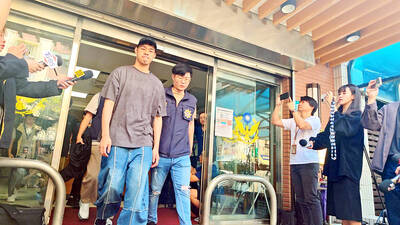
FALSE DOCUMENTS? Actor William Liao said he was ‘voluntarily cooperating’ with police after a suspect was accused of helping to produce false medical certificates Police yesterday questioned at least six entertainers amid allegations of evasion of compulsory military service, with Lee Chuan (李銓), a member of boy band Choc7 (超克7), and actor Daniel Chen (陳大天) among those summoned. The New Taipei City District Prosecutors’ Office in January launched an investigation into a group that was allegedly helping men dodge compulsory military service using falsified medical documents. Actor Darren Wang (王大陸) has been accused of being one of the group’s clients. As the investigation expanded, investigators at New Taipei City’s Yonghe Precinct said that other entertainers commissioned the group to obtain false documents. The main suspect, a man surnamed

DEMOGRAPHICS: Robotics is the most promising answer to looming labor woes, the long-term care system and national contingency response, an official said Taiwan is to launch a five-year plan to boost the robotics industry in a bid to address labor shortages stemming from a declining and aging population, the Executive Yuan said yesterday. The government approved the initiative, dubbed the Smart Robotics Industry Promotion Plan, via executive order, senior officials told a post-Cabinet meeting news conference in Taipei. Taiwan’s population decline would strain the economy and the nation’s ability to care for vulnerable and elderly people, said Peter Hong (洪樂文), who heads the National Science and Technology Council’s (NSTC) Department of Engineering and Technologies. Projections show that the proportion of Taiwanese 65 or older would
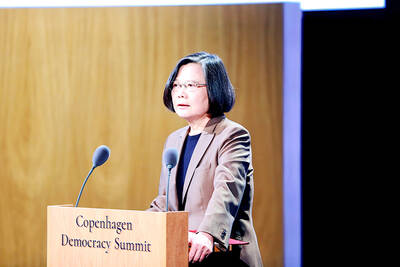
Democracies must remain united in the face of a shifting geopolitical landscape, former president Tsai Ing-wen (蔡英文) told the Copenhagen Democracy Summit on Tuesday, while emphasizing the importance of Taiwan’s security to the world. “Taiwan’s security is essential to regional stability and to defending democratic values amid mounting authoritarianism,” Tsai said at the annual forum in the Danish capital. Noting a “new geopolitical landscape” in which global trade and security face “uncertainty and unpredictability,” Tsai said that democracies must remain united and be more committed to building up resilience together in the face of challenges. Resilience “allows us to absorb shocks, adapt under

Taiwan Semiconductor Manufacturing Co (TSMC, 台積電) yesterday said it is building nine new advanced wafer manufacturing and packaging factories this year, accelerating its expansion amid strong demand for high-performance computing (HPC) and artificial intelligence (AI) applications. The chipmaker built on average five factories per year from 2021 to last year and three from 2017 to 2020, TSMC vice president of advanced technology and mask engineering T.S. Chang (張宗生) said at the company’s annual technology symposium in Hsinchu City. “We are quickening our pace even faster in 2025. We plan to build nine new factories, including eight wafer fabrication plants and one advanced


 RSS
RSS