


It is the government’s responsibility to find a way out of unrest that has rocked Hong Kong, embattled Hong Kong Chief Executive Carrie Lam (林鄭月娥) said yesterday as she began her first public dialogue event, an effort to assuage protesters ahead of the anniversary of Chinese Communist Party rule in China on Tuesday next week.
“In the past three-plus months, no matter what stance you take, everyone is very heartbroken, upset or even angry. The entire unrest is caused by the government’s work in amending the extradition law,” Lam said at the town hall-style session, referring to a controversial bill that first triggered protests. “The government is shouldering the biggest responsibility for finding a way out.”
Lam acknowledged that many in the territory were worried about unrest over the coming weekend, which is to mark the fifth anniversary of 2014’s Occupy demonstrations — Hong Kong’s previous pro-democracy movement.
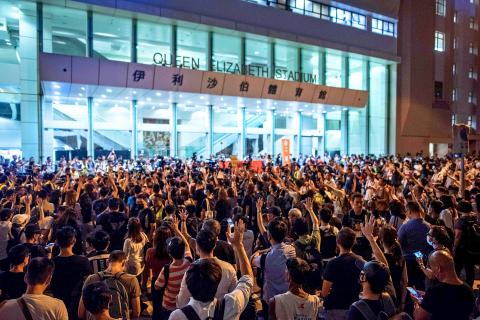
Photo: AFP
As she spoke, hundreds of protesters gathered outside the venue after earlier calls for people to form a human chain, chanting: “Five demands, not one less.”
Lam earlier this week urged demonstrators not to disrupt the forum.
She was joined by four influential ministers: Hong Kong Secretary for Constitutional and Mainland Affairs Patrick Nip (聶德權), Hong Kong Secretary for Commerce and Economic Development Edward Yau (邱騰華), Hong Kong Secretary for Home Affairs Lau Kong-wah (劉江華) and Hong Kong Secretary for Food and Health Sophia Chan (陳肇始).
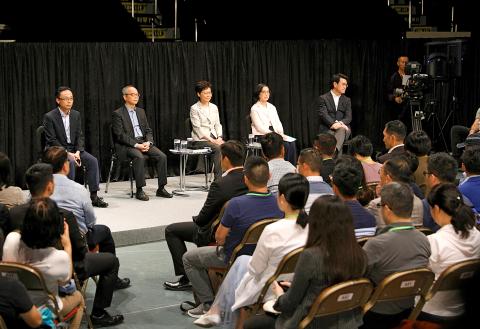
Photo: EPA-EFE
Members of the public attending the two-hour session at the Queen Elizabeth Stadium in the Wanchai neighborhood were to be chosen to speak by a random lottery, the government had said earlier.
The event was moderated by Kenneth Ng, a political assistant to Nip and former news anchor for local station Television Broadcasts, who said in opening remarks that about 130 people were registered to enter the venue and that officials would give an “integrated” response every six questions.
Lam has seemed prepared for the public anger that would likely be directed at her during the forum.
“No doubt, I will receive some harsh criticism. But I also hope to receive constructive suggestions to help this government meet the public’s expectations for a more inclusive and fairer Hong Kong,” she wrote in a Wednesday opinion piece in the New York Times.
“I hear many people asked whether these dialogues are just a political show,” Lam said as the forum began. “These opinions I totally understand. The past days have led to a big drop of trust over the SAR [Hong Kong Special Administrative Region] government and myself. People also doubt whether there’s environment for dialogue. No matter how difficult it is, my colleagues and I all think this direct dialogue should commence now.”
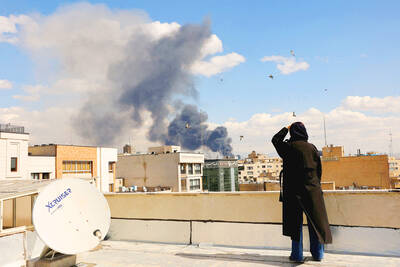
CHAOS: Iranians took to the streets playing celebratory music after reports of Khamenei’s death on Saturday, while mourners also gathered in Tehran yesterday Iranian Supreme Leader Ayatollah Ali Khamenei was killed in a major attack on Iran launched by Israel and the US, throwing the future of the Islamic republic into doubt and raising the risk of regional instability. Iranian state television and the state-run IRNA news agency announced the 86-year-old’s death early yesterday. US President Donald Trump said it gave Iranians their “greatest chance” to “take back” their country. The announcements came after a joint US and Israeli aerial bombardment that targeted Iranian military and governmental sites. Trump said the “heavy and pinpoint bombing” would continue through the week or as long
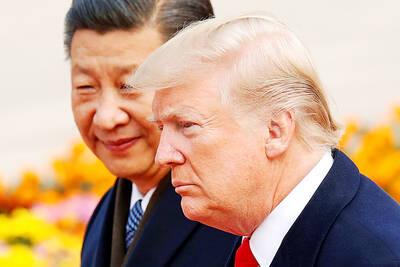
TRUST: The KMT said it respected the US’ timing and considerations, and hoped it would continue to honor its commitments to helping Taiwan bolster its defenses and deterrence US President Donald Trump is delaying a multibillion-dollar arms sale to Taiwan to ensure his visit to Beijing is successful, a New York Times report said. The weapons sales package has stalled in the US Department of State, the report said, citing US officials it did not identify. The White House has told agencies not to push forward ahead of Trump’s meeting with Chinese President Xi Jinping (習近平), it said. The two last month held a phone call to discuss trade and geopolitical flashpoints ahead of the summit. Xi raised the Taiwan issue and urged the US to handle arms sales to
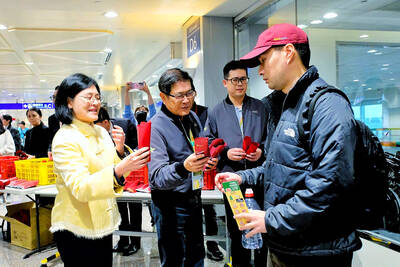
An Emirates flight from Dubai arrived at Taiwan Taoyuan International Airport yesterday afternoon, the first service of the airline since the US and Israel launched strikes against Iran on Saturday. Flight EK366 took off from the United Arab Emirates (UAE) at 3:51am yesterday and landed at 4:02pm before taxiing to the airport’s D6 gate at Terminal 2 at 4:08pm, data from the airport and FlightAware, a global flight tracking site, showed. Of the 501 passengers on the flight, 275 were Taiwanese, including 96 group tour travelers, the data showed. Tourism Administration Deputy Director-General Huang He-ting (黃荷婷) greeted Taiwanese passengers at the airport and
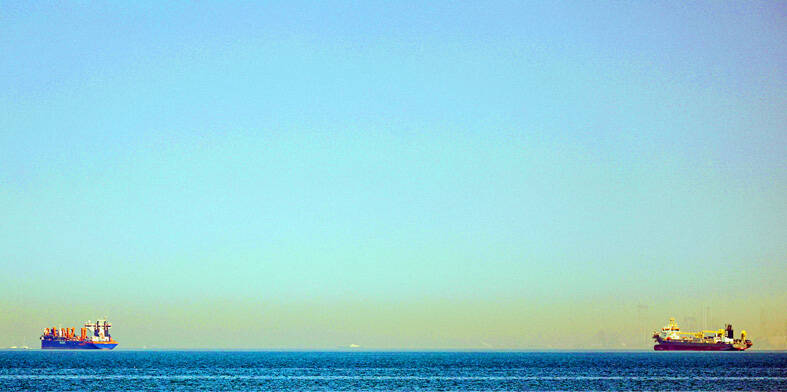
State-run CPC Corp, Taiwan (CPC, 台灣中油) yesterday said that it had confirmed on Saturday night with its liquefied natural gas (LNG) and crude oil suppliers that shipments are proceeding as scheduled and that domestic supplies remain unaffected. The CPC yesterday announced the gasoline and diesel prices will rise by NT$0.2 and NT$0.4 per liter, respectively, starting Monday, citing Middle East tensions and blizzards in the eastern United States. CPC also iterated it has been reducing the proportion of crude oil imports from the Middle East and diversifying its supply sources in the past few years in response to geopolitical risks, expanding


 RSS
RSS