


National Yang-Ming University (NYMU) in Taipei and National Chiao Tung University (NCTU) in Hsinchu yesterday agreed a plan to merge the two universities, whereby they would operate as National Yang-Ming Chiao Tung University (YMCTU) from August next year.
At separate meetings, the councils of NYMU and NCTU voted 65-20 and 59-15 respectively in favor of the merger, the universities’ merger committee said in a statement.
Both universities met the two-thirds threshold needed to approve the plan, it said.
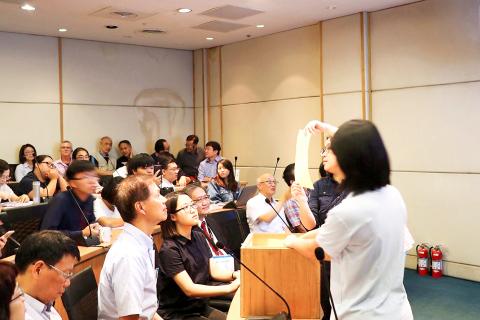
Photo courtesy of National Yang-Ming University
The plan is to be sent to the Ministry of Education for review, NYMU secretary-general Chen I-ju (陳怡如) said, adding that it would also need to be approved by the Executive Yuan.
If all goes to plan, the two universities would operate as one from August next year, she said.
Through the merger, the universities hope to provide students and professors with more interdisciplinary courses and opportunities, and to invest more in bioelectronics, bioinformatics and digital biomedicine, she said.
The merger committee has met several times since the two universities signed a letter of intent to merge in March, NCTU secretary-general Wang Niann-shiah (王念夏) said, adding that both schools’ faculty and students’ associations had also been involved in the process.
The first president of the merged universities is to be selected by a 21-member committee that would include two student representatives, according to the merger plan, which was finalized last month.
A new university council consisting of 120 members, 60 from each of the campuses, would also be formed, the plan says.
NYMU on Sept. 26 last year announced that it had decided to begin the process of merging with another university.
On Dec. 26 last year it agreed to negotiate a merger contract with NCTU.
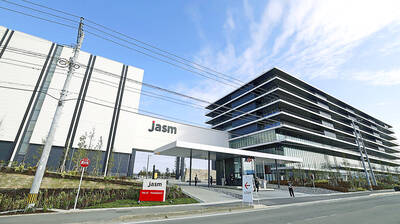
The subsidiary of Taiwan Semiconductor Manufacturing Co (TSMC, 台積電) in Kumamoto, Japan, turned a profit in the first quarter of this year, marking the first time the first fab of the unit has become profitable since mass production started at the end of 2024. According to the contract chipmaker’s financial statement released on Friday, Japan Advanced Semiconductor Manufacturing Inc (JASM), a joint venture running the fab in Kumamoto, posted NT$951 million (US$30.19 million) in profit in the January-to-March period, compared with a loss of NT$1.39 billion in the previous quarter, and a loss of NT$3.25 billion in the first quarter of
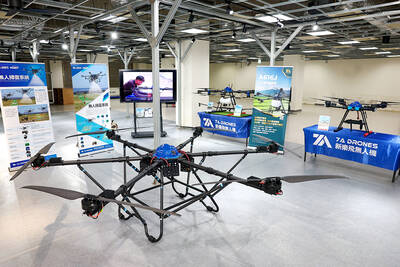
DRONE CENTRAL: Taiwan aims to become Asia’s democratic hub for drones, with most exports focused on high-quality military-grade models, an official said Taiwan’s drone industry is expected to expand significantly by 2030, producing 100,000 units per month and exporting half of them, the Ministry of Economic Affairs said yesterday. Current drone production capacity is about 15,000 units per month, but the industry can quickly scale up as demand increases, Industrial Development Administration Director-General Chiou Chyou-huey (邱求慧) told a news conference in Taipei. Taiwan’s drone output grew 2.5-fold last year to NT$12.9 billion (US$408.3 million) under a government program to develop the uncrewed vehicle sector, he said. The Executive Yuan in October last year approved plans to invest NT$44.2 billion into domestic production of uncrewed aerial
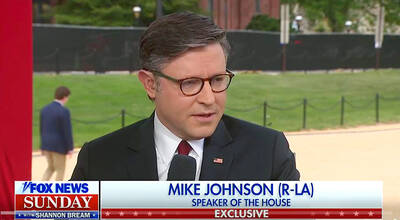
RESOLUTE BACKING: Two Republican senators are planning to introduce legislation that would impose immediate sanctions on China if it attempts to invade Taiwan US House of Representatives Speaker Mike Johnson on Sunday reaffirmed US congressional support for Taiwan, saying the US and “all freedom-loving people” have a stake in preventing China from seizing Taiwan by force. Johnson made the remarks in an interview with Fox News Sunday on US President Donald Trump’s summit with Chinese President Xi Jinping (習近平) last week. In an interview that aired on Friday on Fox News, just as Trump wrapped up a high-stakes visit to China, he said he has yet to green-light a new US$14 billion arms package to Taiwan and that it “depends on China.” “It’s a very good
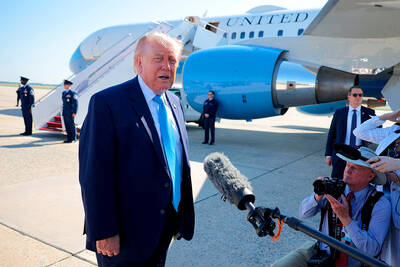
US President Donald Trump yesterday said he would speak to President William Lai (賴清德) as his administration considers whether to move ahead with a US$14 billion weapons sale to Taiwan — a potential arms deal that has drawn criticism from China. “Well, I’ll speak to him. I speak to everybody,” Trump told reporters yesterday when asked if he had any plans to call his counterpart, although he did not offer a time frame for when such a conversation could take place. Trump previously said he would speak to the person “that’s running Taiwan,” without specifying who he meant. “We have that situation very


 RSS
RSS