


Hundreds of Taiwanese expatriates and others marched in the Manhattan borough of New York City on Saturday to call attention to Taiwan’s exclusion from the UN and Beijing’s efforts to further shrink the nation’s space in the international community.
“From the systematic repression against the Uighur Muslims and the stifling of freedoms in Tibet, to the backsliding of human rights in Hong Kong and the blatant lies of ‘one country, two systems,’ we are here to say — enough,” Keep Taiwan Free director and event co-organizer Jenny Wang (汪采羿) told the crowd.
This year’s UN For Taiwan/Keep Taiwan Free rally, an annual New York City event that has been held for more than two decades, emphasized solidarity among groups targeted by the Chinese government and comes amid Hong Kong’s worst political crisis in decades.
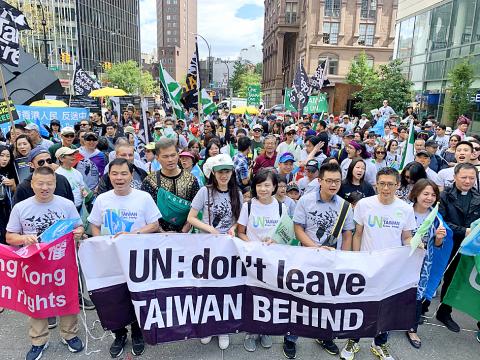
Photo: CNA
Members of NY4HK — New Yorkers Supporting Hong Kong — and other Hong Kongers were among those taking part in Saturday’s march.
“It’s just sad to see that so many people from Hong Kong are coming out to say that this is not the way to go and the government’s not listening,” said Ann Shum, who was born and raised in the US, but whose family is from Hong Kong.
With the 74th session of the UN General Assembly to convene later this month, the rally also echoed the three appeals made by Taiwan’s government to participate in the world body.
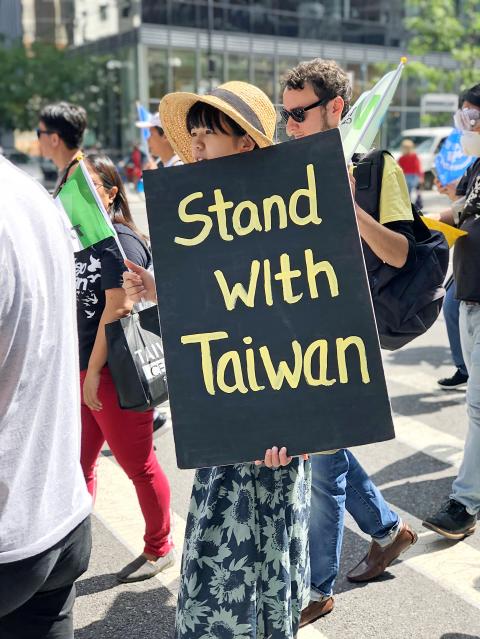
Photo: Chris Fuchs
“Taiwan has been campaigning to be part of the United Nations for such a long time,” Taipei Economic and Cultural Office in New York Director-General Lily Hsu (徐儷文) said. “We know this is an uphill battle; this is a challenging journey.”
Escorted by officers on scooters from the New York Police Department (NYPD), participants marched uptown from East Eighth Street and Fourth Avenue, where some left notes in support of Taiwan and Hong Kong on a portable “Lennon Wall.”
Chanting “Keep Taiwan Free” and “UN for Taiwan,” rallygoers waved flags, including green-and-white ones featuring a green image of Taiwan in the center.
They also held aloft signs and banners, some of which read “Honk 4 HK” and “UN: Don’t Leave Taiwan Behind.”
The march attracted a diverse mix of young and old, including Taiwanese Americans and Canadians, along with supporters of Hong Kong, Tibet and Xinjiang, home to the Uighurs.
A delegation from the Taiwan United Nations Alliance made the trek from Taipei, led by former minister of national defense Michael Tsai (蔡明憲), while Democratic Progressive Party Legislator Yeh Yi-jin (葉宜津) also took part.
The NYPD typically does not provide crowd estimates, but organizers said about 500 people took part in the march, which ended off the West Side Highway, next to the Hudson River, and across the street from the Chinese Consulate on 42nd Street, where demonstrators continued the rally from behind NYPD barricades.
Pro-Beijing demonstrators did not show up, unlike during President Tsai Ing-wen’s (蔡英文) New York City stopover in July during her trip to four Caribbean diplomatic allies.
At least two vehicles with diplomatic plates idled outside the consulate, while two private guards stood in front of the building.
Tony Sze (施承兆), 24, a first-time participant who was born and raised in Hong Kong, said it was important for all groups “trying to free themselves from China and the [Chinese] Communist Party” to unite.
“It doesn’t matter where you’re from, whether you cared about each other before,” he said. “Now we have a strong single enemy that we are all fighting against.”
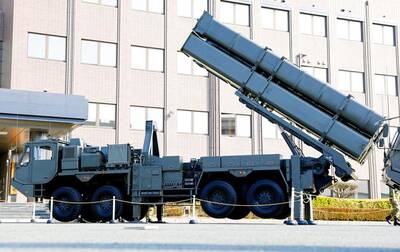
Japan has deployed long-range missiles in a southwestern region near China, the Japanese defense minister said yesterday, at a time when ties with Beijing are at their lowest in recent years. The missiles were installed in Kumamoto in the southern region of Kyushu, as Japan is attempting to shore up its military capacity as China steps up naval activity in the East China Sea. “Standoff defense capabilities enable us to counter the threat of enemy forces attempting to invade our country ... while ensuring the safety of our personnel,” Japanese Minister of Defense Shinjiro Koizumi said. “This is an extremely important initiative for
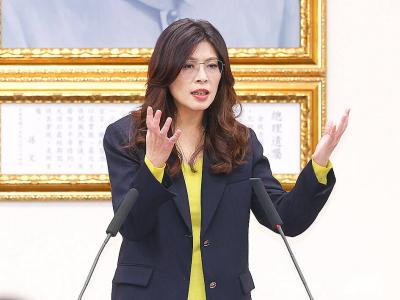
Chinese Nationalist Party (KMT) Chairwoman Cheng Li-wun (鄭麗文) today accepted an invitation from Chinese President Xi Jinping (習近平) to lead a delegation to China next month, saying she hopes to promote the peaceful development of cross-strait relations and bring stability to the Taiwan Strait. “I am grateful and happy to accept this invitation,” Cheng said in a statement from the KMT chairperson’s office. Cheng said she hopes both sides can work together to promote the peaceful development of cross-strait relations, enhance exchange and cooperation, bring stability to the Taiwan Strait and improve people’s livelihoods. At today's news conference, Cheng said any efforts to
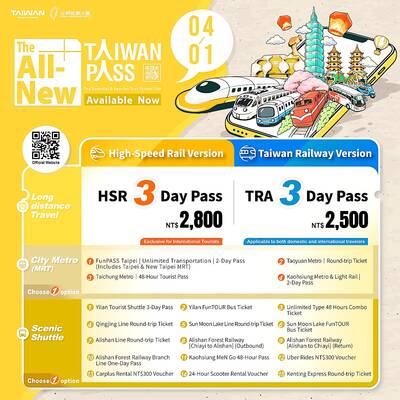
MORE POPULAR: Taiwan Pass sales increased by 59 percent during the first quarter compared with the same period last year, the Tourism Administration said The Tourism Administration yesterday said that it has streamlined the Taiwan Pass, with two versions available for purchase beginning today. The tourism agency has made the pass available to international tourists since 2024, allowing them to access the high-speed rail, Taiwan Railway Corp services, four MRT systems and four Taiwan Tourist Shuttles. Previously, five types of Taiwan Pass were available, but some tourists have said that the offerings were too complicated. The agency said only two types of Taiwan Pass would be available, starting from a three-day pass with the high-speed rail and a three-day pass with Taiwan Railway Corp. The former costs NT$2,800

The nation’s fastest supercomputer, Nano 4 (晶創26), is scheduled to be launched in the third quarter, and would be used to train large language models in finance and national defense sectors, the National Center for High-Performance Computing (NCHC) said. The supercomputer, which would operate at about 86.05 petaflops, is being tested at a new cloud computing center in the Southern Taiwan Science Park in Tainan. The exterior of the server cabinet features chip circuitry patterns overlaid with a map of Taiwan, highlighting the nation’s central position in the semiconductor industry. The center also houses Taiwania 2, Taiwania 3, Forerunner 1 and


 RSS
RSS