


As Hong Kong’s political crisis simmers amid heated protests, the Chinese People’s Liberation Army (PLA) garrison in the territory released a video showing footage of “anti-riot” exercises and its top brass warned violence is “absolutely impermissible.”
The three-minute video posted on the garrison’s official microblogging account late on Wednesday included footage of troops firing guns and rockets, and of light tanks, attack helicopters and missile launchers.
Garrison personnel have remained in barracks since protests started in April, leaving Hong Kong’s police force to deal with the massive and often violent protests.
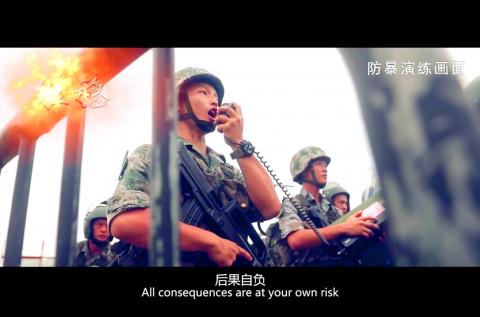
Photo: AFP / China’s People’s Liberation Army Hong Kong Garrison
On Wednesday, 44 people were charged with rioting, the first time authorities have resorted to using the rioting charge.
In one sequence in the PLA video, titled “anti-riot drill footage,” ranks of troops advance with shields and truncheons on “protesters,” firing rifles into the air, while tear gas and water cannons rain down on protesters, armored personnel carriers with battering rams race forward and troops lay barbed-wire coils on the ground.
“All consequences are at your own risk,” one soldier shouts in Cantonese in the video.
A red flag with the words: “Warning. Stop charging or we use force” was also held aloft, similar to what Hong Kong police have long used during protests.
Hong Kong has been plunged into its biggest political crisis since the former British colony’s return to Chinese rule in 1997 by a wave of protests against a now-suspended extradition bill, which would allow people to be sent to the mainland for trial in Chinese Communist Party-controlled courts.
The protests have transformed into broader demands, including the resignation of Hong Kong Chief Executive Carrie Lam (林鄭月娥) and calls for a “free Hong Kong.”
As tensions continue to rise, clashes between protesters and police have become increasingly violent.
Chinese authorities have strongly condemned the violence, issuing reminders that Hong Kong authorities can request the assistance of the PLA’s Hong Kong garrison if necessary.
Diplomats and foreign security analysts are watching the situation closely, but believe that there is little appetite in Beijing for the PLA to be deployed on the streets of Hong Kong.
The role of the PLA in Hong Kong has long been one of the most sensitive elements of the territory’s handover to China.
“We believe that the Hong Kong garrison of the People’s Liberation Army will continue to become a stabilizing pillar for Hong Kong’s long-term prosperity and stability,” Chinese Ministry of Foreign Affairs spokeswoman Hua Chunying (華春瑩) told a briefing in Beijing when asked about the video.
Amid growing speculation that troops could be unleashed to quell violence, police chiefs have insisted that their forces are capable of maintaining order.
The state-run China Daily quoted Major General Chen Daoxiang (陳道祥), the commander of the Hong Kong garrison, as saying that the violent protests in the territory are “absolutely impermissible.”
Speaking at a reception to mark the 92nd anniversary of the PLA, Chen said that the protests were “putting the bottom line of the ‘one country, two systems’ principle to the test.”
The PLA would “resolutely safeguard” China’s sovereignty and security, as well as Hong Kong’s stability, he added.

‘NO SECURITY RISK’: The Railway Bureau reassured the public that the technicians’ activities were limited to technical guidance and did not involve sensitive systems The Railway Bureau yesterday said it had invited eight Chinese technicians to assist with an airport MRT construction project. The bureau issued the confirmation after an Internet user said Chinese nationals had entered the construction zone of Taiwan Taoyuan International Airport’s Terminal 3 project. They asked why “individuals from an enemy state” were allowed access to such a major national infrastructure project, which raised serious concerns over Taiwan’s industrial safety, sensitive systems and information security. The bureau’s Northern Region Engineering Branch Office said subcontractor Taiwan Handle Industrial Co (台灣手把工業) of the Taoyuan airport MRT’s “Contract No. CU05 Project A14 Station Civil, MEP &

A US uncrewed surface vessel (USV) encountered multiple Chinese warships during an autonomous transit of the Taiwan Strait, US defense company Seasats said in a statement on Wednesday. Seasats announced that a Lightfish USV had completed the first autonomous transit of the Taiwan Strait. Over five days, the USV traversed the entire length of the Strait while constantly monitoring surface vessel traffic, the company said. The Lightfish encountered multiple Chinese warships, one of which was a Chinese People’s Liberation Army Navy (PLAN) Type 056 corvette, it said. The Chinese vessels were operating “well within Taiwan’s exclusive economic zone without transmitting their identity via the
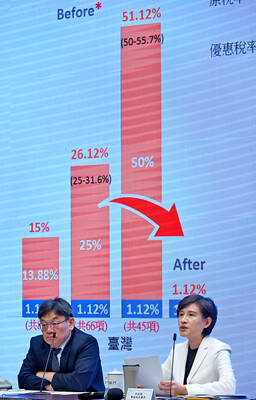
GREATER REACH? Auto parts and wood products would face tariffs of up to 15%, matching those targeting the EU, Japan and South Korea, Vice Premier said The US has announced that preferential tariff treatment for Taiwan’s non-semiconductor Section 232 goods would take effect retroactively from May 1, the Executive Yuan said yesterday. The US government yesterday posted a notice on the Federal Register’s public inspection Web site previewing tariff concessions for Taiwan under a memorandum of understanding (MOU) on Taiwan-US investment after two months of negotiations. The MOU signed on Jan. 15 stipulated three major preferential tariff arrangements: a 15 percent “reciprocal” tariff rate for Taiwan without stacking most-favored nation (MFN) rates; preferential Section 232 treatment for semiconductors and related products; and preferential Section 232 treatment for non-semiconductor

The National Chungshan Institute of Science and Technology yesterday showcased its locally developed variants of the Vision 60 robotic patrol dog, which it plans to deploy on the nation’s outlying territories in the South China Sea. The variants were produced under the Joint Lab project — created by the institute and domestic companies — and assembled with domestically produced motors, lenses and artificial intelligence (AI) systems alongside licensed tech from the US, Missile and Rocket Systems Research Division deputy director Jen Kuo-kang (任國光) told the media event at a military base in Taipei’s Dazhi (大直) area. Taiwan has built up its strengths


 RSS
RSS