


Top Democratic Progressive Party (DPP) officials during a visit with the Dalai Lama in Dharamsala, India, vowed to forge closer cooperation with the exiled Tibetan government and to form an international “Silk Road of Democracy” (民主絲路) to fight Chinese oppression.
A direct channel has been established with the Dalai Lama after their fruitful talks from Wednesday to Friday last week, which focused on the strength of Taiwan’s democracy and protests in Hong Kong, DPP Secretary-General Luo Wen-jia (羅文嘉) said yesterday.
Luo was accompanied by party spokesman Lii Wen (李問) and public relations director Hsieh Yu-li (謝雨利) for their meeting with the Dalai Lama and officials from the exiled Tibetan government.
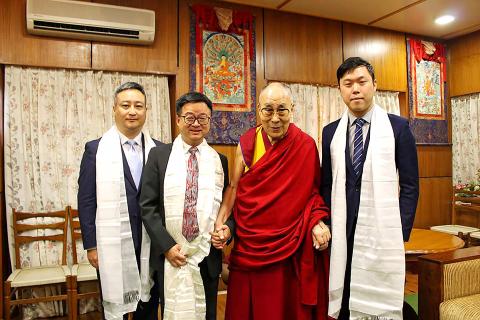
Photo from Lii Wen’s Facebook via CNA
“Taiwan’s main strength lies in its democracy,” Luo quoted the Tibetan spiritual leader as saying.
Although it is threatened by Chinese missiles and other intimidation tactics, “Taiwan’s strongest countermeasures include democracy, freedom and the comprehensive preservation of traditional culture,” Luo added.
Taiwan would build a broad international alliance that brings together Tibetans, Uighurs, Hong Kongers, Inner Mongolians and overseas Chinese democracy advocates to promote freedom, human rights and democratic values in China, Lii said.
The project would be called the “Silk Road of Democracy” to counter China’s Belt and Road Initiative, Lii said.
“The DPP and Tibetans share much of the same values and stand together under the same threatening force. Therefore, we shall forge a network with Tibetans, Uighurs, Hong Kongers and Inner Mongolians to pursue and consolidate democracy,” Luo said.
Asked whether there are plans to invite the Dalai Lama to Taiwan, Luo said that while he was representing the DPP and not the government on the trip, Taiwan is a free nation and the door is always open for people who seek freedom and democracy.
He said that the DPP welcomes the exiled Tibetan leader, who has not visited Taiwan since 2009.
“It is up to the willingness of His Holiness the Dalai Lama,” Luo added. “He has fond memories of his previous trips, but he said that his advanced age is not suitable for taking long flights.”
The DPP entourage also met with other key officials, including exiled Tibetan Prime Minister Lobsang Sangay, Legislative Speaker Pema Jungney, Secretary for Foreign Affairs Sonam Norbu Dagpo and Tibetan Youth Congress president Gonpo Dhondup.
Luo quoted the Dalai Lama as saying that he had not ruled out Taiwan as a location for his reincarnation, since it would take place in a Buddhist country.
Human Rights Network for Tibet and Taiwan president Tashi Tsering conferred hada, traditional Tibetan silk scarfs, on Luo, Lii and DPP Deputy Secretary-General Lin Fei-fan (林飛帆) to thank them for the party’s efforts in helping him obtain Republic of China citizenship.
As an exile, he has never seen his Tibetan homeland and has lived in Taiwan for 21 years, Tashi said.
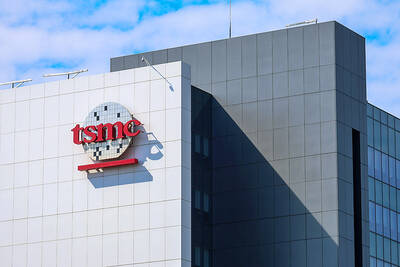
Taiwan Semiconductor Manufacturing Co (TSMC, 台積電), the world’s largest foundry service provider, yesterday said that global semiconductor revenue is projected to hit US$1.5 trillion in 2030, after the figure exceeds US$1 trillion this year, as artificial intelligence (AI) demand boosts consumption of token and compute power. “We are still at the beginning of the AI revolution, but we already see a significant impact across the whole semiconductor ecosystem,” TSMC deputy cochief operating officer Kevin Zhang (張曉強) said at the company’s annual technology symposium in Hsinchu City. “It is fair to say that in the past decade, smartphones and other mobile devices were
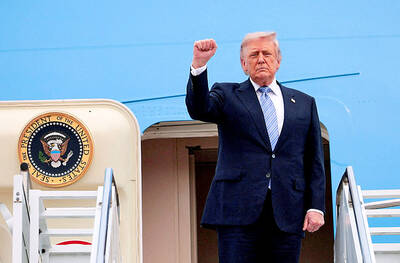
US-CHINA SUMMIT: MOFA welcomed US reassurance of no change in its Taiwan policy; Trump said he did not comment when Xi talked of opposing independence US President Donald Trump yesterday said he has not made a decision on whether to move forward with a major arms package for Taiwan after hearing concerns about it from Chinese President Xi Jinping (習近平). Trump’s comments on Taiwan came as he flew back to Washington after wrapping up critical talks in which both leaders said important progress was made in stabilizing US-China relations even as deep differences persist between the world’s two biggest powers on Iran and Taiwan. “I will make a determination,” Trump said, adding: “I’ll be making decisions. But, you know, I think the last thing we need right

TAIWAN ISSUE: US treasury secretary Scott Bessent said on the first day of meetings that ‘it wouldn’t be a US-China summit without the Taiwan issue coming up’ There were no surprises on the first day of the summit between US President Donald Trump and Chinese President Xi Jinping (習近平), the Mainland Affairs Council (MAC) said yesterday, as the government reiterated that cross-strait stability is crucial to the Asia-Pacific region, as well as the world. As the two presidents met for a highly anticipated summit yesterday, Chinese state media reported that Xi warned Trump that missteps regarding Taiwan could push their two countries into “conflict.” Trump arrived in China with accolades for his host, calling Xi a “great leader” and “friend,” and extending an invitation to visit the White House
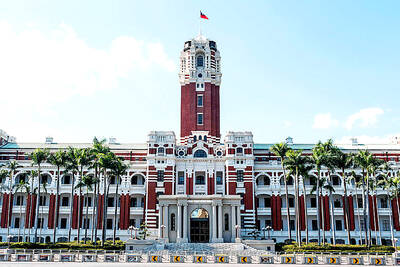
SECURITY: Taipei presses the US for arms supplies, saying the arms sales are not only a reflection of the US security commitment to Taiwan but also serve as a mutual deterrent against regional threats Taiwan is committed to preserving the cross-strait “status quo” and contributing to regional peace and stability, the Presidential Office said yesterday. “It is an undeniable fact that the Republic of China is a sovereign and independent democratic nation,” Presidential Office spokeswoman Karen Kuo (郭雅慧) reiterated, adding that Beijing has no right to claim sovereignty over Taiwan. The statements came after US President Donald Trump warned against Taiwanese independence. Trump wrapped up a state visit to Beijing on Friday, during which Chinese President Xi Jinping (習近平) had pressed him not to support Taiwan. Taiwan depends heavily on US security backing to deter China from carrying


 RSS
RSS