


The Executive Yuan is to release a list of Chinese technology companies whose products are to be barred from being used by government agencies, including Huawei Technologies Co (華為), ZTE Corp (中興通訊) and Hangzhou Hikvision Digital Technology Co (杭州海康威視數字技術), a source said.
Huawei is being blacklisted because of its alleged ties to the Chinese People’s Liberation Army, ZTE for its alleged involvement in cyberespionage in the US and Hikvision because of the use of its surveillance cameras to monitor Uighurs in Xinjiang, said the source, who asked to remain anonymous.
The government is still deciding whether products manufactured by Lenovo Group (聯想) would be included in the ban, the source said.
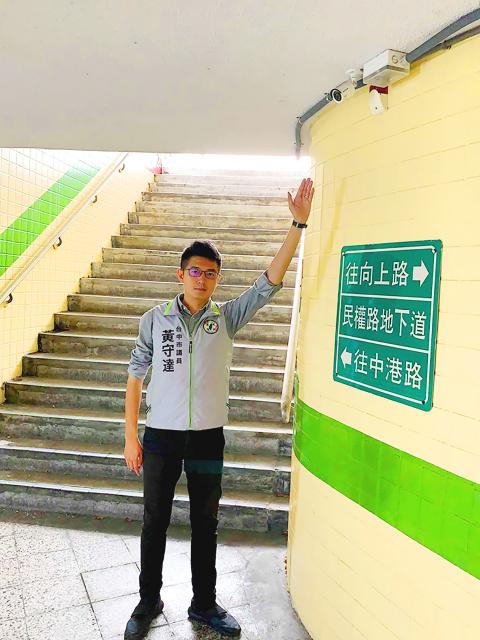
Photo: CNA
The Executive Yuan this week began a series of interagency meetings led by Minister Without Portfolio Kung Ming-hsin (龔明鑫) to review the lists proposed by different agencies, the source said.
The process is expected to take two weeks, after which the Executive Yuan is expected to approve a list of banned items at the end of this month, the source said, adding that the Executive Yuan has declined to say how many firms might be affected.
The drafting of the list must be handled carefully, said an aide to Kung, who declined to be named.
The Ministry of Economic Affairs and the Financial Supervisory Commission are among the agencies taking part in the discussions, the source said.
The Executive Yuan on April 19 released guidelines on the use of “products that endanger national cybersecurity” by public agencies.
In related news, Democratic Progressive Party (DPP) Taichung City Councilor Chiang Chao-kuo (江肇國) yesterday said that surveillance cameras manufactured by Hikvision are being used in several underpasses along the city’s Taiwan Boulevard.
He found the cameras at the intersections of the boulevard and Wucyuan, Yingcai, Meichun and Jhongming roads, he wrote on Facebook.
The Taichung Construction Bureau has been installing surveillance systems in underpasses since 2012, he wrote.
It had not originally used Chinese brands, but when the original cameras were damaged, they were replaced with Hikvision cameras as the contract did not specify a brand, he said.
The bureau has promised to cooperate with the Executive Yuan’s proposed ban and to replace the cameras as soon as possible, he said.
The Chinese government is Hikvision’s largest shareholder, Chiang said.
The international community believes there are information security concerns because the company helped the Chinese government set up its “sky eye” surveillance system, he said.
The Taichung City Government must take a “crisis awareness mode” toward Chinese infiltration, he said.
It should check of all of its current equipment, and replace and ban Chinese products that are cause for concern, he said.
DPP Taichung City Councilor Huang Shou-ta (黃守達) previously found Hikvision cameras in the underpasses at the intersections of the boulevard and Mincyuan and Yingcai roads.
He also asked the city government to check all of the city’s surveillance systems.
If items are made by brands that the Executive Yuan lists as banned they cannot remain, Huang said.
Additional reporting by Chang Ching-ya
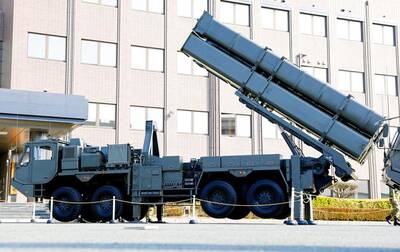
Japan has deployed long-range missiles in a southwestern region near China, the Japanese defense minister said yesterday, at a time when ties with Beijing are at their lowest in recent years. The missiles were installed in Kumamoto in the southern region of Kyushu, as Japan is attempting to shore up its military capacity as China steps up naval activity in the East China Sea. “Standoff defense capabilities enable us to counter the threat of enemy forces attempting to invade our country ... while ensuring the safety of our personnel,” Japanese Minister of Defense Shinjiro Koizumi said. “This is an extremely important initiative for
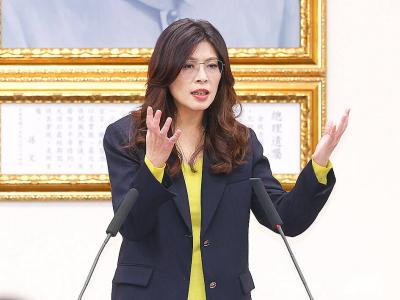
Chinese Nationalist Party (KMT) Chairwoman Cheng Li-wun (鄭麗文) today accepted an invitation from Chinese President Xi Jinping (習近平) to lead a delegation to China next month, saying she hopes to promote the peaceful development of cross-strait relations and bring stability to the Taiwan Strait. “I am grateful and happy to accept this invitation,” Cheng said in a statement from the KMT chairperson’s office. Cheng said she hopes both sides can work together to promote the peaceful development of cross-strait relations, enhance exchange and cooperation, bring stability to the Taiwan Strait and improve people’s livelihoods. At today's news conference, Cheng said any efforts to
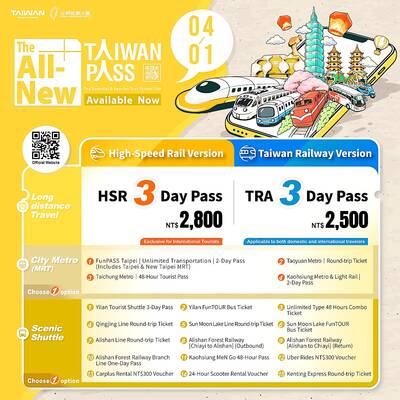
MORE POPULAR: Taiwan Pass sales increased by 59 percent during the first quarter compared with the same period last year, the Tourism Administration said The Tourism Administration yesterday said that it has streamlined the Taiwan Pass, with two versions available for purchase beginning today. The tourism agency has made the pass available to international tourists since 2024, allowing them to access the high-speed rail, Taiwan Railway Corp services, four MRT systems and four Taiwan Tourist Shuttles. Previously, five types of Taiwan Pass were available, but some tourists have said that the offerings were too complicated. The agency said only two types of Taiwan Pass would be available, starting from a three-day pass with the high-speed rail and a three-day pass with Taiwan Railway Corp. The former costs NT$2,800

The nation’s fastest supercomputer, Nano 4 (晶創26), is scheduled to be launched in the third quarter, and would be used to train large language models in finance and national defense sectors, the National Center for High-Performance Computing (NCHC) said. The supercomputer, which would operate at about 86.05 petaflops, is being tested at a new cloud computing center in the Southern Taiwan Science Park in Tainan. The exterior of the server cabinet features chip circuitry patterns overlaid with a map of Taiwan, highlighting the nation’s central position in the semiconductor industry. The center also houses Taiwania 2, Taiwania 3, Forerunner 1 and


 RSS
RSS