


The Taipei High Administrative Court yesterday struck down Asia Cement Corp’s (亞泥) permit renewal for a mine in Hualien County’s Sincheng Township (新城), giving the Truku people a hard-won victory, civic groups said.
After operating the marble quarry for nearly 40 years, the company’s application to extend its permit to continue operations for another 20 years was approved by the Ministry of Economic Affairs in March 2017, months before it was set to expire on Nov. 22, 2017.
A massive protest gathered on Taipei’s Ketagalan Boulevard in June 2017, after aerial footage shot by filmmaker Chi Po-lin (齊柏林) — who was killed on June 10, 2017, in a helicopter crash while at work — appeared to show that the firm had expanded its operations at the quarry.
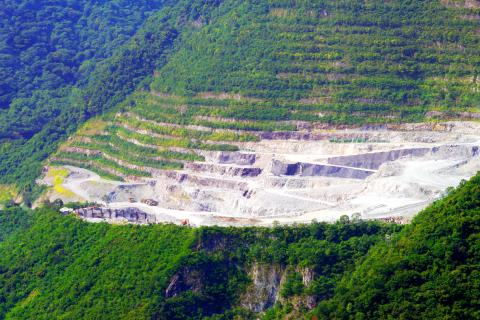
Photo: Wang Chun-chi, Taipei Times
After reviewing an administrative lawsuit filed by four Truku against the ministry in 2017, the court yesterday ordered the ministry to revoke its approval for the permit extension, as well as its rejection of the appeal.
A self-help group against Asia Cement hailed the ruling as “a win for the Truku people.”
In its ruling, the court referred to the developer’s failure to obtain local Aborigines’ approval for extending mining operations in their domains, as is required by Article 21 of the Indigenous Peoples Basic Act (原住民族基本法), the group said in a statement.
While negotiations among the Truku, Asia Cement and the ministry are ongoing, they hope that discussions for geological and land surveys, as well as quarry transformation would yield concrete results, the group added.
The ruling is a landmark in transitional justice for Aborigines, said Legal Aid Foundation lawyer Hsieh Meng-yu (謝孟羽), who has been assisting the plaintiffs.
Hopefully, the verdict would prompt an equal negotiation between the Truku, the ministry and Asia Cement, he added.
Applauding the court’s ruling, Citizen of the Earth, Taiwan urged the government to amend the Mining Act (礦業法) to close potential loopholes and to achieve President Tsai Ing-wen’s (蔡英文) call to promote transitional justice.
Amendments to the Mining Act have been stalled at the Legislative Yuan for more than a year, organization member Huang Ching-ting (黃靖庭) said, adding that the group is awaiting cross-caucus negotiations in the next legislative session starting in September.
The ministry said that it would determine whether to appeal the ruling within two months after receiving the official verdict.
Following instructions from Tsai, the ministry has supervised three meetings between members of the Indigenous Historical Justice and Transitional Justice Committee, representatives of a local Truku committee and Asia Cement in an attempt to resolve conflicts, it said, adding that it is seeking a triple-win situation.
Asia Cement said it was disappointed about the decision and would appeal to uphold the rights of shareholders and employees within the legal time limit after it receives the verdict and consults with lawyers.
Asia Cement said that as the extension would be a continuation of mining rights, not new permissions, it is not covered by Article 21 of the Indigenous Peoples Basic Act, a decision that was made by the Executive Yuan in November 2016 and is followed by the ministry and the Council of Indigenous Peoples.
The company said the ruling would “seriously affect” any cases concerning extension of mining rights and land development, which would leave the industry bewildered, damage government credibility, harm the economy and take jobs from workers — including Aborigines.
Additional reporting by Natasha Li and Kwan Shin-han
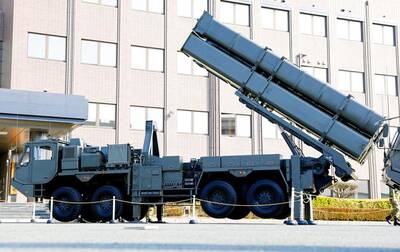
Japan has deployed long-range missiles in a southwestern region near China, the Japanese defense minister said yesterday, at a time when ties with Beijing are at their lowest in recent years. The missiles were installed in Kumamoto in the southern region of Kyushu, as Japan is attempting to shore up its military capacity as China steps up naval activity in the East China Sea. “Standoff defense capabilities enable us to counter the threat of enemy forces attempting to invade our country ... while ensuring the safety of our personnel,” Japanese Minister of Defense Shinjiro Koizumi said. “This is an extremely important initiative for
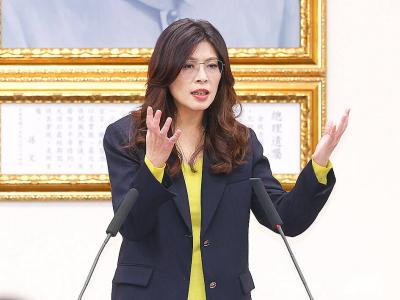
Chinese Nationalist Party (KMT) Chairwoman Cheng Li-wun (鄭麗文) today accepted an invitation from Chinese President Xi Jinping (習近平) to lead a delegation to China next month, saying she hopes to promote the peaceful development of cross-strait relations and bring stability to the Taiwan Strait. “I am grateful and happy to accept this invitation,” Cheng said in a statement from the KMT chairperson’s office. Cheng said she hopes both sides can work together to promote the peaceful development of cross-strait relations, enhance exchange and cooperation, bring stability to the Taiwan Strait and improve people’s livelihoods. At today's news conference, Cheng said any efforts to

MORE POPULAR: Taiwan Pass sales increased by 59 percent during the first quarter compared with the same period last year, the Tourism Administration said The Tourism Administration yesterday said that it has streamlined the Taiwan Pass, with two versions available for purchase beginning today. The tourism agency has made the pass available to international tourists since 2024, allowing them to access the high-speed rail, Taiwan Railway Corp services, four MRT systems and four Taiwan Tourist Shuttles. Previously, five types of Taiwan Pass were available, but some tourists have said that the offerings were too complicated. The agency said only two types of Taiwan Pass would be available, starting from a three-day pass with the high-speed rail and a three-day pass with Taiwan Railway Corp. The former costs NT$2,800

The nation’s fastest supercomputer, Nano 4 (晶創26), is scheduled to be launched in the third quarter, and would be used to train large language models in finance and national defense sectors, the National Center for High-Performance Computing (NCHC) said. The supercomputer, which would operate at about 86.05 petaflops, is being tested at a new cloud computing center in the Southern Taiwan Science Park in Tainan. The exterior of the server cabinet features chip circuitry patterns overlaid with a map of Taiwan, highlighting the nation’s central position in the semiconductor industry. The center also houses Taiwania 2, Taiwania 3, Forerunner 1 and


 RSS
RSS