


Suspected attacks yesterday left two tankers, including one leased by CPC Corp, Taiwan (台灣中油), in flames in the waters of the Gulf of Oman, sending world oil prices soaring as Iran helped rescue crew members.
State-owned oil refiner CPC Corp in a statement said that the Norwegian-owned vessel, Front Altair, is registered in the Marshall Islands and leased by its supplier, Ocean Energy Co, under cost and freight terms.
The vessel carried 75,000 tonnes of naphtha that was loaded at al-Ruwais Port in the United Arab Emirates on Tuesday, CPC said.
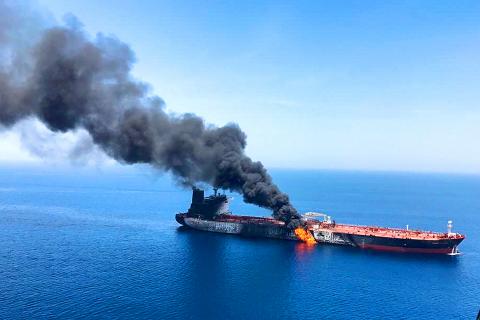
Photo: Reuters / Islamic Republic News Agency
All crew members abandoned ship and were saved by neighboring vessel Hyundai Dubai, the company said, adding that the crew members were not Taiwanese nationals.
The attacker has not been identified and that damage to the cargo has yet to be clarified, CPC said.
Fuel supply would not be affected, it added.
The mystery incident, the second involving shipping in the strategic sea lane in only a few weeks, came amid spiraling tensions between Tehran and Washington, which has pointed the finger at Iran over tanker attacks last month.
The Norwegian Maritime Authority said that three explosions were reported on board the Front Altair after it was “attacked” along with the Singapore-owned ship Kokuka Courageous.
Iran said that its navy had rescued 44 crew members after the two vessels, which were carrying highly inflammable material, caught fire.
TV images showed huge, thick plumes of smoke and fire billowing from one of the tankers as it lay at sea.
Iranian Minister of Foreign Affairs Mohammad Javad Zarif spoke of “reported attacks” as Japanese Prime Minister Shinzo Abe held talks in Tehran.
“Suspicious doesn’t begin to describe what likely transpired this morning,” Zarif said on Twitter.
The US Fifth Fleet said that its warships had received distress calls from the vessels in a “reported attack.”
Iranian state media said that the first incident occurred on board the Front Altair at 8:50am, 25 nautical miles (46.3km) off Iran’s Bandar-e-Jask.
“As the ship caught fire, 23 of the crew jumped into the water and were saved by a passing ship and handed over to the Iranian rescue unit,” it said. “An hour after the first accident, the second ship caught fire at 9:50am 28 nautical miles off the port.”
“I can confirm that the vessel has NOT sunk,” Robert Hvide Macleo, chief executive officer for the ship’s owner, Frontline, wrote in a text message.
No injuries were reported.
The Panama-flagged Kokuka Courageous was headed to Singapore from Saudi Arabia with a cargo of methanol, and 21 of its crew jumped and were rescued, the Islamic Republic News Agency said.
Singapore-based BSM Ship Management said that it has “launched a full-scale emergency response following a security incident” involving the ship, which is owned by Japanese company Kokuka Sangyo Ltd.
“The 21 crew of the vessel abandoned ship after the incident on board, which resulted in damage to the ship’s hull starboard side,” it said. “One crewman from the Kokuka Courageous was slightly injured in the incident and is receiving first aid.”
The vessel was about 70 nautical miles from the United Arab Emirates and just 14 nautical miles from the coast of Iran, it said.
Tehran said it has dispatched a helicopter from the port of Bandar-e-Jask to the ships’ location for “further investigation.”
World oil prices spiked after a merchant shipping information service run by the British Royal Navy reported an “incident” in the Gulf of Oman.
Global oil prices gained about 4 percent immediately after the reports of the attack. Benchmark Brent oil was trading at US$61.74 per barrel, up about 3 percent.
The Gulf of Oman lies at the other end of the strategic Strait of Hormuz, part of a vital shipping lane through which at least 15 million barrels of crude oil and hundreds of millions of US dollars of non-oil imports pass.
White House National Security Adviser John Bolton said Iranian naval mines were almost certainly behind those attacks, but declined to provide specific evidence that Tehran was involved.
Additional reporting by Natasha Li

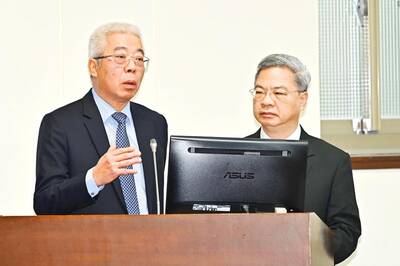
Taiwan has arranged for about 8 million barrels of crude oil, or about one-third of its monthly needs, to be shipped from the Red Sea this month to bypass the Strait of Hormuz and ease domestic supply pressures, CPC Corp, Taiwan (CPC, 台灣中油) said yesterday. The state-run oil company has worked with Middle Eastern suppliers to secure routes other than the Strait of Hormuz, through which about 20 percent of the world’s oil and liquefied natural gas typically passes, CPC chairman Fang Jeng-zen (方振仁) said at a meeting of the legislature’s Economics Committee in Taipei. Suppliers in Saudi Arabia have indicated they
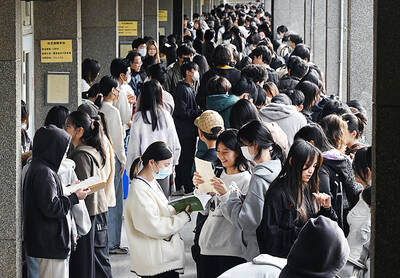
A global survey showed that 60 percent of Taiwanese had attained higher education, second only to Canada, the Ministry of the Interior said. Taiwan easily surpassed the global average of 43 percent and ranked ahead of major economies, including Japan, South Korea and the US, data from the Organisation for Economic Co-operation and Development (OECD) for 2024 showed. Taiwan has a high literacy rate, data released by the ministry showed. As of the end of last year, Taiwan had 20.617 million people aged 15 or older, accounting for 88.5 percent of the total population, with a literacy rate of 99.4 percent, the data

CCP ‘PAWN’? Beijing could use the KMT chairwoman’s visit to signal to the world that many people in Taiwan support the ‘one China’ principle, an academic said Chinese Nationalist Party (KMT) Chairwoman Cheng Li-wun (鄭麗文) yesterday arrived in China for a “peace” mission and potential meeting with Chinese President Xi Jinping (習近平), while a Taiwanese minister detailed the number of Chinese warships currently deployed around the nation. Cheng is visiting at a time of increased Chinese military pressure on Taiwan, as the opposition-dominated Legislative Yuan stalls a government plan for US$40 billion in extra defense spending. Speaking to reporters before going to the airport, Cheng said she was going on a “historic journey for peace,” but added that some people felt uneasy about her trip. “If you truly love Taiwan,

NEW LOW: The council in 2024 based predictions on a pessimistic estimate for the nation’s total fertility rate of 0.84, but last year that rate was 0.69, 17 percent lower An expected National Development Council (NDC) report expects the nation’s population to drop below 12 million by 2065, with the old-age dependency ratio to top 100 percent sooner than 2070, sources said yesterday. The council is slated to release its latest population projections in August, using an ultra-low fertility model, the sources said. The previous report projected that Taiwan’s population would fall to 14.37 million by 2070, but based on a new estimate of the total fertility rate (TFR) — the average number of children born to a woman over her lifetime — the population is expected to reach 12 million by


 RSS
RSS