


A “same-sex union” bill drafted by HTC chairwoman Cher Wang’s (王雪紅) Faith, Hope and Love Foundation and sponsored by Democratic Progressive Party (DPP) Legislator Lin Tai-hua (林岱樺) yesterday advanced to a second reading.
The DPP caucus at a plenary session successfully moved to advance the bill, titled the “draft enforcement act for Judicial Yuan Interpretation No. 748 and Referendum No. 12,” to a second reading.
The New Power Party caucus filed a separate motion to return the bill to the Procedural Committee, which was struck down.
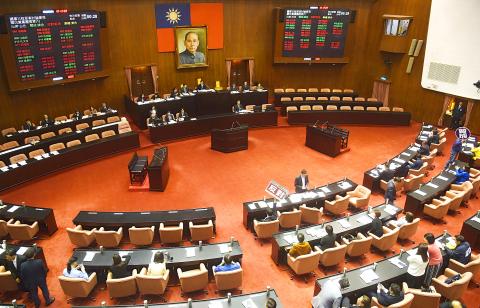
Photo: Huang Yao-cheng, Taipei Times
The result was in line with a decision reached during cross-caucus negotiations on Thursday that all three bills on the issue be reviewed side-by-side during another round of negotiations.
DPP caucus whip Ker Chien-ming (柯建銘) said that the next round of negotiations could begin next week, as the deadline set by the interpretation nears.
It is to be reviewed alongside the Executive Yuan’s “enforcement act of Judicial Yuan Interpretation No. 748” and another sponsored by Chinese Nationalist Party (KMT) Legislator Lai Shyh-bao (賴士葆) on behalf of the conservative Happiness of the Next Generation Alliance, both of which proceeded to a second reading in March.
Referendum No. 12, which was voted on alongside the nine-in-one elections on Nov. 24 last year, asked voters: “Do you agree that the right to persons of the same sex to create a permanent union should be guaranteed by an institution other than marriage as defined by the Civil Code?”
It passed after garnering 6.4 million “yes” votes to 4.07 million “no” votes.
Lin’s version of the bill uses the term “same-sex union,” while the Cabinet’s version uses “same-sex marriage.”
The latter is in line with the Council of Grand Justices’ interpretation passed on May 24, 2017, which declared the lack of language guaranteeing the right of same-sex couples to get married in the Civil Code unconstitutional, and required that a law or amendment be introduced to legalize same-sex marriage within two years.
Although supporters of Lin’s version have said that it is a compromise between the other two versions, DPP legislators Yu Mei-nu (尤美女) and Tuan Yi-kang (段宜康) said otherwise.
Yu on Thursday called Lin’s version “stark discrimination” against same-sex couples.
The version contains a “fake marriage” clause that would authorize prosecutors or social welfare agencies to request that a court intervene and abrogate a same-sex union if relatives within three degrees of consanguinity of either member of the union believe that it was not for the purpose of two people “living life together,” Yu said on Facebook, questioning what right people have to scrutinize the sincerity of others’ marriage.
The version also has a clause that says: “As one’s conscience and freedom should not be affected by the enactment of this act, conveying or inculcating beliefs against the relationship described in Article 2 [same-sex union] does not constitute discrimination,” she said.
Tuan said that he despises all lawmakers who sponsored or cosponsored the bill, regardless of their party affiliation.

LEVERAGE: China did not ‘need to fire a shot’ to deny Taiwan airspace over Africa when it owns ‘half the continent’s debt,’ a US official said, calling it economic warfare The EU has raised concerns about overflight rights following the delay of President William Lai’s (賴清德) planned state visit to the Kingdom of Eswatini after three African nations denied overflight clearance for his charter at the last minute. Taiwanese allies Paraguay and Saint Kitts and Nevis, as well as several US lawmakers and the Inter-Parliamentary Alliance on China (IPAC) condemned China for allegedly pressuring the countries. Lai was scheduled to fly directly to Taiwan’s only African ally from yesterday to Sunday to celebrate the 40th anniversary of King Mswati III’s accession and his 58th birthday, but Seychelles, Mauritius and Madagascar suddenly revoked

The final batch of 28 M1A2T Abrams tanks purchased from the US arrived at Taipei Port last night and were transported to the Armor Training Command in Hsinchu County’s Hukou Township (湖口), completing the military’s multi-year procurement of 108 of the tanks. Starting at 12:10am today, reporters observed more than a dozen civilian flatbed trailers departing from Taipei Port, each carrying an M1A2T tank covered with black waterproof tarps. Escorted by military vehicles, the convoy traveled via the West Coast Expressway to the Armor Training Command, with police implementing traffic control. The army operates about 1,000 tanks, including CM-11 Brave Tiger
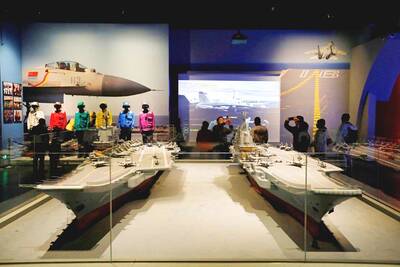
China on Wednesday teased in a video an aircraft carrier that could be its fourth, and the first using nuclear power, while making an allusion to Taiwan and vowing to further build up its islands, as it looks to boost maritime power, secure resources and bolster territorial claims. The video, issued on the eve of the 77th founding anniversary of the Chinese People’s Liberation Army Navy, featured fictional officers with names that are homophones of three commissioned aircraft carriers, the Liaoning (遼寧), Shandong (山東) and Fujian (福建). Titled Into the Deep, it showed a 19-year-old named “Hejian” (何劍) joining the group, sparking

PROVOCATIVE: Chinese Deputy Ambassador to the UN Sun Lei accused Japan of sending military vessels to deliberately provoke tensions in the Taiwan Strait China denounced remarks by Japan and the EU about the South China Sea at a UN Security Council meeting on Monday, and accused Tokyo of provocative behavior in the Taiwan Strait and planning military expansion. Ayano Kunimitsu, a Japanese vice foreign minister, told the Council meeting on maritime security that Tokyo was seriously concerned about the situation in the East China and South China seas, and reiterated Japan’s opposition to any attempt to change the “status quo” by force, and obstruction of freedom of navigation and overflight. Stavros Lambrinidis, head of the EU delegation to the UN, also highlighted South China Sea


 RSS
RSS