


The American Institute in Taiwan (AIT) yesterday confirmed that it purchased a plot of land in Taipei to build a residential complex for its staff, saying the decision reflects the US’ strong long-term commitment to the nation.
“On Nov. 28, 2018, AIT finalized a conditional purchase agreement with Jean Co, Ltd [新美齊] for the construction of a new residential tower in Tianmu [天母] and purchase of the underlying land,” AIT spokesperson Jesse Curtis said in an e-mail.
“When completed, AIT plans to use the residential tower as housing for AIT staff and their families,” Curtis said, confirming a report in the Chinese-language Liberty Times (the Taipei Times’ sister newspaper) about the deal.
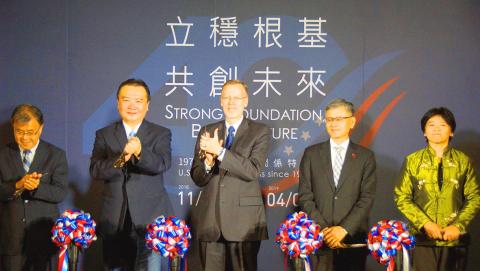
Photo: CNA
It was not the AIT’s first real-estate purchase in Taiwan, as the newspaper had reported, he said without elaborating.
The purchase reflected the US’ commitment to its ties with Taiwan, but did not indicate any change in the US’ “one China” policy or its commitments under the Taiwan Relations Act, Curtis said.
“The US is strongly committed to our enduring friendship with Taiwan, with whom we share common values and enjoy close cooperation on a wide range of regional and global issues,” he said. “The purchase of real property on Taiwan is another reflection of this commitment.”

Photo: Hsu Yi-ping, Taipei Times
Presidential Office spokesman Sidney Lin (林鶴明) welcomed the purchase, saying that it symbolizes the progression of Taiwan-US ties over the past two years.
Chinese Nationalist Party (KMT) Chairman Wu Den-yih (吳敦義) said renting houses is not a permanent solution, and that he believed the deal is a clear signal that the ties between Taiwan and the US are strong and solid.
The 1,000m2 plot of land and construction of the building is to cost NT$1.16 billion (US$37.6 million), Jean Co said.
The AIT in June held a dedication ceremony for its new compound in Taipei’s Neihu District (內湖), the first purpose-built facility by a foreign representative office in the nation.
The AIT is still operating out of its compound on Xinyi Road in Taipei, where it has been for almost 40 years, but is expected to officially move into the Neihu compound next month.
Additional reporting by staff writer

Japan has deployed long-range missiles in a southwestern region near China, the Japanese defense minister said yesterday, at a time when ties with Beijing are at their lowest in recent years. The missiles were installed in Kumamoto in the southern region of Kyushu, as Japan is attempting to shore up its military capacity as China steps up naval activity in the East China Sea. “Standoff defense capabilities enable us to counter the threat of enemy forces attempting to invade our country ... while ensuring the safety of our personnel,” Japanese Minister of Defense Shinjiro Koizumi said. “This is an extremely important initiative for
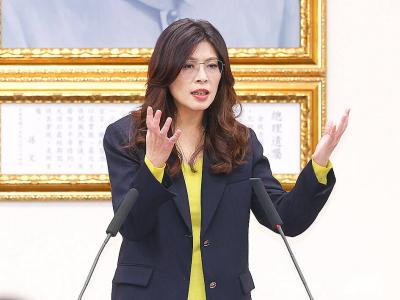
Chinese Nationalist Party (KMT) Chairwoman Cheng Li-wun (鄭麗文) today accepted an invitation from Chinese President Xi Jinping (習近平) to lead a delegation to China next month, saying she hopes to promote the peaceful development of cross-strait relations and bring stability to the Taiwan Strait. “I am grateful and happy to accept this invitation,” Cheng said in a statement from the KMT chairperson’s office. Cheng said she hopes both sides can work together to promote the peaceful development of cross-strait relations, enhance exchange and cooperation, bring stability to the Taiwan Strait and improve people’s livelihoods. At today's news conference, Cheng said any efforts to

MORE POPULAR: Taiwan Pass sales increased by 59 percent during the first quarter compared with the same period last year, the Tourism Administration said The Tourism Administration yesterday said that it has streamlined the Taiwan Pass, with two versions available for purchase beginning today. The tourism agency has made the pass available to international tourists since 2024, allowing them to access the high-speed rail, Taiwan Railway Corp services, four MRT systems and four Taiwan Tourist Shuttles. Previously, five types of Taiwan Pass were available, but some tourists have said that the offerings were too complicated. The agency said only two types of Taiwan Pass would be available, starting from a three-day pass with the high-speed rail and a three-day pass with Taiwan Railway Corp. The former costs NT$2,800

The nation’s fastest supercomputer, Nano 4 (晶創26), is scheduled to be launched in the third quarter, and would be used to train large language models in finance and national defense sectors, the National Center for High-Performance Computing (NCHC) said. The supercomputer, which would operate at about 86.05 petaflops, is being tested at a new cloud computing center in the Southern Taiwan Science Park in Tainan. The exterior of the server cabinet features chip circuitry patterns overlaid with a map of Taiwan, highlighting the nation’s central position in the semiconductor industry. The center also houses Taiwania 2, Taiwania 3, Forerunner 1 and


 RSS
RSS