


The Pentagon has sounded a warning over China’s plans to introduce floating nuclear power plants on disputed islands and reefs in the South China Sea, part of an annual report assessing the nation’s military strength.
“China’s plans to power these islands may add a nuclear element to the territorial dispute,” the Pentagon said in a report to US Congress titled Military and Security Developments Involving the People’s Republic of China. “China indicated development plans may be under way to power islands and reefs in the typhoon-prone South China Sea with floating nuclear power stations; development reportedly is to begin prior to 2020.”
The South China Morning Post last year reported that the state-run China Securities Journal in 2016 said that China could build as many as 20 floating nuclear plants to “speed up the commercial development” of the South China Sea.
Several Chinese state-run companies last year established a joint venture that aims to strengthen China’s nuclear power capabilities in line with its ambitions to “become a strong maritime power,” the South China Morning Post said, citing a statement released by the venture.
Beijing claims more than 80 percent of the South China Sea, through which about US$3.4 trillion of global trade passes each year. Taiwan, Brunei, Malaysia, Vietnam and the Philippines also have claims to all or parts of the region.
US-China military ties have deteriorated over the past few months, with the administration of US President Donald Trump in May revoking an invitation for Beijing to join in Pacific naval exercises due to its activities in disputed parts of the sea.
China has reclaimed 1,295 hectares of land in the Spratly Islands (Nansha Islands, 南沙群島), on which it has added ports, runways and other military infrastructure.
“The best-case scenario for the region would be China reconsidering the electricity supply source for its controlled islands, or at least a delay in the deployment of the fleet,” given potential safety challenges and security risks from pirates or regional terror groups, Viet Phuong Nguyen, a researcher at South Korean university KAIST, wrote on the Diplomat Web site in May.
The report also found that the Chinese military has expanded bomber operations and was “likely training for strikes” against the US and its allies.
China is willing to employ coercive measures and mitigate opposition of other countries, including the unsuccessful use of economic and diplomatic pressure to get South Korea to reconsider the deployment of a US anti-missile system, the report said.
The Chinese People’s Liberation Army (PLA) Navy, the China Coast Guard and the China Maritime Militia now form the largest maritime force in the Indo-Pacific region, the report said, adding that the three services sometimes conduct coordinated missions, including planting a flag on Sandy Cay (Dunqian Cay, 敦謙沙洲), a sandbar within 12 nautical miles (22.km) of Subi Reef (Jhubi Reef, 渚碧礁) and Thitu Island (Jhongye Island, 中業島), “possibly in response to Manila’s reported plans to upgrade its runway on Thitu Island.”
The PLA Air Force has significantly increased circumnavigations of Taiwan, passing through the Miyako Strait and Bashi Channel in the same mission, it said.
Military-controlled coast guard ships sailed an average of once every 10 days within 12 nautical miles of Japan-administered islands in the East China Sea, it added.
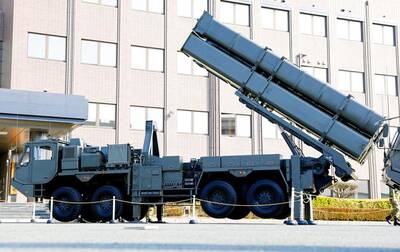
Japan has deployed long-range missiles in a southwestern region near China, the Japanese defense minister said yesterday, at a time when ties with Beijing are at their lowest in recent years. The missiles were installed in Kumamoto in the southern region of Kyushu, as Japan is attempting to shore up its military capacity as China steps up naval activity in the East China Sea. “Standoff defense capabilities enable us to counter the threat of enemy forces attempting to invade our country ... while ensuring the safety of our personnel,” Japanese Minister of Defense Shinjiro Koizumi said. “This is an extremely important initiative for
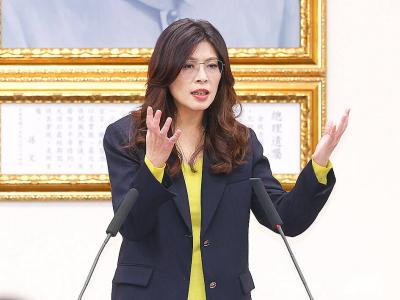
Chinese Nationalist Party (KMT) Chairwoman Cheng Li-wun (鄭麗文) today accepted an invitation from Chinese President Xi Jinping (習近平) to lead a delegation to China next month, saying she hopes to promote the peaceful development of cross-strait relations and bring stability to the Taiwan Strait. “I am grateful and happy to accept this invitation,” Cheng said in a statement from the KMT chairperson’s office. Cheng said she hopes both sides can work together to promote the peaceful development of cross-strait relations, enhance exchange and cooperation, bring stability to the Taiwan Strait and improve people’s livelihoods. At today's news conference, Cheng said any efforts to
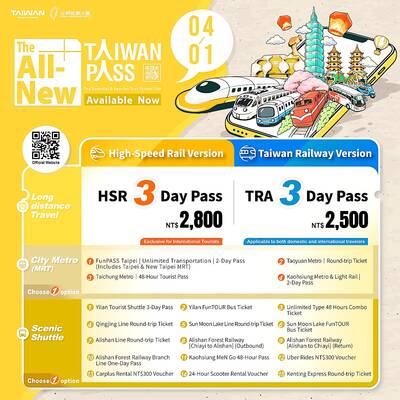
MORE POPULAR: Taiwan Pass sales increased by 59 percent during the first quarter compared with the same period last year, the Tourism Administration said The Tourism Administration yesterday said that it has streamlined the Taiwan Pass, with two versions available for purchase beginning today. The tourism agency has made the pass available to international tourists since 2024, allowing them to access the high-speed rail, Taiwan Railway Corp services, four MRT systems and four Taiwan Tourist Shuttles. Previously, five types of Taiwan Pass were available, but some tourists have said that the offerings were too complicated. The agency said only two types of Taiwan Pass would be available, starting from a three-day pass with the high-speed rail and a three-day pass with Taiwan Railway Corp. The former costs NT$2,800

The nation’s fastest supercomputer, Nano 4 (晶創26), is scheduled to be launched in the third quarter, and would be used to train large language models in finance and national defense sectors, the National Center for High-Performance Computing (NCHC) said. The supercomputer, which would operate at about 86.05 petaflops, is being tested at a new cloud computing center in the Southern Taiwan Science Park in Tainan. The exterior of the server cabinet features chip circuitry patterns overlaid with a map of Taiwan, highlighting the nation’s central position in the semiconductor industry. The center also houses Taiwania 2, Taiwania 3, Forerunner 1 and


 RSS
RSS