


Taiwanese athletes on Saturday marched in the opening ceremony of the Gay Games in Paris, waving the Republic of China (ROC) flag and a carrying a banner that read, “The first Asian country to legalize gay marriage: Taiwan.”
However, spectators and participants at the ceremony, including members of team France and team San Fransisco, also waved ROC flags that they obtained from Taiwanese athletes as a show of support for the nation.
Although Taiwanese athletes had previously participated individually in the Games, this year is the first time a national team was sent to the event.
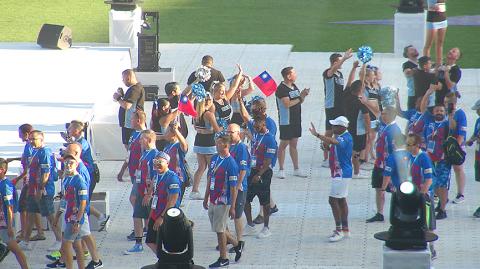
Photo: CNA
The team is comprised of 18 athletes competing in categories including speed roller skating, tennis, swimming and table tennis.
As the Games are not organized by nationality, athletes carried various national and regional flags as well as rainbow flags at the opening ceremony at the Stade Jean Bouin.
US participants were grouped by local affiliations such as San Fransisco, New York and Washington.
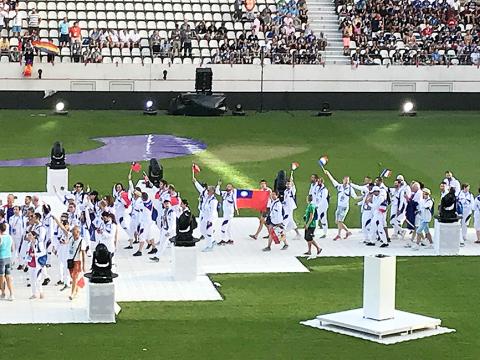
Photo: CNA
Organizers of the Games late last month changed the Taiwanese team’s name on its Web site from “Taiwan” to “Taipei.”
The French softball team took scores of ROC flags, said Yang Chih-chun (楊智群), team leader and Gay Sports and Taiwan Gay Development Movement Association president.
“They said using the name ‘Taipei’ is disrespectful to the people of Taiwan. We are certainly grateful for their help,” Yang said.
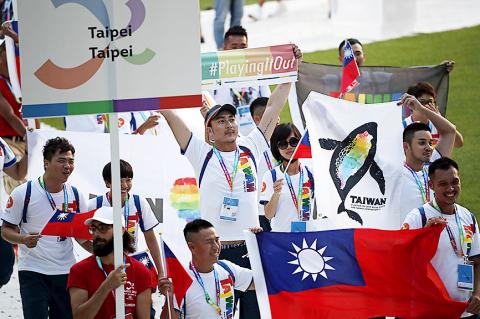
Photo: EPA
Swimmer and team co-leader Yu Kun-i (游坤義) said that Team Taiwan would not shy away from using the ROC flag, as other teams were flying their national flags as they pleased.
“The organizers do not provide flags for participants, because they want to show their respect for the way the teams choose to represent themselves,” he said.
Most importantly, the team wants to advertise that Taiwan is the first Asian nation to allow same-sex marriage, Yu said.
“For us, Taiwan represents the values of our group and society,” he added.
The organizers have unofficially told the team that they would not interfere with how Team Taiwan represents itself in the arena, because Taiwan stands for human rights, democracy and freedom, he said.
The team in its promotional materials used the bajiajiang (eight generals, 八家將) from Taiwanese folk religion to showcase Taiwan’s local culture, Yu said.
The generals’ faces are painted in the colors of the rainbow and half of their faces are covered to symbolize gay pride and coming out of the closet, he said.
Australian and Canadian participants told the team that they know that the real name of the team is “Taiwan” and conveyed their sympathy for the name change, a Team Taiwan supporting staff member said.
The Games are the 10th iteration of the event held once every four years and are sponsored by the French Presidency, the French Ministry of Culture, the French Ministry of Youth Affairs and Sports, and the city of Paris.
The Games, which opened on Saturday, would run through Sunday and have attracted 10,317 participants from 91 nations to compete in 36 categories.
The organizers are expecting 300,000 spectators to attend the Games.
Additional reporting by Lu Yi-hsuan

‘NO SECURITY RISK’: The Railway Bureau reassured the public that the technicians’ activities were limited to technical guidance and did not involve sensitive systems The Railway Bureau yesterday said it had invited eight Chinese technicians to assist with an airport MRT construction project. The bureau issued the confirmation after an Internet user said Chinese nationals had entered the construction zone of Taiwan Taoyuan International Airport’s Terminal 3 project. They asked why “individuals from an enemy state” were allowed access to such a major national infrastructure project, which raised serious concerns over Taiwan’s industrial safety, sensitive systems and information security. The bureau’s Northern Region Engineering Branch Office said subcontractor Taiwan Handle Industrial Co (台灣手把工業) of the Taoyuan airport MRT’s “Contract No. CU05 Project A14 Station Civil, MEP &

The National Chungshan Institute of Science and Technology yesterday showcased its locally developed variants of the Vision 60 robotic patrol dog, which it plans to deploy on the nation’s outlying territories in the South China Sea. The variants were produced under the Joint Lab project — created by the institute and domestic companies — and assembled with domestically produced motors, lenses and artificial intelligence (AI) systems alongside licensed tech from the US, Missile and Rocket Systems Research Division deputy director Jen Kuo-kang (任國光) told the media event at a military base in Taipei’s Dazhi (大直) area. Taiwan has built up its strengths

NOT IMMEDIATE: Taiwan has a chance to appeal the proposed 10 percent tariff before it starts, while other countries face a 12.5 percent tariff from the trade office Taiwan is among 60 economies determined by the US to have failed to impose or enforce a ban on the importation of goods produced with forced labor, according to a notice released on Tuesday by the Office of the US Trade Representative (USTR), which proposed imposing an additional 10 percent or more tariff on them. The USTR in a statement said that following an investigation, it had determined under Section 301 of the Trade Act of 1974 that the failure of the 60 economies to impose and effectively enforce a prohibition on the importation of goods produced with forced labor is

TIT-FOR-TAT: The US allegedly revoked the visa of a Chinese national working at Xinhua News Agency in the US in response to Beijing’s expulsion of Vivian Wang The Presidential Office yesterday condemned China for expelling a New York Times correspondent from Beijing following the newspaper’s interview with President William Lai (賴清德), saying the move highlighted Beijing’s suppression of press freedom and its threat to international news media. Taiwan has noted a series of recent incidents in which Beijing used similar tactics to “threaten and pressure international media outlets and journalists,” Presidential Office spokeswoman Karen Kuo (郭雅慧) said in a statement. “This concerns not only press freedom and freedom of expression, but also the safety of journalists, and Taiwan and relevant partners are paying close attention to the situation,” she


 RSS
RSS