


Kinmen County yesterday began importing water from China’s Fujian Province to stabilize its water supply, while county Commissioner Chen Fu-hai (陳福海) said he hopes to boost bilateral ties with the Chinese province through what he called “three new links.”
Separate ceremonies were held in Kinmen and China’s Jinjiang City to mark the opening of the water supply system, with Chen and other local politicians attending the ceremony in Kinmen.
The county government held the ceremony as scheduled, despite calls by the Mainland Affairs Council (MAC) to delay it after Beijing pressured members of the East Asian Olympic Committee to revoke Taichung’s right to host the East Asian Youth Games next year.
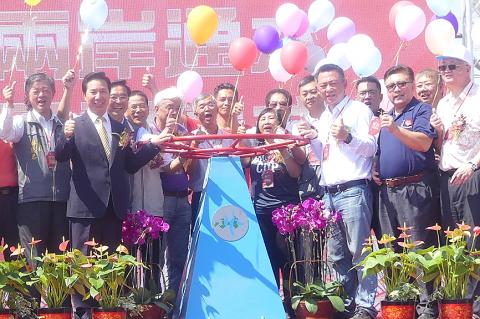
Photo: Wu Cheng-ting, Taipei Times
The “water link” — one of Chen’s “three new links” — is the result of an agreement that Taiwan and China signed in 2015 to provide Kinmen with water for 30 years, Chen said.
It is followed by an “electricity link” and “bridge link” between Kinmen and China, he added.
Chen also referred to the “small three links” — postal, transportation and trade connections between Taiwan and China that started in 1991.
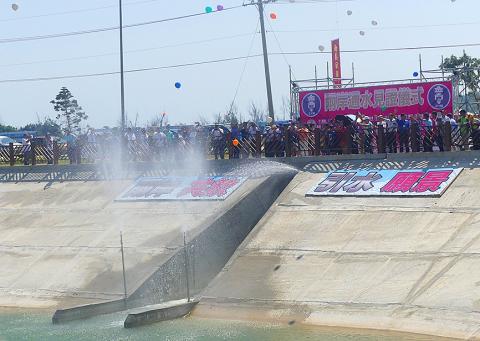
Photo: Wu Cheng-ting, Taipei Times
According to the water purchase agreement, Kinmen is to import up to an average of 34,000 tonnes of water a day at a cost of NT$9.86 per cubic meter, and the daily supply could reach 55,000 tonnes a day, the Kinmen County Waterworks said.
The ceremony in Jinjiang was attended by China’s Taiwan Affairs Office Minister Liu Jieyi (劉結一), along with China’s Fujian Province Governor Yu Weiguo (于偉國), and a Taiwanese delegation of more than 20 councilors led by Kinmen County Council Speaker Hung Li-ping (洪麗萍).
The water connection signals the development of peaceful cooperation between Kinmen and Jinjiang, which were previously divided by military conflicts, Liu said at the ceremony.
“Only if cross-strait relations are good will Taiwanese be better off,” Liu said.
Liu criticized Taiwanese who opposed the system out of “malicious political purposes,” saying they would “meet their doom” for neglecting the well-being of their compatriots.
The MAC in a statement congratulated Kinmen, while condemning Beijing for using the system for political gains.
The water system — a commercial agreement — was politicized by China as a “gift” to Taiwan in a bid to split Taiwanese, it said.
The government has displayed its utmost goodwill by allowing the system to be launched as scheduled, at a time when cross-strait relations are tense, the council said.
Executive Yuan spokeswoman Kolas Yotaka said more deliberation is needed regarding the “three new links,” but added that the government would prioritize the needs of Kinmen residents.
Additional reporting by Chen Yu-fu
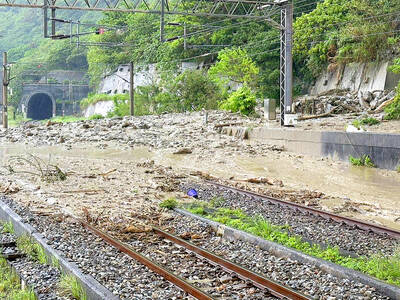
ROLLER-COASTER RIDE: More than five earthquakes ranging from magnitude 4.4 to 5.5 on the Richter scale shook eastern Taiwan in rapid succession yesterday afternoon Back-to-back weather fronts are forecast to hit Taiwan this week, resulting in rain across the nation in the coming days, the Central Weather Administration said yesterday, as it also warned residents in mountainous regions to be wary of landslides and rockfalls. As the first front approached, sporadic rainfall began in central and northern parts of Taiwan yesterday, the agency said, adding that rain is forecast to intensify in those regions today, while brief showers would also affect other parts of the nation. A second weather system is forecast to arrive on Thursday, bringing additional rain to the whole nation until Sunday, it
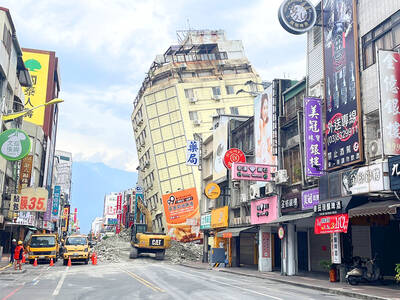
LANDSLIDES POSSIBLE: The agency advised the public to avoid visiting mountainous regions due to more expected aftershocks and rainfall from a series of weather fronts A series of earthquakes over the past few days were likely aftershocks of the April 3 earthquake in Hualien County, with further aftershocks to be expected for up to a year, the Central Weather Administration (CWA) said yesterday. Based on the nation’s experience after the quake on Sept. 21, 1999, more aftershocks are possible over the next six months to a year, the agency said. A total of 103 earthquakes of magnitude 4 on the local magnitude scale or higher hit Hualien County from 5:08pm on Monday to 10:27am yesterday, with 27 of them exceeding magnitude 5. They included two, of magnitude

CONDITIONAL: The PRC imposes secret requirements that the funding it provides cannot be spent in states with diplomatic relations with Taiwan, Emma Reilly said China has been bribing UN officials to obtain “special benefits” and to block funding from countries that have diplomatic ties with Taiwan, a former UN employee told the British House of Commons on Tuesday. At a House of Commons Foreign Affairs Committee hearing into “international relations within the multilateral system,” former Office of the UN High Commissioner for Human Rights (OHCHR) employee Emma Reilly said in a written statement that “Beijing paid bribes to the two successive Presidents of the [UN] General Assembly” during the two-year negotiation of the Sustainable Development Goals. Another way China exercises influence within the UN Secretariat is

Taiwan’s first drag queen to compete on the internationally acclaimed RuPaul’s Drag Race, Nymphia Wind (妮妃雅), was on Friday crowned the “Next Drag Superstar.” Dressed in a sparkling banana dress, Nymphia Wind swept onto the stage for the final, and stole the show. “Taiwan this is for you,” she said right after show host RuPaul announced her as the winner. “To those who feel like they don’t belong, just remember to live fearlessly and to live their truth,” she said on stage. One of the frontrunners for the past 15 episodes, the 28-year-old breezed through to the final after weeks of showcasing her unique


 RSS
RSS