


The Chinese Nationalist Party (KMT) last year declared NT$18.9 billion (US$618.54 million) in total assets and remains by far the nation’s richest political party, according to the Ministry of the Interior’s 2017 Political Parties’ Assets and Finances report released yesterday.
The annual report, which is mandated by the Political Party Act (政黨法), aims to make the finances of political parties more transparent, Deputy Minister of the Interior Lin Tzu-ling (林慈玲) said yesterday.
Of the parties that declared their finances, the Democratic Progressive Party was second-richest with NT$769 million in total assets, followed by the New Power Party — founded in January 2015 — with NT$25 million, the People First Party with NT$20 million and the New Party with NT$16 million, the report said.
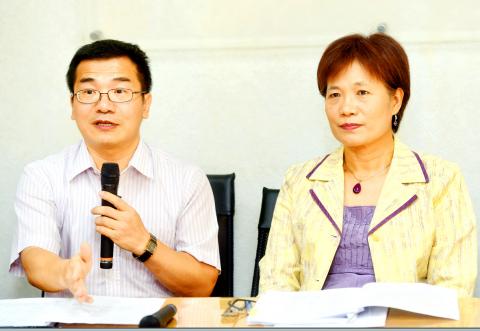
Photo: Chien Jung-feng, Taipei Times
The Executive Yuan’s Ill-gotten Party Assets Settlement Committee in 2016 designated Central Investment Co (中央投資) and its spin-off, Hsinyutai Co (欣裕台), as affiliated organizations of the KMT and froze the two companies’ assets through an administrative order, which the KMT has contested in an ongoing lawsuit.
The two firms were considered the KMT’s most valuable assets in yesterday’s report.
As of last year, Central Investment Co was worth NT$15.4 billion and Hsinyutai NT$200 million, a combined NT$400 million increase from 2015, the report said.
The KMT’s real-estate assets were estimated to be worth NT$910 million, a decrease of NT$9 million from 2015, it added.
The party’s overall expenditures last year totaled NT$2.22 billion, including personnel costs, which comprised the lion’s share of the expenses at NT$1.81 billion, the report said.
The regulations requiring political parties to disclose their finances to the government were drafted in 2006, but they did not initially include punitive measures for noncompliance and their implementation was delayed until last year, because many political parties were small and did not have proper financial records, the ministry said.
All parties were required to declare their assets by May 31, Lin said, but added that as of last month, the ministry had been unable to establish contact with 95 parties, calling on those parties to contact the ministry to safeguard their rights.
The ministry earlier this year vowed to step up efforts to communicate with political parties about the regulations and expectations of conduct under the act, he said.
As of last month, 163 of 301 registered parties had filed declarations, with 95 reports in compliance with the act, Lin said, adding that all parties should submit their final paperwork to the ministry before Jan. 15 next year.
The act stipulates that noncompliance by parties, or a refusal to file a declaration after notification has been served could result in fines of between NT$1 million and NT$5 million, the ministry said.
Parties whose reports require corrections and are not fixed within a given timeframe, or whose corrections have failed to meet ministry standards could face fines of between NT$200,000 and NT$1 million, the ministry said, adding that fines are issued per individual breach.
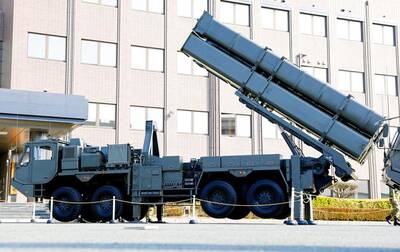
Japan has deployed long-range missiles in a southwestern region near China, the Japanese defense minister said yesterday, at a time when ties with Beijing are at their lowest in recent years. The missiles were installed in Kumamoto in the southern region of Kyushu, as Japan is attempting to shore up its military capacity as China steps up naval activity in the East China Sea. “Standoff defense capabilities enable us to counter the threat of enemy forces attempting to invade our country ... while ensuring the safety of our personnel,” Japanese Minister of Defense Shinjiro Koizumi said. “This is an extremely important initiative for
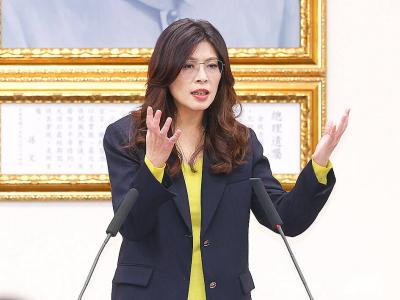
Chinese Nationalist Party (KMT) Chairwoman Cheng Li-wun (鄭麗文) today accepted an invitation from Chinese President Xi Jinping (習近平) to lead a delegation to China next month, saying she hopes to promote the peaceful development of cross-strait relations and bring stability to the Taiwan Strait. “I am grateful and happy to accept this invitation,” Cheng said in a statement from the KMT chairperson’s office. Cheng said she hopes both sides can work together to promote the peaceful development of cross-strait relations, enhance exchange and cooperation, bring stability to the Taiwan Strait and improve people’s livelihoods. At today's news conference, Cheng said any efforts to
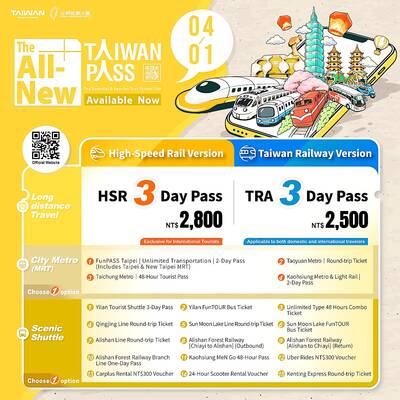
MORE POPULAR: Taiwan Pass sales increased by 59 percent during the first quarter compared with the same period last year, the Tourism Administration said The Tourism Administration yesterday said that it has streamlined the Taiwan Pass, with two versions available for purchase beginning today. The tourism agency has made the pass available to international tourists since 2024, allowing them to access the high-speed rail, Taiwan Railway Corp services, four MRT systems and four Taiwan Tourist Shuttles. Previously, five types of Taiwan Pass were available, but some tourists have said that the offerings were too complicated. The agency said only two types of Taiwan Pass would be available, starting from a three-day pass with the high-speed rail and a three-day pass with Taiwan Railway Corp. The former costs NT$2,800

The nation’s fastest supercomputer, Nano 4 (晶創26), is scheduled to be launched in the third quarter, and would be used to train large language models in finance and national defense sectors, the National Center for High-Performance Computing (NCHC) said. The supercomputer, which would operate at about 86.05 petaflops, is being tested at a new cloud computing center in the Southern Taiwan Science Park in Tainan. The exterior of the server cabinet features chip circuitry patterns overlaid with a map of Taiwan, highlighting the nation’s central position in the semiconductor industry. The center also houses Taiwania 2, Taiwania 3, Forerunner 1 and


 RSS
RSS