


Residents in western Japan were cleaning up debris yesterday after a powerful earthquake hit the area around Osaka, killing three people and injuring hundreds while knocking over walls and setting off fires.
The magnitude 6.1 quake that struck early yesterday damaged buildings and left many homes without water or gas. It also grounded flights in and out of Osaka, and paralyzed traffic and commuter trains most of the day.
By the evening, bullet trains and some local trains had resumed operation, with stations swollen with commuters trying to get home, many of them waiting in long lines. An exodus of commuters who chose to walk home filled sidewalks and bridges.
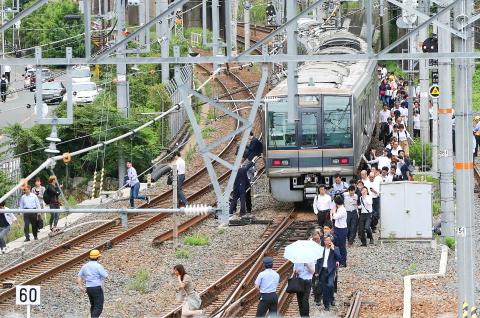
Photo: AFP
Some commuters took refuge at nearby shelters instead of going home. Footage on Japan’s NHK public television showed dozens of men wearing ties and carrying briefcases sitting on gym mats at a junior high school gymnasium in Ibaraki city, where some families also gathered.
A nine-year-old girl, Rina Miyake, was killed by a falling concrete wall as she walked at her elementary school in Takatsuki, while the two other fatalities were men in their 80s.
Takatsuki Mayor Takeshi Hamada apologized over Miyake’s death because of the collapse of the wall, which was old and made of concrete blocks.
One 80-year-old man died in the collapse of a concrete wall in Osaka, while an 85-year-old man in Ibaraki died after a bookcase fell on top of him at home, authorities said.
Japan’s Fire and Disaster Management Agency said 307 people have been treated at hospitals in five prefectures, with most of the injured in Osaka.
Osaka officials did not give details, but the injuries reported in Kyoto and three other prefectures were all minor.
The quake struck shortly after 8am north of Osaka at a depth of about 13km, the Japan Meteorological Agency said.
The strongest shaking was north of Osaka, but the quake rattled large parts of western Japan, including Kyoto, the agency said.
Dozens of domestic flights in and out of Osaka were grounded, while train and subway services in the Osaka area, including bullet trains, were suspended to check for damage.
The quake knocked over walls, broke windows and set off scattered building fires.
It toppled bookcases in homes, scattered goods on shop floors, cracked roads and broke water pipes, leaving homes without water and toppled a part of at least one Osaka temple.
Japanese Chief Cabinet Secretary Yoshihide Suga ordered the Ministry of Education to conduct nationwide safety checks of concrete block structures at public schools.
More than 1,000 schools were closed in Osaka and nearby prefectures, Kyodo News reported.
Many homes and buildings, including a major hospital, were temporarily without power, though electricity was restored at most places by midafternoon.
Due to damage to underground gas lines, 110,000 homes in Takatsuki and Ibaraki cities were without gas, and repairs are expected to take as long as two weeks, according to Osaka Gas Co.
Defense troops joined rescue and relief operations in parts of Osaka, along with special vehicles to deliver clean drinking water.
Meteorological agency officials warned of strong aftershocks in the area.

‘NO SECURITY RISK’: The Railway Bureau reassured the public that the technicians’ activities were limited to technical guidance and did not involve sensitive systems The Railway Bureau yesterday said it had invited eight Chinese technicians to assist with an airport MRT construction project. The bureau issued the confirmation after an Internet user said Chinese nationals had entered the construction zone of Taiwan Taoyuan International Airport’s Terminal 3 project. They asked why “individuals from an enemy state” were allowed access to such a major national infrastructure project, which raised serious concerns over Taiwan’s industrial safety, sensitive systems and information security. The bureau’s Northern Region Engineering Branch Office said subcontractor Taiwan Handle Industrial Co (台灣手把工業) of the Taoyuan airport MRT’s “Contract No. CU05 Project A14 Station Civil, MEP &

The National Chungshan Institute of Science and Technology yesterday showcased its locally developed variants of the Vision 60 robotic patrol dog, which it plans to deploy on the nation’s outlying territories in the South China Sea. The variants were produced under the Joint Lab project — created by the institute and domestic companies — and assembled with domestically produced motors, lenses and artificial intelligence (AI) systems alongside licensed tech from the US, Missile and Rocket Systems Research Division deputy director Jen Kuo-kang (任國光) told the media event at a military base in Taipei’s Dazhi (大直) area. Taiwan has built up its strengths

TIT-FOR-TAT: The US allegedly revoked the visa of a Chinese national working at Xinhua News Agency in the US in response to Beijing’s expulsion of Vivian Wang The Presidential Office yesterday condemned China for expelling a New York Times correspondent from Beijing following the newspaper’s interview with President William Lai (賴清德), saying the move highlighted Beijing’s suppression of press freedom and its threat to international news media. Taiwan has noted a series of recent incidents in which Beijing used similar tactics to “threaten and pressure international media outlets and journalists,” Presidential Office spokeswoman Karen Kuo (郭雅慧) said in a statement. “This concerns not only press freedom and freedom of expression, but also the safety of journalists, and Taiwan and relevant partners are paying close attention to the situation,” she
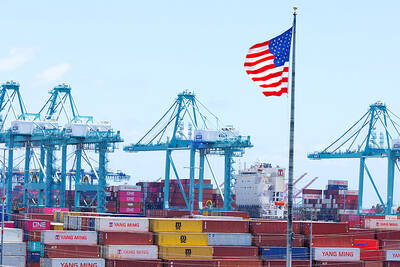
NOT IMMEDIATE: Taiwan has a chance to appeal the proposed 10 percent tariff before it starts, while other countries face a 12.5 percent tariff from the trade office Taiwan is among 60 economies determined by the US to have failed to impose or enforce a ban on the importation of goods produced with forced labor, according to a notice released on Tuesday by the Office of the US Trade Representative (USTR), which proposed imposing an additional 10 percent or more tariff on them. The USTR in a statement said that following an investigation, it had determined under Section 301 of the Trade Act of 1974 that the failure of the 60 economies to impose and effectively enforce a prohibition on the importation of goods produced with forced labor is


 RSS
RSS